
Quick answer: Storm water management in Louisiana is the system of pipes, drains, pumps, and practices that move rainfall off streets and properties before it floods them. Because much of the state sits at or below sea level with a high water table, gravity drainage often fails and aging storm pipes wear out faster than elsewhere. Good management combines clean storm drains, properly sized pipes, and trenchless repair to keep water moving. Property owners, businesses, and municipalities all share responsibility under state and federal rules.
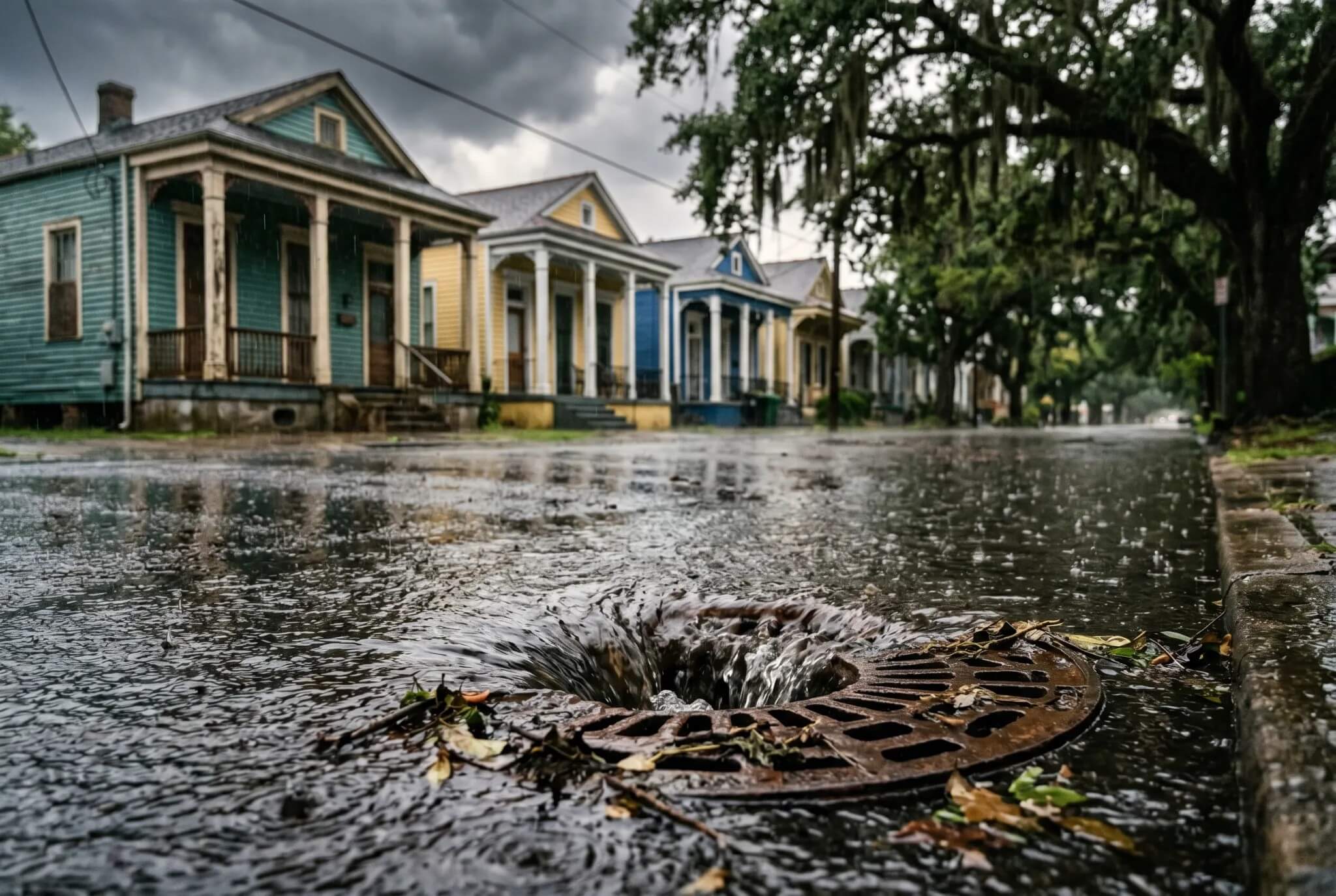
Storm water management in Louisiana is one of the toughest infrastructure problems in the country, and for good reason. The state gets heavy, sudden downpours, sits on soft soil, and drains much of its water uphill with pumps instead of gravity. When a single storm can drop several inches of rain in an hour, the pipes and drains under your street have to be in top shape, or the water has nowhere to go. That is why aging storm drains and failing pipes are such a big deal here.
Across New Orleans, Baton Rouge, Lafayette, and Lake Charles, property owners and facility managers face the same questions: Why does it still flood? Whose job is it to fix the pipe? And what does it actually cost to do it right? This guide breaks down how Louisiana’s drainage system works, the real challenges behind repeated flooding, and how modern trenchless pipe repair rehabilitates failing storm water lines without tearing up your property.
Key takeaways
- Louisiana’s low elevation and high water table make storm water harder to drain than almost anywhere in the U.S.
- Most flooding comes from rainfall outpacing pump and pipe capacity, plus decades-old pipes that have cracked or collapsed.
- Trenchless methods repair storm pipes from the inside, with no large trenches and far less downtime.
- Costs range from a few hundred dollars for a small drain to several thousand for a full system, so getting a clear assessment first saves money.
Why Is Storm Water So Hard to Manage in Louisiana?
Louisiana’s geography works against fast drainage. Much of the New Orleans metro sits 5 to 10 feet below sea level, which means rain water cannot simply flow downhill to a river. Instead, it has to be collected in pipes, carried to pump stations, and lifted up and out. When any link in that chain falls behind, water backs up onto streets and into properties.
The numbers tell the story. The New Orleans drainage system is built to handle roughly one inch of rain in the first hour and about half an inch each hour after that. Strong Gulf storms routinely beat that pace, dropping four to eight inches in a morning. When that happens, the pumps simply cannot move water fast enough, and the older pipes feeding them are often cracked, clogged, or undersized.
Soil makes it worse. The region’s soft, wet ground shifts and settles over time, a process called subsidence. As the ground sinks, rigid pipes crack at the joints, sag, and let in groundwater and soil. A high water table also keeps the soil saturated, so there is little natural absorption and even more water ends up in the pipes.
Pro insight: Many property owners blame the pumps when their street floods, but the more common hidden culprit is a collapsed or root-clogged pipe upstream of the pump. A camera inspection often finds the real bottleneck in minutes, before anyone spends money on the wrong fix.
What Does Louisiana’s Storm Water Infrastructure Actually Include?
Storm water infrastructure is more than the grate you see at the curb. It is a connected network, and most of it is buried. In regulated cities and parishes, that network is managed as a municipal separate storm sewer system (MS4), which the EPA defines as the publicly owned system of drains, pipes, and ditches that carry runoff to local waterways.
A typical Louisiana drainage system is built from these parts:
- Storm drains and catch basins: the inlets that capture water at the surface and drop it into the pipe network.
- Underground storm pipes and culverts: the buried lines, often concrete, clay, or metal, that carry water toward canals and pump stations.
- Ditches and canals: open channels that move large volumes of water across low-lying land.
- Pump stations: the powered stations that lift water up and out, since gravity alone will not do it here.
- On-site drainage: French drains, dry wells, and channel drains that handle water on private property before it reaches the public system.
When any of these pieces fails, the whole system slows down. A single collapsed pipe can flood an entire block, which is why keeping the buried network healthy matters as much as the visible drains.
What Are the Biggest Storm Water Infrastructure Challenges?
Louisiana communities face a stacked set of problems that few other states deal with all at once:
- Aging pipes: Much of the buried network was installed decades ago. Concrete and clay pipes crack, joints separate, and metal corrodes, letting in soil and groundwater.
- Subsidence: As soft ground settles, pipes sag and form low spots where sediment collects and blocks flow.
- Capacity limits: Systems built for past rainfall patterns struggle with today’s heavier, faster storms.
- Pollution and compliance: Runoff picks up oil, sediment, and debris, which the state regulates to protect waterways.
That last point carries legal weight. Larger sites and municipalities must follow Louisiana’s storm water permit program, administered by the Louisiana Department of Environmental Quality under the LPDES system. Construction sites and many commercial properties need a storm water pollution prevention plan that spells out how runoff and sediment will be controlled.
How Do Trenchless Solutions Fix Failing Storm Water Pipes?
Traditional repair means digging up the pipe, which is slow, expensive, and disruptive, especially in wet Louisiana soil where open trenches fill with water. Trenchless methods fix the pipe from the inside instead. After a camera inspection pinpoints the problem, the right no-dig method restores the line with minimal surface damage.
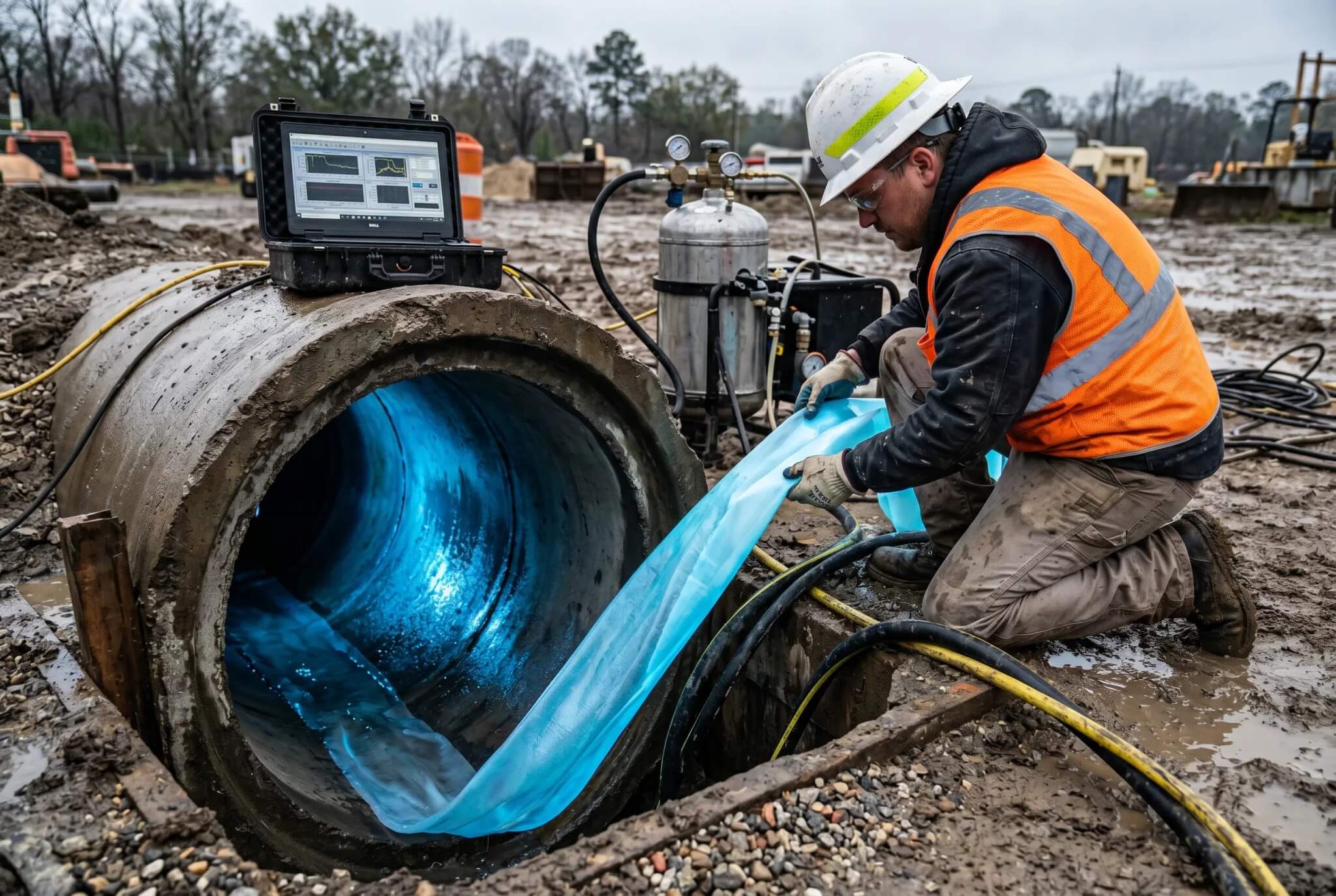
For most storm pipe failures in Louisiana, cured-in-place pipe (CIPP) lining is the workhorse. It seals cracks, blocks out groundwater and roots, and adds 50 years or more of life, all without a single large trench across your yard or parking lot.
How Much Does Storm Water Management Cost in Louisiana?
Cost depends on what is failing and how big the job is. Property-level drainage is priced per linear foot or per device, while pipe rehabilitation is priced by pipe size and length. The ranges below reflect typical U.S. pricing for these solutions and are a starting point, not a quote.
| Solution | What it solves | Typical cost |
| French drain | Soggy yard, standing water, runoff | $10 – $100 per linear foot |
| Catch basin / yard drain | Water pooling at a low spot | $1,000 – $3,500 each |
| Channel (trench) drain | Driveways, patios, paved areas | $30 – $100 per linear foot |
| Dry well | Roof and downspout runoff | $1,500 – $4,800 |
| Full yard drainage system | Whole-property water problems | $2,100 – $7,200 typical |
| Trenchless pipe relining (CIPP) | Cracked or leaking storm pipe | $80 – $300 per linear foot |
The biggest cost drivers are access, pipe size, and damage severity. A pipe under an open lawn is cheaper to reach than one beneath a slab or street, and a fully collapsed line costs more than a simple crack. This is exactly why a camera inspection first pays for itself: it stops you from over-buying or under-fixing.
How Often Should You Inspect and Maintain Storm Water Pipes?
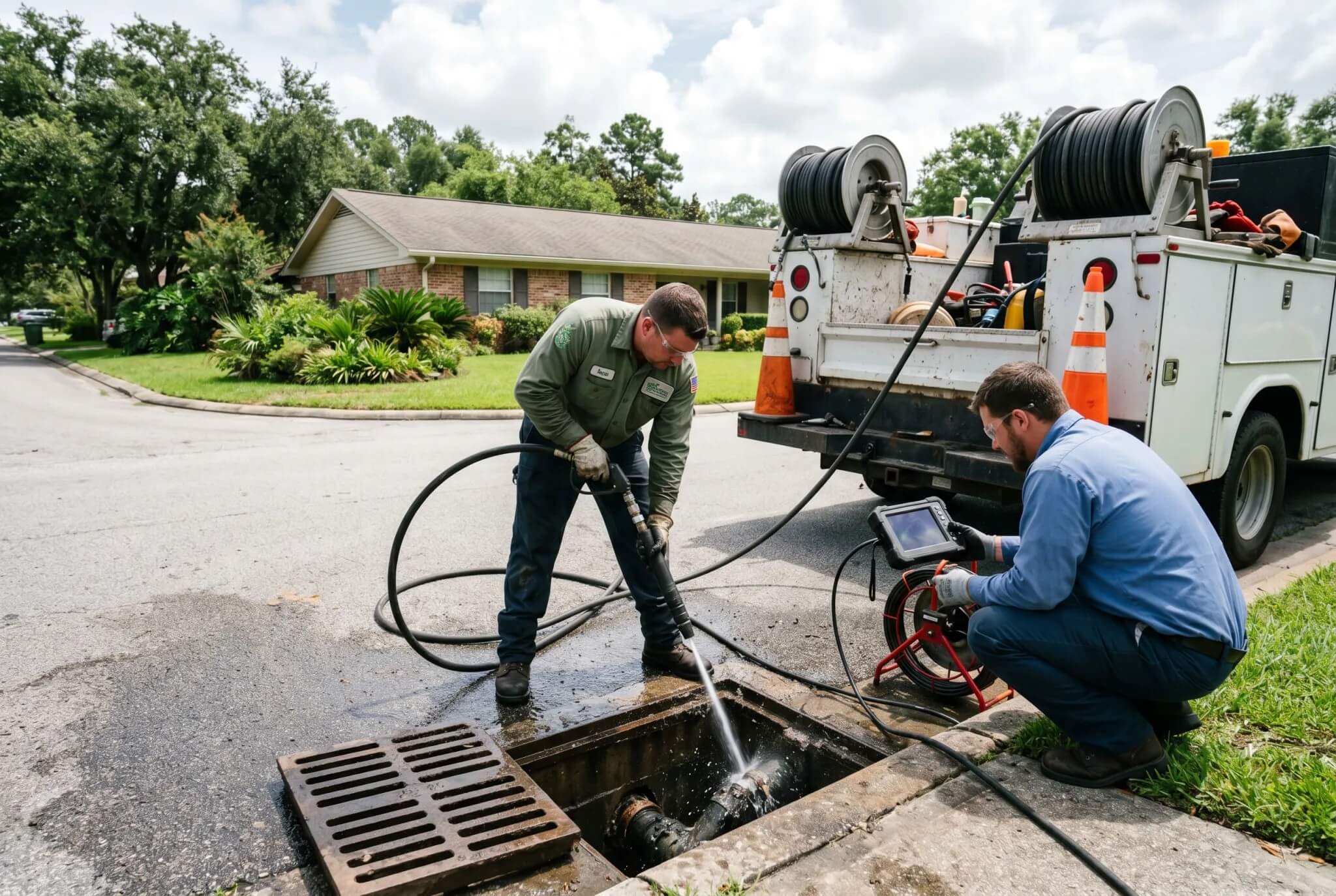
Storm water systems fail quietly. A pipe can lose a third of its capacity to sediment and root intrusion long before anything floods, so the property looks fine right up until a big storm proves otherwise. Regular maintenance is far cheaper than emergency repair, and in Louisiana’s wet, shifting soil it matters even more.
A practical maintenance rhythm for most Louisiana properties looks like this:
- Before hurricane season: clear catch basins and storm drains of leaves and debris so they can take on water fast.
- Every 1 to 2 years: hydro jet older or tree-lined storm lines to remove roots and sediment buildup.
- Every 3 to 5 years: run a camera inspection on critical or aging pipes to catch cracks early.
- After major storms: check for new low spots, slow drains, or sinkholes that signal a pipe problem underneath.
For commercial and industrial sites, this routine is not just good practice, it also supports compliance with the runoff controls Louisiana requires. Catching a failing line in Baton Rouge or Lafayette during a planned inspection costs a fraction of what it costs to dig it up after it collapses under a parking lot.
Who Is Responsible, the City, the Business, or the Property Owner?
Responsibility is shared, and the line is not always obvious. Cities and parishes maintain the public network through their municipal storm water solutions and MS4 permits. But property owners are responsible for drainage on their own land and, in most cases, for the lateral pipe that connects their property to the public main.
In practice, this means a homeowner usually owns the pipe from the house to the street connection, a business owns its on-site drains and any private storm lines, and the municipality owns the mains and pump stations. When water backs up, the first step is to find out which side of that line the failure is on, which again starts with an inspection. Getting this wrong is common and costly: owners sometimes wait months for a city crew to fix a pipe that was actually on their own property, while the water damage keeps adding up. A quick camera inspection settles the question and gives you documentation if you do need to involve the parish or your insurer.
Where Should You Invest, and Where Can You Save?
Not every dollar belongs in the same place. Spend where failure is expensive and hard to reach, and save where simpler fixes do the job.
Worth investing in
- A proper camera inspection before any work, so you fix the real problem.
- Trenchless relining for pipes under driveways, slabs, or mature landscaping, where digging is costly.
- Correctly sized pipes and drains, since undersized systems fail again in the next big storm.
- Licensed, insured contractors familiar with Louisiana soil and permits.
Where you can save
- Surface French drains and channel drains in open, easy-to-reach yard areas.
- Routine hydro jetting to prevent clogs, which is far cheaper than emergency repairs.
- Bundling nearby drainage fixes into one visit to cut mobilization costs.
- Maintaining and cleaning existing drains instead of replacing healthy pipe.
Storm Water Management in Louisiana at a Glance
- Louisiana’s low elevation, high water table, and soft soil make drainage uniquely difficult.
- Flooding usually comes from rain outpacing pumps plus aging, cracked, or collapsed pipes.
- Trenchless methods like CIPP lining and pipe bursting fix storm pipes with little to no digging.
- Costs run from about $10 per linear foot for simple drains to thousands for full systems.
- Responsibility is split between owners and municipalities, so confirm which pipe is yours.
- Next step: get a camera inspection and a clear quote. Call Pelican Underground at (504) 400-8817 or request a free assessment.
Frequently Asked Questions
How much does storm water management cost in Louisiana?
Costs vary with scope. Simple French drains run about $10 to $100 per linear foot, while a full yard drainage system usually falls between $2,100 and $7,200. Trenchless pipe relining runs roughly $80 to $300 per linear foot. An inspection first gives you an exact number.
Why does New Orleans flood even when the pumps are running?
Much of the city sits 5 to 10 feet below sea level, so water must be pumped out. The drainage system handles about one inch of rain the first hour and a half inch after, and heavy storm water events in Louisiana often exceed that. Aging pipes and turbines make it worse.
Can storm drains be repaired without digging?
Yes. CIPP lining and pipe bursting rehabilitate failing storm drains from the inside, with no open trench. A camera inspection confirms the damage first, then a new liner or pipe is installed through small access points.
Who is responsible for storm water management on my property?
In Louisiana, owners are generally responsible for on-site drainage and the lateral pipe to the public connection, while the municipality maintains the mains and pumps under its storm water permits. Finding the failure point determines who handles the repair.
What is the difference between a French drain and a catch basin?
A French drain is a gravel-filled trench with a perforated pipe that collects water across an area. A catch basin captures surface water at a single low point and pipes it away. Many Louisiana properties use both together.
Related Guides
- Microtunneling vs. Open-Cut Excavation in Louisiana’s High Water Table
- Soft-Ground Tunneling in New Orleans
- Underground Utility Tunneling in the Gulf South
- Epoxy Pipe Lining in Louisiana: How It Works
- How Much Does CIPP Lining Cost in Louisiana?
- Pipe Lining in New Orleans, LA: Why No-Dig Repair Makes Sense
- Storm Water Management Services
Get a Free Storm Water Management Assessment
Louisiana’s drainage challenges are not going away, but the right repair, done once and done right, keeps water moving and protects your property for decades. Whether you manage a home, a business, or public infrastructure across New Orleans and the Gulf Coast, the smartest first move is a clear diagnosis.
Ready to get started? Contact Pelican Underground today for a free, no-obligation inspection and quote, and find out exactly what your storm water system needs.
About Pelican Underground: Pelican Underground LLC is a locally owned, family-operated trenchless sewer and drainage specialist serving Louisiana, Mississippi, and Alabama for over 15 years. Led by owner Chase St. Clair, a NASSCO-certified trenchless specialist licensed by the Louisiana State Licensing Board for Contractors, our team is fully licensed, insured, and bonded. Call (504) 400-8817 for a free assessment.