
Quick answer: Stormwater drain repair in New Orleans means restoring the catch basins and below-grade pipes that carry rain off your property before it floods. Because the city sits below sea level on soft, settling soil, its 120-year-old drainage network cracks, clogs, and collapses faster than almost anywhere. Trenchless repair fixes failing drain lines from the inside, with no large trench. The first step is always a camera inspection to find out whether the line is clogged, cracked, or collapsed — and who is responsible for fixing it.
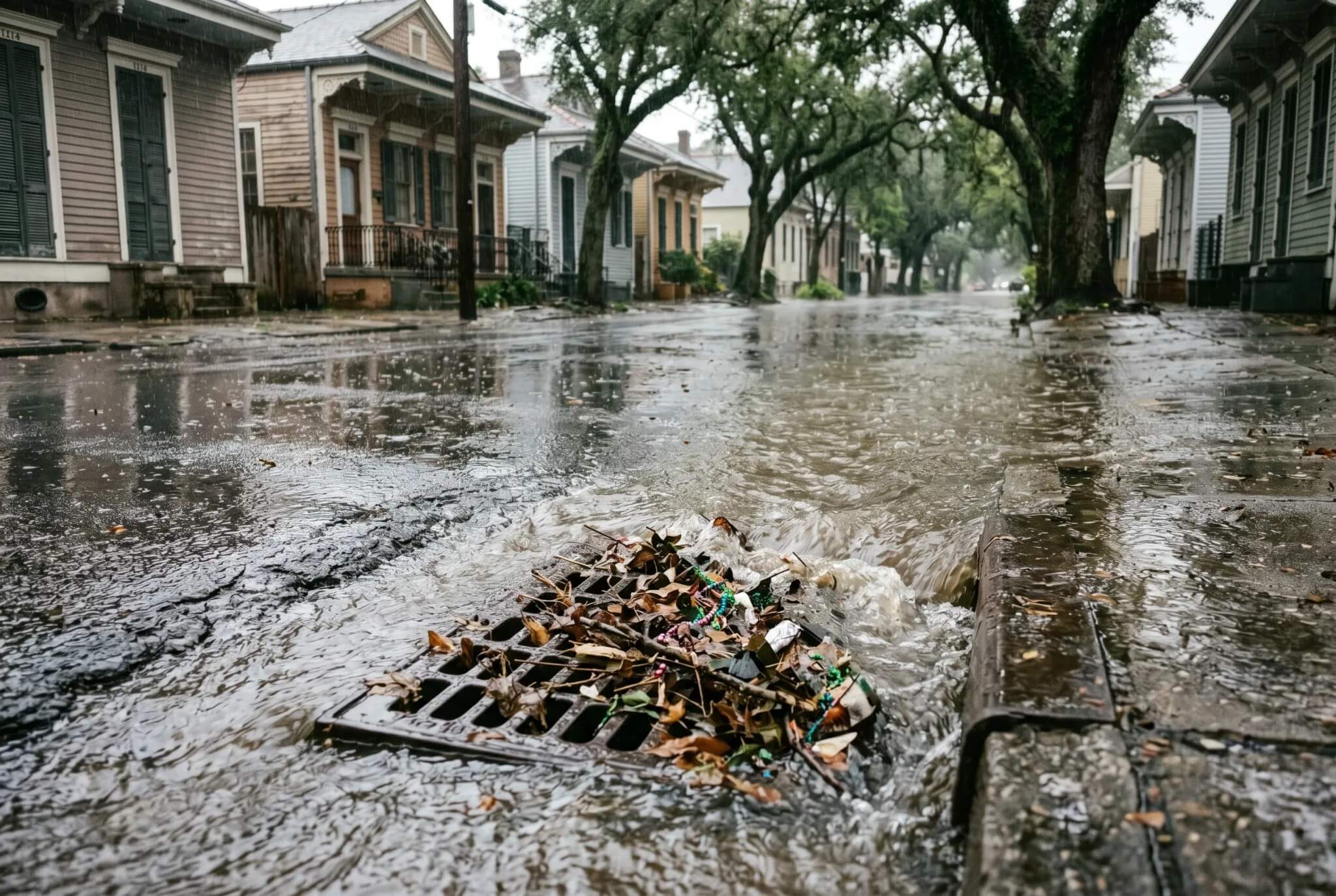
If your yard pools after every storm or your street turns into a canal, the problem is often hidden below the surface. Stormwater drain repair in New Orleans is about the buried half of the system — the catch basins and pipes that move water before the pumps ever get involved. When those storm drains fail, water backs up onto streets, into garages, and against foundations.
New Orleans has one of the oldest and most stressed drainage networks in the country, and much of it runs under private property. This guide explains what below-grade infrastructure includes, why it fails here, the warning signs to watch for, how trenchless pipe repair fixes it without tearing up your yard, who is responsible, and what repair actually costs.
Key takeaways
- New Orleans drainage relies on 68,000+ catch basins and roughly 1,500 miles of below-grade pipe — most of it over a century old.
- Below sea level, on settling soil, these pipes crack, sag, and collapse faster than in most cities.
- Slow drains, sinkholes, foul odors, and foundation cracks are early signs a drain needs repair.
- Trenchless methods repair drains from the inside, with little to no digging.
- Responsibility is split: the Sewerage & Water Board maintains public drains; owners maintain private lines and laterals.
What Counts as Below-Grade Stormwater Infrastructure in New Orleans?
Below-grade simply means everything buried beneath the surface that moves rainwater. In New Orleans, this is an enormous, aging network. According to the Sewerage & Water Board’s drainage facts, the system includes more than 68,000 catch basins, about 1,500 miles of underground drain pipes, 200 miles of canals, and 120 pumps across 24 stations — much of it designed around the turn of the 20th century.
The water follows a clear path, and a failure anywhere along it causes backups:
- Catch basins: the curbside inlets that capture water from the street and yard.
- Lateral drain pipes: the smaller buried lines that carry water from basins toward the mains — the part most likely to crack or clog.
- Canals and culverts: the larger channels that move big volumes toward the pumps.
- Pump stations: the powered stations that lift water up and out, since gravity alone cannot.
- Private drain lines: the pipes, area drains, and downspout lines on your own property that connect to the public system.
That last category matters most for repair, because the buried lines on private property are the owner’s responsibility, not the city’s. Many New Orleans homes also have older clay or cast-iron drain lines and decorative area drains that were never built for today’s heavier downpours, so even a structurally sound public system can leave a property flooding if its own connections have failed.
Why Do New Orleans Stormwater Drains Fail So Often?
Few cities stack as many drainage challenges as New Orleans does, and they all wear on the same buried pipes:
- Age: Much of the network is more than 100 years old. Old clay and concrete pipe cracks, and joints separate over time.
- Subsidence: The city’s soft, wet soil settles and shifts, which sags pipes, opens joints, and creates low spots where debris collects.
- Below sea level: Most of the city sits 5 to 10 feet below sea level, so water cannot drain by gravity and any blockage backs up fast.
- Clogging: Leaves, sediment, and trash pack catch basins and pipes; the city can only clean a fraction of its basins each year.
The result is a network where a single cracked or clogged lateral can flood a whole block. And because the public system carries a large maintenance backlog, problems on private property often sit unaddressed until the owner fixes them directly.
Pro insight: Homeowners often assume repeated street flooding is purely the city’s pump problem. Just as often, the real cause is a collapsed or root-choked lateral on their own property that never lets water reach the main. A camera inspection settles it in minutes and tells you exactly whose pipe is failing.
What Are the Warning Signs You Need Stormwater Drain Repair?
Below-grade problems show themselves above ground long before a full collapse. Watch for these signs:
- Standing water that returns: the same low spot floods after every rain and drains slowly.
- Slow or gurgling drains: area drains and downspout lines back up or make noise.
- Sinkholes or soft spots: depressions in the yard or near the driveway often mean a pipe below is leaking soil in.
- Foundation cracks: water pooling against the slab from a failed drain can undermine the foundation.
- Foul odors: standing water and trapped debris in a damaged line can smell.
If you see two or more of these, the smart move is an inspection before the next big storm rather than after the water damage is done.
What Happens If You Ignore a Failing Stormwater Drain?
A cracked or clogged drain rarely fixes itself, and in New Orleans the damage compounds quickly. What starts as a slow drain can turn into a structural problem in a single wet season.
- Foundation damage: water that cannot drain pools against the slab, and on the city’s soft soil that leads to settling, cracks, and costly foundation repair.
- Sinkholes and soil loss: a cracked pipe pulls in surrounding soil with every rain, creating voids that collapse into sinkholes under yards and driveways.
- Mold and interior damage: repeated standing water finds its way into garages, ground floors, and crawl spaces, bringing mold and ruined finishes.
- A bigger, costlier repair: a pipe that could have been relined for a modest cost becomes a full excavation and replacement once it fully collapses.
In short, a small drainage issue is one of the cheapest things to fix and one of the most expensive things to ignore. Catching it early, while the pipe can still be relined from the inside, is almost always the lower-cost path.
How Is Stormwater Drain Repair Done Without Digging?
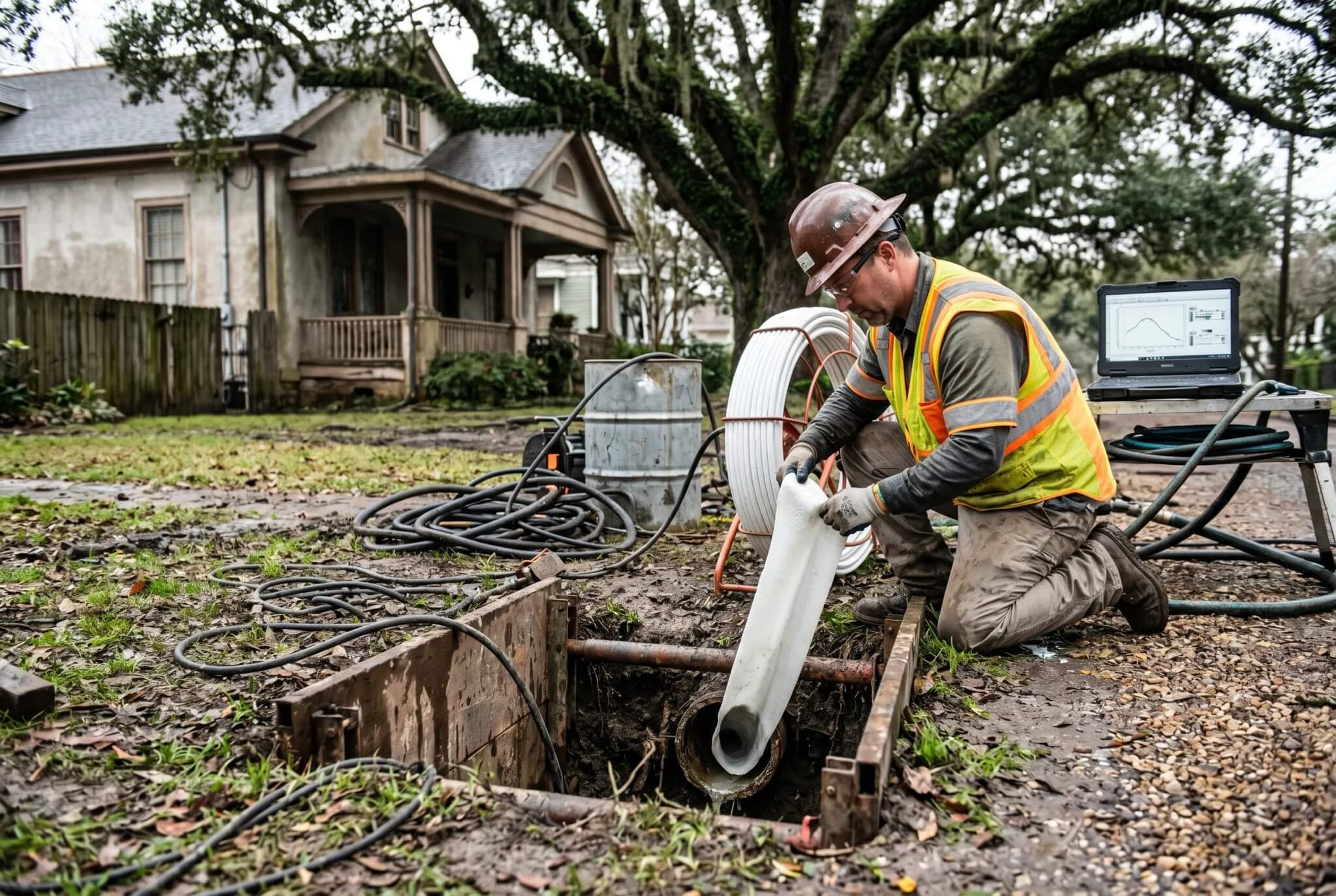
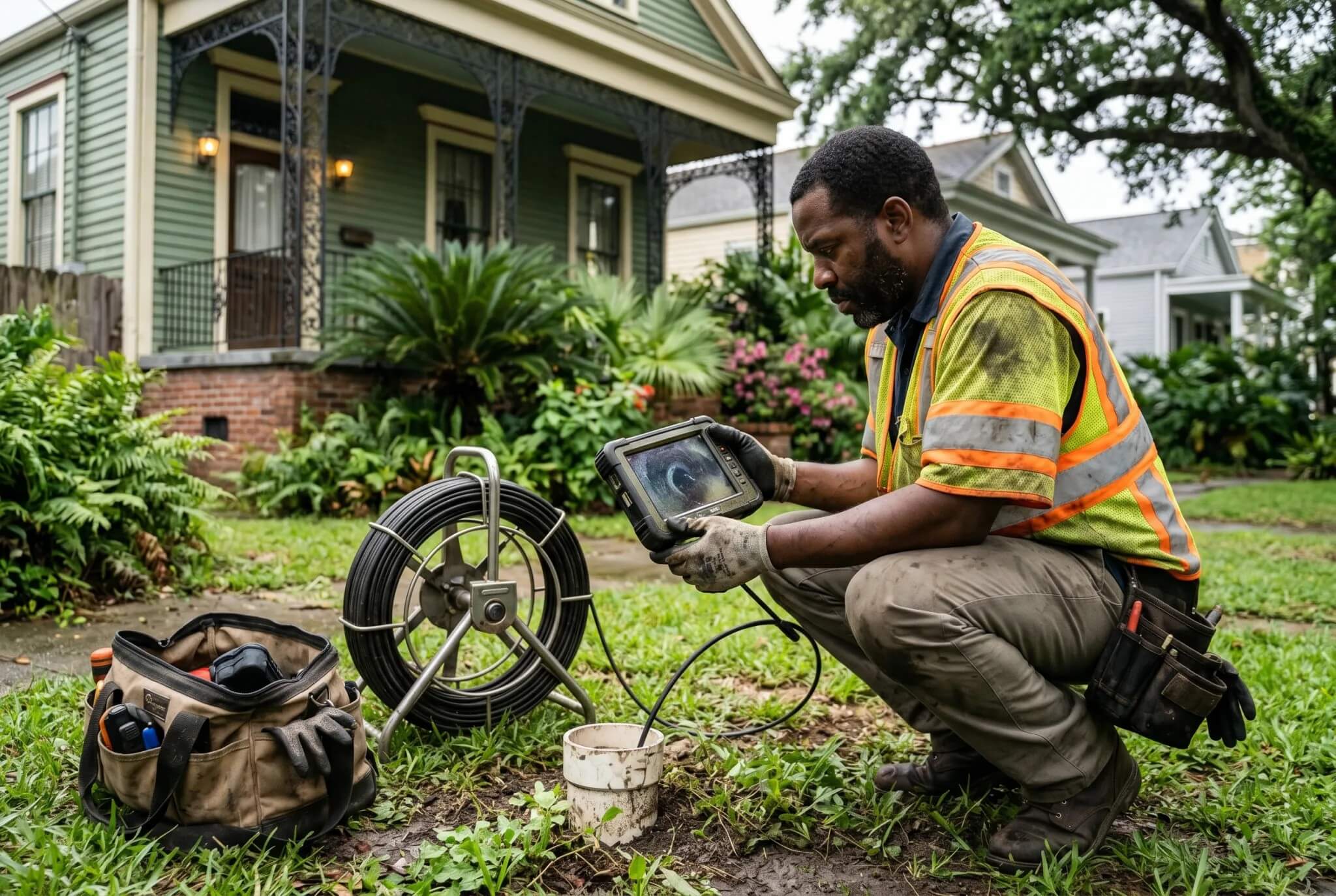
Digging up a drain in New Orleans is slow and messy: open trenches fill with groundwater, and excavation tears up yards, driveways, and streets. Trenchless repair fixes the pipe from the inside instead. After a camera inspection locates the exact problem, the right no-dig method restores the line.
| Method | What it does | Best for |
|---|---|---|
| Camera inspection | Sends an HD camera through the pipe to find cracks, clogs, and collapses. | Diagnosis before any repair |
| Hydro jetting | Uses high-pressure water to clear roots, sediment, and debris. | Clogged or slow drains |
| CIPP lining | Cures a resin liner inside the old pipe to form a strong new pipe wall. | Cracked or leaking drain pipes |
| Pipe bursting | Pulls a new pipe through the old one, breaking the old pipe outward. | Collapsed or undersized lines |
For most cracked or leaking New Orleans drain lines, CIPP lining is the go-to: it seals out groundwater and roots and adds decades of life without a single large trench. For fully collapsed pipe, pipe bursting replaces the line through small access points. Routine hydro jetting handles clogs before they become failures.
Who Is Responsible — the City, the Sewerage & Water Board, or You?
This is the question that traps the most homeowners. As of January 2025, the Sewerage & Water Board took over maintenance of the city’s public catch basins and connecting drains and now runs the public side end to end, from basins to storm drain cleaning through the pumps. Residents report public drainage problems by calling 311.
But the public agency only owns the public network. The drain lines on your property, and the lateral that connects your property to the public system, are the owner’s responsibility. So when water pools in your yard or backs up at your area drain, the failure is very often on your side of the line, which means waiting on the city will not fix it.
For commercial properties and facilities, the same split applies, and large sites may also coordinate with the city on municipal sewer line repair where private and public systems meet. Either way, confirming which side of the line has failed is step one, and an inspection answers it.
There is a practical reason this matters beyond who pays. If the failure is on the public side, a camera inspection gives you documentation to submit with a 311 request or an insurance claim, which can speed up the response. If it is on your side, you avoid waiting months on a city crew for a pipe they were never responsible for. Either way, you stop guessing and start fixing the right thing.
How Much Does Stormwater Drain Repair Cost in New Orleans?
Repair cost depends on what is wrong and how the line is accessed. A simple clog is inexpensive to clear; a collapsed pipe under a driveway costs more. The ranges below are typical starting points, not a quote.
| Service | What it solves | Typical cost |
|---|---|---|
| Camera inspection | Diagnosis of clogs, cracks, collapses | Often bundled or low flat fee |
| Hydro jetting | Clogged or slow-draining lines | $300 - $900 per visit |
| CIPP relining | Cracked or leaking drain pipe | $80 - $300 per linear foot |
| Pipe bursting / replacement | Collapsed or undersized pipe | Higher; by length and access |
| Catch basin repair | Damaged or sunken private basin | $1,000 - $4,000+ each |
The biggest cost drivers are access, pipe diameter, and damage severity. A line under an open lawn is far cheaper to reach than one beneath a slab or street, which is exactly why a camera inspection first pays for itself — it stops you from over-buying or fixing the wrong thing.
How Long Does Stormwater Drain Repair Take in New Orleans?
One of the biggest advantages of trenchless repair is speed, which matters in a city where open trenches fill with groundwater and rain can return any afternoon. Most repairs follow a predictable timeline:
- Inspection and quote: a camera inspection and written assessment usually take an hour or two.
- Cleaning and prep: hydro jetting and clearing the line is typically a same-day step.
- Trenchless repair: most residential CIPP relines or spot repairs are completed in a single day, with the liner cured and ready to carry water by the next.
- Larger or collapsed lines: pipe bursting or replacement of a long or deep line can take two to three days depending on access.
Compared with traditional excavation, which can tie up a yard or driveway for a week or more, trenchless work gets your drainage back in service fast and leaves the surface largely untouched.
Where Should You Invest, and Where Can You Save?
Spend where a failure is expensive and hard to reach; save where simpler maintenance does the job.
Worth investing in
- A camera inspection before any work, so you repair the actual failure.
- Trenchless relining for pipes under driveways, slabs, or mature trees, where digging is costly.
- Fixing cracked laterals promptly, before soil loss causes sinkholes or foundation damage.
- Licensed, insured contractors who know New Orleans soil, permits, and the high water table.
Where you can save
- Routine hydro jetting and basin clearing to prevent clogs, far cheaper than emergency repair.
- Keeping catch basins clear of leaves and debris yourself between visits.
- Bundling nearby repairs into one mobilization to cut trip costs.
- Maintaining sound pipe instead of replacing lines that only need cleaning.
Stormwater Drain Repair in New Orleans at a Glance
- New Orleans’ 100+ year-old, below-sea-level drainage network cracks, clogs, and collapses faster than most.
- Slow drains, sinkholes, odors, and foundation cracks are early signs a buried drain needs repair.
- Trenchless methods — CIPP lining, pipe bursting, hydro jetting — fix drains with little to no digging.
- The Sewerage & Water Board maintains public drains; you own the private lines and lateral on your property.
- Relining typically runs $80–$300 per linear foot; an inspection gives an exact number.
- Next step: get a camera inspection and a clear quote. Call Pelican Underground at (504) 400-8817 or request a free inspection.
Frequently Asked Questions
Who is responsible for stormwater drain repair in New Orleans?
It is shared. The Sewerage & Water Board maintains public catch basins and drainage mains, but property owners are responsible for the private drain lines and the lateral that connects to the public system. If the failure is on your property, the repair is yours.
What are the signs a stormwater drain needs repair?
Watch for standing water that keeps returning, slow or gurgling drains, sinkholes or soft spots, cracks near the foundation, and foul odors. A camera inspection confirms whether the line is clogged, cracked, or collapsed.
Can a stormwater drain be repaired without digging?
Yes. CIPP lining and pipe bursting rehabilitate or replace failing drains through small access points, with no large trench — a major advantage in New Orleans, where the high water table makes open digs slow and messy.
How much does stormwater drain repair cost in New Orleans?
It varies. Clearing a clog is the low end, while trenchless relining of a cracked pipe usually runs $80 to $300 per linear foot. A collapsed-line repair or replacement costs more. An inspection gives a firm number.
Why does my New Orleans street or yard still flood after rain?
Because the city sits below sea level, drainage depends on basins, pipes, and pumps rather than gravity. A clogged basin or cracked drain line leaves water with nowhere to go, so it pools even when the pumps are running.
Related Guides
- Storm Water Management in Louisiana: Infrastructure Challenges and Trenchless Solutions
- Microtunneling vs. Open-Cut Excavation in Louisiana’s High Water Table
- Soft-Ground Tunneling in New Orleans
- Pipe Lining in New Orleans, LA: Why No-Dig Repair Makes Sense
- How Much Does CIPP Lining Cost in Louisiana?
- Storm Water Management Services
- Municipal Storm Water Solutions
Get a Free Stormwater Drain Inspection in New Orleans
A failing below-grade drain only gets worse and more expensive the longer it sits. The smartest, cheapest first move is a clear diagnosis so you know exactly what is wrong and whose pipe it is. Whether you own a home or manage a property in New Orleans and across the Gulf Coast, we can find the problem fast and fix it without tearing up your property.
Ready to get started? Contact Pelican Underground today for a free, no-obligation camera inspection and quote, and protect your property before the next storm.
About Pelican Underground: Pelican Underground LLC is a locally owned, family-operated trenchless sewer and drainage specialist serving New Orleans, Louisiana, Mississippi, and Alabama for over 15 years. Led by owner Chase St. Clair, a NASSCO-certified trenchless specialist licensed by the Louisiana State Licensing Board for Contractors, our team is fully licensed, insured, and bonded. Call (504) 400-8817 for a free inspection.