
Louisiana does not give its stormwater infrastructure an easy life. Flat topography means water has nowhere fast to go. A water table that hovers only a few feet below the surface keeps buried pipes in near-constant contact with moisture. And every hurricane or extended rain season dumps far more volume through those pipes than most systems were ever designed to handle. The result: storm drains across the state—whether under a parish road, a municipal parking lot, or a large commercial property—degrade years faster than the national average.
When a storm drain starts to fail, the old answer was excavation: dig up the pavement, pull out the old pipe, drop in a new one, and patch everything back together. That approach can cost hundreds of thousands of dollars on a single corridor and knock a facility out of service for weeks.
Today, there is a better option. CIPP storm drain lining lets a qualified contractor restore structural integrity to a failing pipe from the inside—no digging required. This article explains exactly how it works, what to look for when choosing a storm drain lining contractor in Louisiana, what the work costs, and how lining helps municipalities and property managers stay on the right side of LDEQ stormwater regulations.
Why Louisiana’s Storm Drains Age Faster Than Most
Three factors combine to put Louisiana stormwater infrastructure under exceptional stress:
Flat topography and slow drainage. Unlike states with natural slope, much of Louisiana relies entirely on engineered drainage systems to move stormwater. Pipes carry standing water longer, increasing the time that moisture, sediment, and root intrusion can attack pipe walls.
A high water table. Buried pipes in the New Orleans metro, Baton Rouge, the River Parishes, and coastal communities are often surrounded by groundwater. Hydrostatic pressure works continuously against pipe joints and cracks, allowing infiltration that erodes the pipe interior from the inside out.
Hurricane and rain season loads. Events that would qualify as “100-year floods” in other states arrive with regularity. The surge volumes that hit storm drain networks during major rain events accelerate cracking, joint separation, and structural deformation far beyond what normal wear produces. Concrete and clay pipes in particular—common in systems built before the 1980s—have little tolerance for repeated hydraulic shock.
The combination means a storm drain in Louisiana may have a practical service life 20–30% shorter than an equivalent system in the Midwest or Mid-Atlantic. For public works directors and commercial property managers, that translates directly into earlier rehabilitation timelines and higher long-term capital costs if trenchless options are not part of the plan.
What Is Storm Drain Lining—and How Does It Differ from Excavation?
Storm drain lining is a trenchless rehabilitation method that installs a new structural liner inside an existing, failing pipe—without excavating the ground above it.
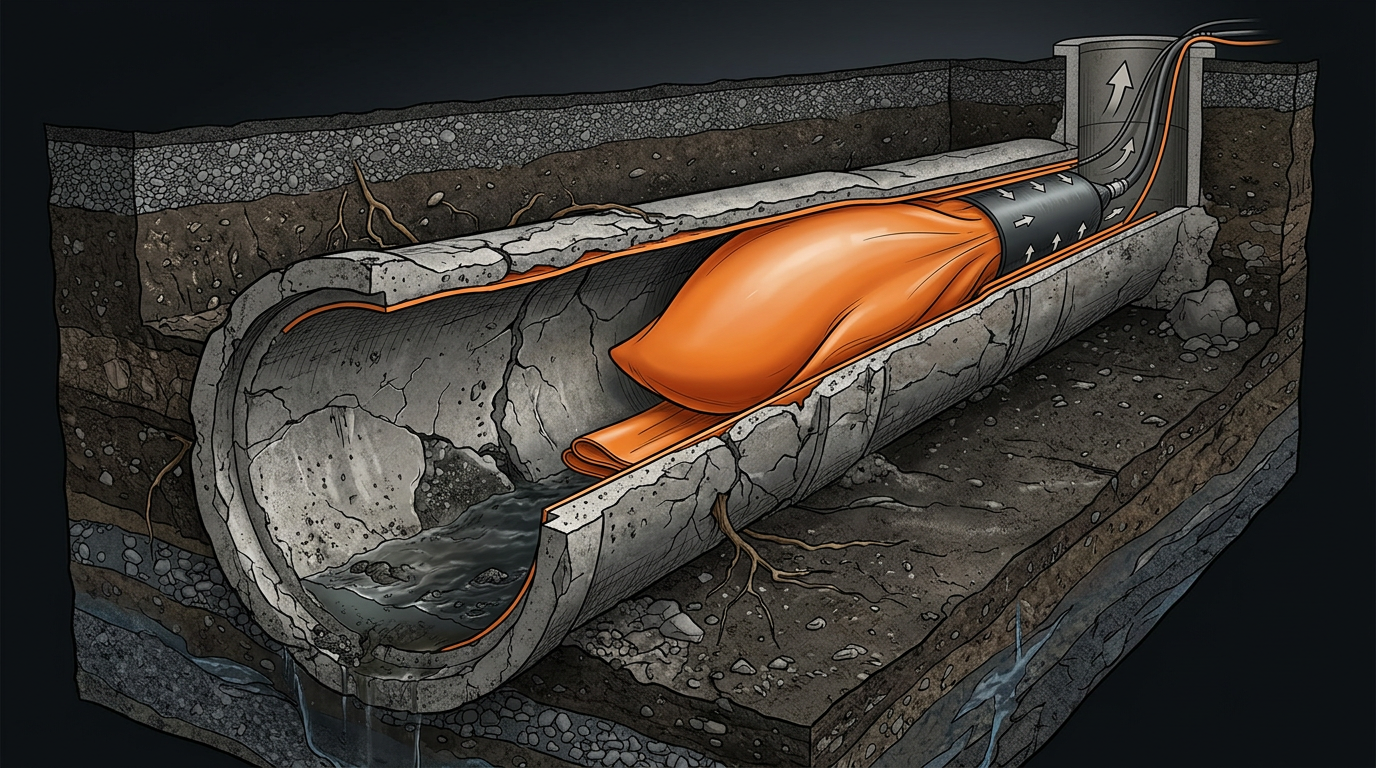
The most widely used approach is Cured-In-Place Pipe (CIPP) lining. Here is how it works in practice:
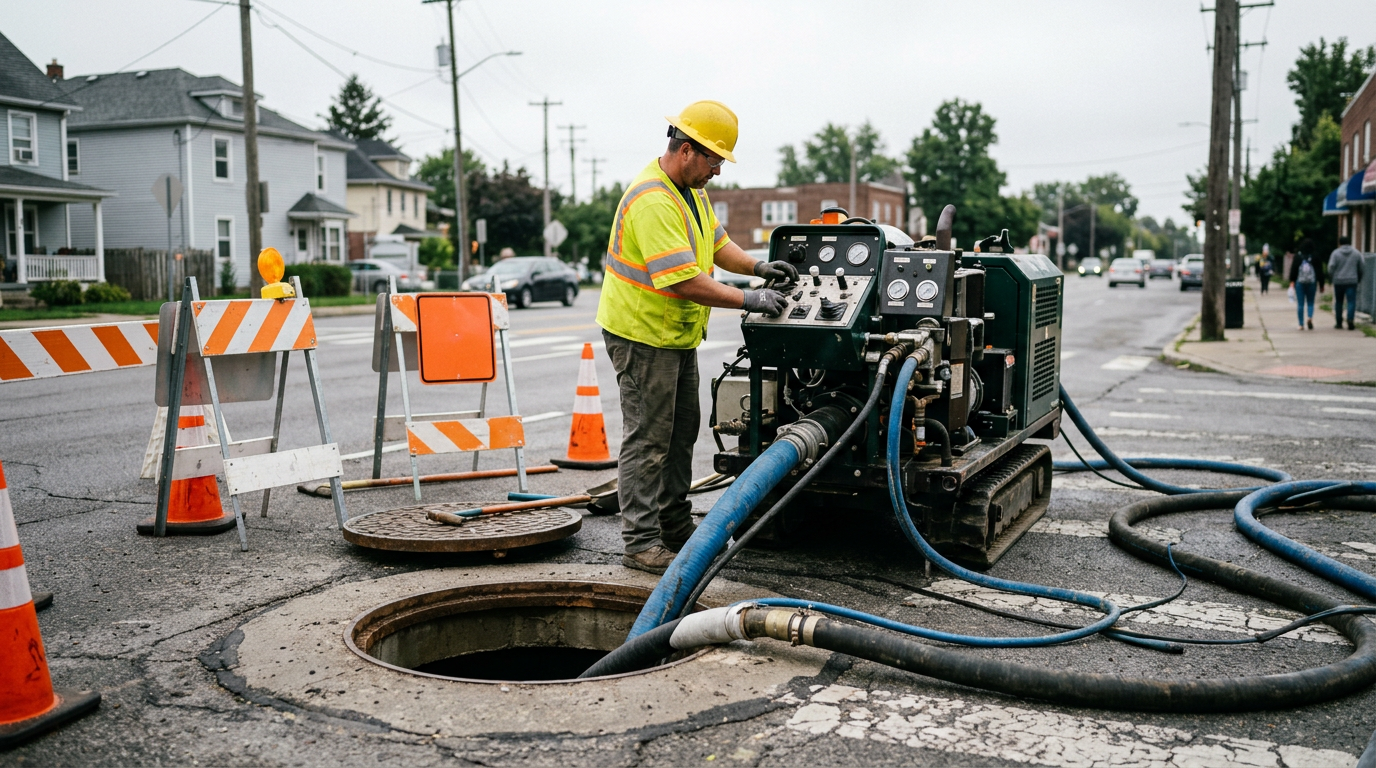
- CCTV Pre-Inspection. A high-resolution sewer camera inspection is deployed through the pipe to document its condition: cracks, joint separation, root intrusion, corrosion, and any deformation. This footage drives the rehabilitation design and establishes a baseline for post-lining comparison.
- Cleaning. The pipe is hydro-jetted to remove debris, sediment, and root growth so the liner can bond properly to the host pipe wall.
- Liner Fabrication and Staging. A flexible liner—typically a felt or fiberglass tube saturated with thermosetting resin—is cut to length and staged at the access point. For storm drain work, liners are engineered to the specific diameter and required wall thickness based on pipe depth, soil loading, and traffic loads.
- Inversion or Pulling Into Place. The liner is inserted through an existing manhole or cleanout. No open trench is needed.
- Curing. Heat (steam or hot water) or UV light activates the resin. Within hours, the liner hardens into a rigid, jointless pipe within the pipe—smooth, corrosion-resistant, and structurally independent of the original host.
- Post-Lining CCTV Verification. A second camera pass confirms the liner has cured correctly, lateral connections have been reinstated, and the finished pipe meets specification.
How does this compare to excavation?
| Factor | CIPP Lining | Open-Cut Excavation |
| Surface disruption | Minimal — access from manholes | Full trench across affected area |
| Traffic/operational impact | Hours to 1–2 days | Days to weeks |
| Road/pavement restoration | Not required | Required — significant added cost |
| Typical project timeline | 1–3 days for most runs | 1–4 weeks or more |
| Liner service life | 50+ years (ASTM F1216 rated) | Equivalent, but at higher upfront cost |
| Suitable for active systems | Yes | No — requires full bypass |
For municipalities managing live road crossings, and for commercial property managers who cannot close a parking facility for weeks, CIPP lining is almost always the operationally superior choice.
Note: Storm drain lining addresses structural pipe rehabilitation. It is distinct from storm sewer lining in Louisiana, which focuses on sanitary and combined sewer conveyances, and should be specified separately in rehabilitation planning. For pipes with severe root intrusion or grease accumulation ahead of lining, hydrojetting in Louisiana is often the first step in the preparation sequence.
What to Look for in a Storm Drain Lining Contractor in Louisiana
Not every trenchless contractor is equipped to handle municipal storm drain work. Here are the qualifications that matter most before you sign a contract.
1. NASSCO Certification (PACP/LACP/ITCP)
NASSCO—the National Association of Sewer Service Companies—sets the industry standard for underground pipeline assessment and trenchless rehabilitation. Look for contractors whose inspection technicians hold current PACP (Pipeline Assessment Certification Program) credentials and whose CIPP installation crews carry ITCP (Inspector Training Certification Program) certification for cured-in-place pipe.
These certifications confirm that the contractor’s team understands how to document pipe condition using standardized defect codes, design a liner to the correct structural class, and verify installation quality against measurable benchmarks. For municipal procurement, many LDEQ-compliant project specifications now require NASSCO-certified personnel on-site.
2. CCTV Pre-Inspection with Deliverable Reporting
Any reputable storm drain lining contractor will perform a full CCTV inspection before submitting a final proposal—and will provide you with the recorded footage and a written condition report. Be cautious of contractors who quote without inspecting. Pipe conditions in Louisiana vary enormously: a 24-inch RCP that looks serviceable from the manhole rim may have significant joint separation or voids in the haunching that only a camera inspection reveals.
The pre-inspection report should include pipe diameter, length, material, defect grades (using NASSCO PACP scoring), and a rehabilitation recommendation. This document becomes the baseline against which the completed lining is measured.
3. Post-Lining Verification
After curing, the contractor should conduct a second CCTV pass and provide documentation that:
- The liner has fully cured and is free of wrinkles, delamination, or voids
- All lateral connections have been robotically reinstated to full opening
- The finished inside diameter meets the minimum flow capacity specified
For municipal contracts in Louisiana, this post-lining report is typically a required deliverable for project closeout and payment processing.
4. Liability Insurance for Municipal Contracts
Stormwater infrastructure work on public right-of-way carries specific liability exposure. Confirm that your contractor carries:
- General Liability: minimum $2 million per occurrence is standard for municipal storm drain work
- Professional Liability (Errors & Omissions): particularly relevant if the contractor is also providing engineering design for the liner thickness
- Pollution Liability: CIPP resin styrene emissions during curing are a regulatory concern in some jurisdictions; verify the contractor uses low-styrene or styrene-free resins and carries appropriate coverage
- Workers’ Compensation: verified for all employees and subcontractors working on the project
Request certificates of insurance naming your municipality or organization as an additional insured before mobilization.
5. Experience with Louisiana Site Conditions
Ask specifically about the contractor’s experience working in high-water-table environments, FEMA flood zone projects, and sites with active groundwater infiltration. Louisiana’s soil and groundwater conditions create installation challenges—particularly with liner flotation during inversion—that a contractor experienced only in arid or northern markets may not have encountered.
CIPP Storm Drain Lining Cost in Louisiana: Price by Pipe Diameter
Pricing for storm drain lining varies by pipe diameter, pipe length, liner wall thickness (which depends on pipe depth and loading class), site access, and whether mobilization, cleaning, and CCTV are included or quoted separately.
The table below reflects typical ranges for municipal and commercial storm drain CIPP lining in Louisiana as of 2025–2026. For a deeper breakdown of how CIPP pricing is calculated statewide, see our CIPP lining cost guide for Louisiana. These figures are for budgeting purposes; final pricing should always come from a site-specific inspection and competitive bidding process.
| Pipe Diameter | Typical CIPP Lining Cost (per linear foot) | Notes |
| 12″ | $85 – $135 | Common for parking lot and smaller commercial drains |
| 18″ | $115 – $175 | Standard municipal collector pipe size |
| 24″ | $150 – $225 | Common for road crossings and main collectors |
| 36″ | $210 – $320 | Large-diameter trunk lines; UV curing often specified |
| 48″ and above | $280 – $450+ | Major trunk infrastructure; project-specific pricing |
What is typically included: liner material, resin, cleaning (light to moderate debris load), inversion/installation, curing, post-lining CCTV, and lateral reinstatement.
What may be billed separately: mobilization, heavy hydrojetting for root-laden or severely fouled pipes, bypass pumping if the system cannot be taken offline, traffic control, and engineering/structural design fees for non-standard loading conditions.
In most Louisiana municipal comparisons, CIPP lining runs 40–60% less than equivalent open-cut replacement when road restoration, traffic control, utility conflicts, and operational disruption costs are fully accounted for.
LDEQ Stormwater Compliance and How Lining Helps
Louisiana’s stormwater regulatory framework is administered by the Louisiana Department of Environmental Quality (LDEQ) through the Louisiana Pollutant Discharge Elimination System (LPDES) program, which operates under delegation from the U.S. EPA under the Clean Water Act.
Municipalities operating Municipal Separate Storm Sewer Systems (MS4s) are required to hold LPDES MS4 permits, which mandate programs to reduce pollutants discharged through the storm system to the maximum extent practicable. Commercial sites that disturb one acre or more during construction must comply with LDEQ’s Construction Stormwater General Permit (LAR100000 for large sites, LAR200000 for smaller sites), including development and implementation of a Stormwater Pollution Prevention Plan (SWPPP).
Here is where storm drain lining intersects directly with LDEQ compliance:
- Reducing infiltration and inflow (I/I). Deteriorated storm drain pipes with cracked joints or separated sections allow groundwater and soil fines to enter the system. This can increase discharge volumes, introduce pollutants, and cause the system to exceed its permitted hydraulic capacity. CIPP lining seals joints and cracks, directly reducing I/I and the associated pollutant load in stormwater discharges.
- Maintaining conveyance capacity. MS4 permit holders are responsible for maintaining their systems in a condition capable of handling design storm events. A structurally failing pipe that collapses or significantly deforms can be cited as a permit deficiency. Proactive lining maintains conveyance capacity and documents the municipality’s due diligence.
- Supporting Stormwater Management Plans. LDEQ MS4 permits require permittees to develop and implement a Stormwater Management Program (SWMP) that includes a component for operations and maintenance of the storm system. A documented rehabilitation program—with CCTV inspection records, lining specifications, and post-installation verification reports—provides the kind of documented evidence that supports permit compliance during LDEQ inspections.
- Avoiding permit violations from structural failures. A storm drain that collapses under a roadway or parking lot and creates an uncontrolled discharge pathway can trigger an LPDES violation notice. Addressing deterioration proactively through lining is considerably less expensive than responding to an enforcement action.
Municipalities and property managers who treat storm drain rehabilitation as part of ongoing LDEQ compliance management—rather than a reactive emergency measure—consistently find better outcomes in both permit reviews and long-term infrastructure budgets.
Related Services
If you are evaluating your stormwater system’s condition and rehabilitation options in Louisiana, these related services are often part of a comprehensive program:
- Storm Drain Repair Louisiana — For structural failures, collapses, and point repairs in storm drain systems that require targeted trenchless intervention
- CIPP Lining Louisiana — Full overview of cured-in-place pipe technology and applications across pipe types and diameters
- Hydrojetting Louisiana — High-pressure cleaning used to prepare pipes ahead of lining or to restore flow capacity in partially blocked storm drains
- Inflow & Infiltration Reduction — Addressing groundwater and stormwater intrusion into sewer systems through trenchless sealing and lining
- Municipal Stormwater Solutions — Comprehensive stormwater infrastructure programs for parishes, municipalities, and public works departments
Ready to Assess Your Storm Drain System?
Pelican Underground LLC provides storm drain lining and trenchless stormwater infrastructure rehabilitation across Louisiana. Our crews are experienced in the site conditions, regulatory requirements, and pipe configurations common throughout the state—from coastal parishes to inland municipal systems.
If you manage a municipal storm system or a commercial property with aging underground drainage, the first step is a CCTV inspection to understand exactly what you are working with. From there, we can provide a scope-specific proposal that gives you real numbers, not guesses.
Contact Pelican Underground — Stormwater Management Services →
We work with public works departments, parish engineering offices, and private property managers throughout Louisiana. Let us know what you are managing and we will put together an assessment plan that fits your timeline and budget.
Pelican Underground LLC is a licensed Louisiana contractor specializing in trenchless pipe rehabilitation, storm drain lining, and stormwater infrastructure services.