
Quick Answer: Refinery sewer pipe lining in Louisiana uses trenchless methods such as cured-in-place pipe (CIPP) to rebuild buried oily-water sewers, effluent collection lines, and process drainage from the inside, without excavating near tanks, pipe racks, or foundations. A resin-saturated liner is installed through existing manholes and cured into a seamless, corrosion-resistant pipe-within-a-pipe that seals leaking joints and pinholes. Resin is matched to the waste stream, and work is scheduled around turnaround windows with bypass pumping. CIPP applies to buried gravity drainage, not pressurized hydrocarbon process piping.
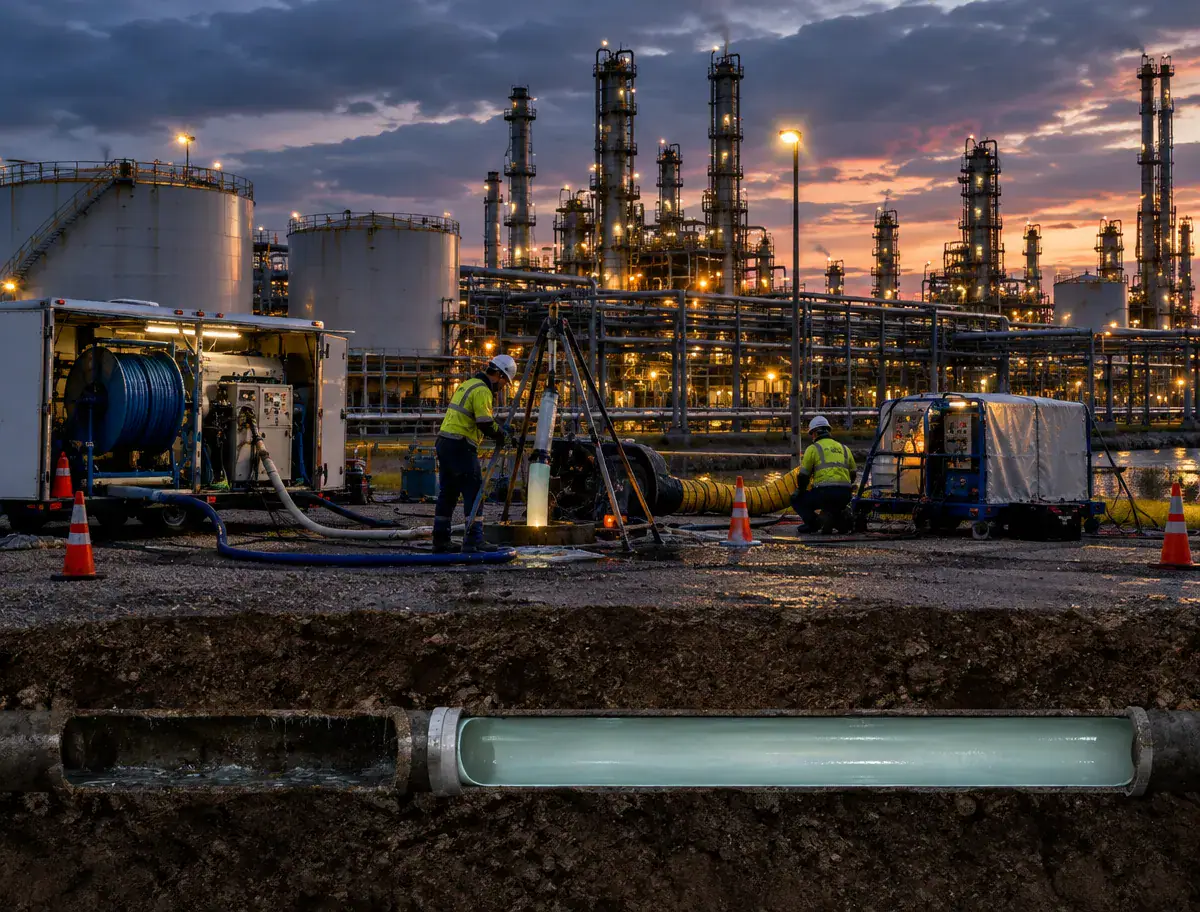
Refinery oily water drains across Louisiana require trenchless rehabilitation using cured-in-place lining or epoxy coating, avoiding excavation near active process lines. Pelican Underground LLC provides camera inspection, NASSCO-credentialed crews, and licensed, insured service to Louisiana refineries and industrial facilities, restoring pipe integrity while minimizing plant downtime, environmental exposure, and disruption to surrounding infrastructure.
Why Choose Trenchless Lining For Louisiana Refinery Drains?
Refinery process lines rarely get the luxury of a shutdown for excavation. Trenchless rehabilitation exists precisely for that constraint: plant engineers in oil and gas, industrial, and manufacturing operations turn to no-dig methods when a line has to stay running and the ground above it cannot be torn up. That reality defines nearly every refinery site along Louisiana’s industrial corridor. Sewer trunk lines, process water piping, and stormwater systems sit beneath active production zones, pipe racks, and load-bearing sidewalk.
We built our operation around that constraint. Operating from New Orleans, LA, we travel throughout Louisiana to serve refinery and industrial clients who cannot afford excavation downtime.
Why does aging infrastructure matter for refinery sewer pipe lining in Louisiana?
Age changes the calculation entirely. Trenchless pipe lining developed as a growing methodology specifically to restore deteriorated pipelines without digging. Much of that need traces back to installation dates. Many sewer, storm drain, and culvert systems still in service were first laid in the early 20th century. Everything built above ground has changed dramatically since. Louisiana’s older refinery sites carry that same legacy: process water and sanitary lines installed decades before today’s tank farms, control buildings, and containment structures ever existed.
Digging near those structures risks costly damage. Trenchless methods avoid that exposure by rehabilitating pipe from within.
Trenchless benefits for refinery operators include:
- Continued line operation during rehabilitation, when feasible
- No excavation near tanks, foundations, or buried utilities
- Reduced disruption to production schedules
- A repair approach suited to pipe corridors that predate current site layouts
We apply that same logic to every Louisiana refinery drain assessment we perform.
What Causes Oily Water Line Failures At Refineries?
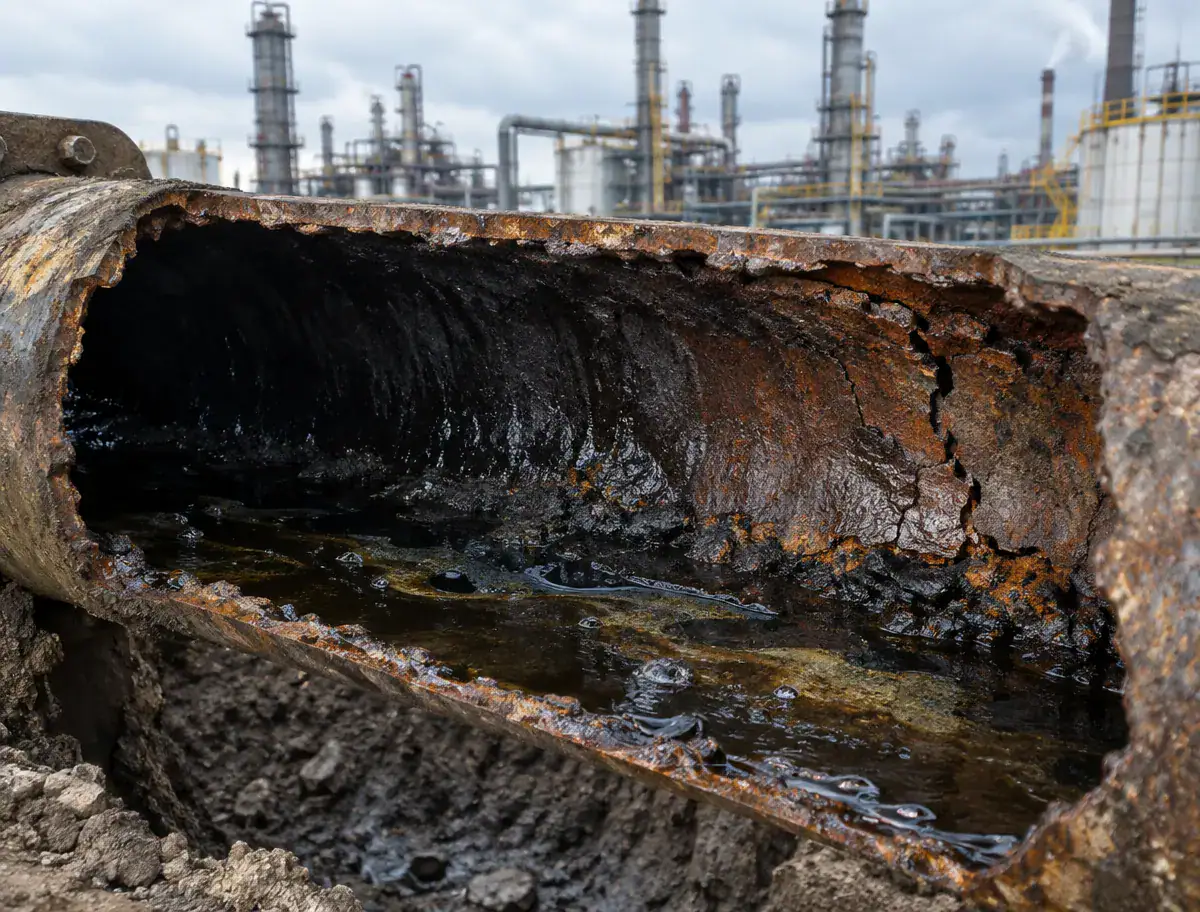
Corroded joints and pinhole leaks account for most oily water line failures at refinery sites. A Gulf Coast refinery required rehabilitation of 16,000 feet of 6-inch ductile iron pipe after multiple leaks developed at pipe joints and pinholes throughout the system. We treat this case as representative of the deterioration patterns we expect across aging Louisiana refinery infrastructure.
Age compounds the risk. The processed water line at that facility had operated for 35 years before failures. Leaks forced the terminal to suspend the line entirely. Once a processed water or oily water line goes offline, refineries lose a critical piece of their wastewater treatment chain. Downtime carries operational and regulatory consequences that extend well beyond the pipe itself.
Those regulatory stakes are real: refinery wastewater falls under the EPA petroleum refining effluent guidelines (40 CFR Part 419), and Louisiana discharges are permitted through the LDEQ Water Permits Division, so a leaking oily-water sewer is a compliance issue as well as a maintenance one.
How Do Refineries Find These Failures Before A Shutdown?
Routine inspection intervals catch most failures before catastrophic loss of service. A southeastern US oil refinery evaluated the condition of its process sewer manholes at one of its refinery sites. Officials discovered leaks during a scheduled five-year inspection of the process sewer line. That inspection cadence gives plant managers and maintenance supervisors a defined checkpoint for identifying deterioration.
Common failure sources we document during inspections include:
- Corroded joints in ductile iron sections
- Pinhole leaks from long-term chemical exposure
- Deteriorated manhole seals where trunk lines enter structures
- Annular gaps around pipe penetrations
Pelican Underground LLC brings this same diagnostic approach to refinery sewer pipe lining Louisiana clients, serving industrial corridor facilities with sewer camera inspection and condition assessments before failures force an unplanned shutdown.
📞 Planning a Refinery Drain Rehab? Pelican Underground LLC inspects and lines buried oily-water sewers and process drainage across Louisiana, scheduled around your turnaround window. Request a refinery drain assessment to get a condition report and lining plan.
How Does CIPP Lining Rehabilitate Refinery Sewer Pipes?
Cured-in-place pipe (CIPP) lining restores a failing sewer line by inserting a resin-saturated liner inside the existing pipe and curing it into a new, seamless structure. No excavation. No pipeline swap. The original pipe becomes the housing for a durable replacement built inside it. NASSCO documents over 50 years of CIPP use as a mainline rehabilitation method, spanning pipe diameters from 2 inches to 120 inches, giving refinery sewer pipe lining Louisiana projects a proven operational history rather than an experimental one.
Liner design and installation typically reference ASTM F1216 for inversion-installed CIPP and the NASSCO CIPP Installation Performance Specification Guideline, which set minimum requirements for materials, installation, and post-cure testing.
Scope note: CIPP lining applies to buried gravity systems: oily-water sewers, effluent collection lines, and process drainage. It is not used on pressurized hydrocarbon or process piping managed under API 570. Oily-water sewers that handle benzene-bearing or VOC-laden waste may also be subject to 40 CFR Part 61 Subpart FF benzene waste operations standards and Subpart QQQ VOC standards for refinery wastewater systems, so rehab plans should preserve required drain seals, water traps, and covers.
We treat every refinery line differently, because no two systems share the same age, material, or damage profile. Some lines need a full structural liner; others require targeted point repair. That is why a range of trenchless technologies and solutions exists rather than a single fix-all method.
Which Trenchless Method Fits a Given Refinery Line?
Selection depends on pipe condition, diameter, and how critical the line is to ongoing operations. After assessment, we recommend the safest, longest-lasting, most cost-effective option, whether that means a pipe-within-a-pipe CIPP lining installation or pipe bursting, which replaces the old pipe without digging.
| Factor | CIPP Lining | Pipe Bursting |
|---|---|---|
| Method | Resin liner cured inside existing pipe | Old pipe fractured, new pipe pulled through |
| Excavation | None to minimal | None to minimal |
| Best for | Structural deterioration, corrosion | Undersized or collapsed lines |
Does Trenchless Lining Cost Less Than Digging?
Trenchless lining costs far less than open-cut replacement in most cases. Avoiding excavation protects refinery foundations, roadways, and active process areas from disruption, a factor that matters directly to Louisiana facility capital budgets and downtime planning. The EPA fact sheet on trenchless sewer rehabilitation compares CIPP, sliplining, and pipe bursting methods, including their typical applications and costs.
What Lessons Come From Gulf Coast Refinery Projects?
Gulf Coast refinery projects teach a consistent lesson: partial repairs invite repeat failures. Thorough inspection, not spot-fixing, protects both compliance records and production schedules. We apply these lessons directly to every refinery sewer pipe lining Louisiana engagement we manage.
One southeastern refinery case offers a clear model. The owner chose to inspect and repair every manhole on site, including structures showing no visible signs of leaking. That decision reflected a proactive standard rather than a reactive one, and it caught deterioration before it reached the surface.
Assessment work on that same site traced most leaks to a specific weak point: poorly sealed annular space where pipes penetrate manhole walls. This finding matters for Louisiana facilities operating on aging concrete and clay infrastructure near humid, high-groundwater sites along the industrial corridor.
Why does downtime matter so much in refinery repair decisions?
Downtime carries direct financial consequences for continuous-process facilities. Epoxy spray lining, while a viable repair method in some manhole rehabilitation cases, required extended cleaning and drying time before application. Every added hour of downtime translates into lost throughput or costly workarounds.
What happens when a processed water line fails without a trenchless option?
A Houston-area refinery terminal learned this the hard way when its processed water line went out of service. Terminal owners had no choice but to truck material to the treatment plant, absorbing exorbitant added cost until repairs were complete.
Key takeaways for Louisiana operators:
- Inspect all structures, not just visibly failing ones.
- Target annular seal integrity around pipe penetrations first.
- Weigh downtime costs against lining method selection.
- Plan for contingency logistics if a line must go offline.
How Should Louisiana Facilities Plan Their Rehab Project?
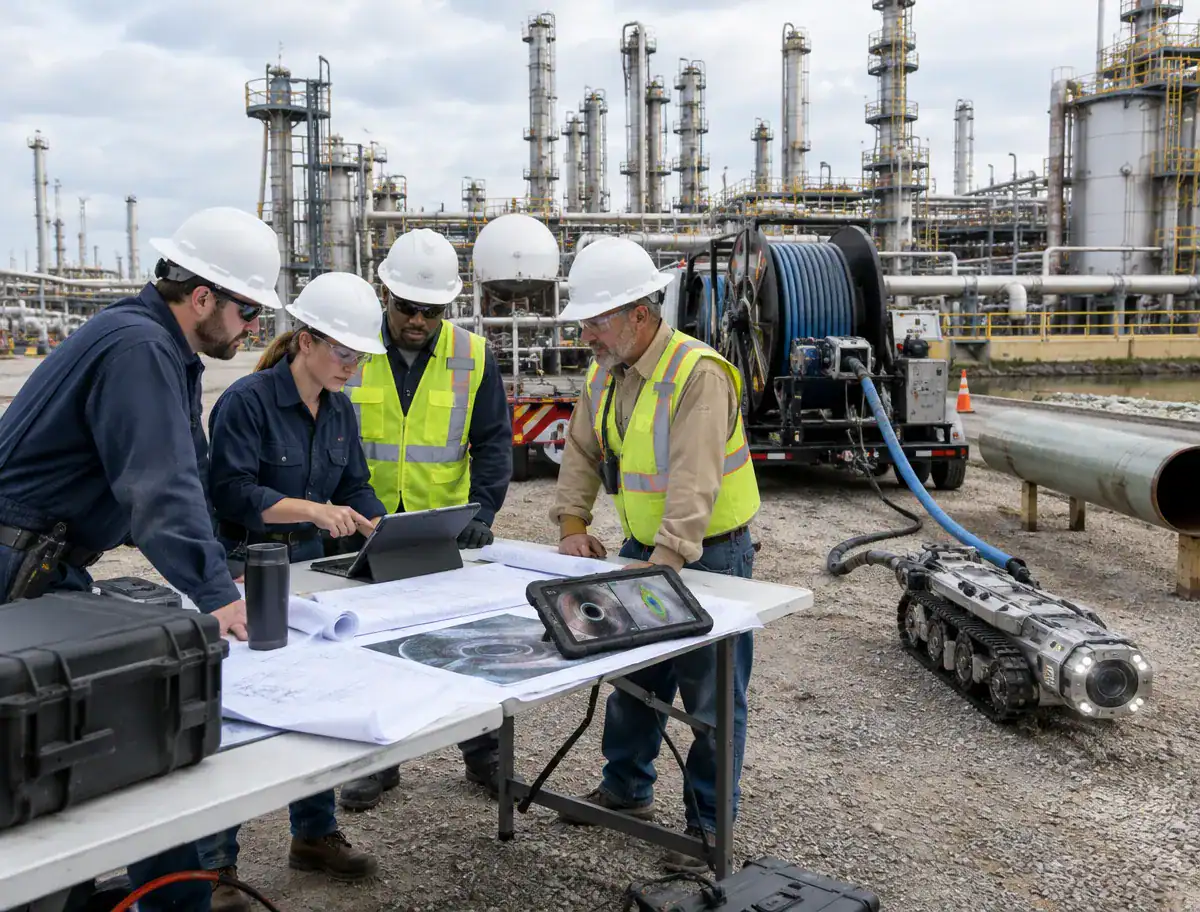
Planning starts with an honest assessment of pipeline condition, project scope, and operational downtime tolerance. Louisiana refineries, chemical plants, and industrial sites cannot afford unplanned outages or environmental violations tied to failing sewer infrastructure. Loss of containment, regulatory penalties, and emergency excavation costs all stack up when rehab planning gets rushed or skipped entirely.
We at Pelican Underground LLC, based in New Orleans, LA, support refinery sewer pipe lining Louisiana projects with trenchless methods deployed across the state, from commercial and industrial pipe lining in New Orleans to CIPP lining in Baton Rouge. Our position lets us respond to plant managers and maintenance supervisors from the industrial corridor without requiring facilities to travel or coordinate remote logistics.
What makes trenchless rehab a better fit for refinery environments?
Trenchless lining avoids the excavation that traditional dig-and-replace repair requires. We deliver trenchless services because they run efficient, cost-effective, and far less disruptive to active refinery operations than open-cut methods. For facilities where downtime carries real financial and safety consequences, that difference matters.
Our crews bring specialized knowledge to every job. Team members stay current on trenchless technology, which supports the complexity that industrial rehabilitation demands, from tight easements to sensitive process areas near active equipment. Manhole and sewer entry on refinery sites is typically handled as permit-required confined space work under OSHA’s permit-required confined spaces guidance, alongside each facility’s contractor pre-qualification and site safety requirements.
A sound rehab plan generally includes:
- Condition assessment of existing sewer lines and joints
- Selection of trenchless repair or lining method suited to pipe material and diameter
- Scheduling that accounts for plant shutdown windows
- Post-repair inspection to confirm structural integrity
Should preventative maintenance be part of the plan?
Yes. Preventative maintenance programs extend system life and reduce the risk of future failures. Routine inspections, industrial drain cleaning, and related strategies catch problems before they escalate into emergency repairs. Building these steps into a facility’s ongoing maintenance schedule protects both compliance standing and long-term infrastructure investment.
Frequently Asked Questions
Why do refineries choose trenchless lining over excavation?
Refinery process lines rarely get shutdown time for excavation, and digging near tanks, foundations, or buried utilities near active production zones and pipe racks risks costly damage to critical infrastructure.
What causes oily water drain failures at refineries?
Corroded joints and pinhole leaks account for most oily water line failures. Seen at a Gulf Coast refinery requiring rehabilitation of 16,000 feet of 6-inch ductile iron pipe after multiple leaks developed.
How does Pelican Underground rehabilitate refinery drains without shutting down operations?
Pelican Underground uses cured-in-place lining, epoxy coating, camera inspection, and trenchless bypass pumping systems, letting refineries maintain continuous operations while avoiding excavation near process lines.
Can CIPP lining be used on pressurized refinery process piping?
No. CIPP lining as described here applies to buried gravity systems such as oily-water sewers, effluent collection lines, and process drainage. Pressurized hydrocarbon and process piping is managed under API 570 inspection programs and requires different repair methods, so Pelican Underground does not line pressurized process lines.
Which liner resin works best for refinery oily-water and chemical drains?
Resin choice depends on the waste stream. Vinyl ester resins are generally selected for caustic or acidic drainage, while epoxy resins suit hydrocarbon exposure. Final selection should follow a review of the drain’s chemistry, temperature, and flow conditions during the condition assessment.
TL;DR — Refinery Sewer Pipe Lining in Louisiana at a Glance
- Pelican Underground rehabilitates oily water drain pipes without excavation using cured-in-place lining technology.
- Trenchless methods eliminate joint leaks and pinhole corrosion in refinery ductile iron pipe systems.
- Video inspection identifies pipe damage before Pelican Underground implements targeted rehabilitation solutions.
- Refineries maintain continuous operations during pipe rehabilitation with Pelican Underground’s trenchless bypass pumping systems.
- Next step: Schedule a refinery drain condition assessment with Pelican Underground LLC before your next turnaround.
Related Resources
- Trenchless Pipe Repair Services
- Pipe Lining and Sewer Repair in New Orleans, LA
- Choosing a CIPP Lining Contractor in Baton Rouge
- Epoxy Pipe Lining in Louisiana
- Pipe Lining vs. Pipe Bursting
- Microtunneling vs. Open-Cut Excavation in Louisiana’s High Water Table
- How Long Does Pipe Lining Last?
Get a Free Refinery Sewer Lining Quote
Refinery oily water drain lining through trenchless rehabilitation represents a critical infrastructure solution for Louisiana’s industrial operations. Cured-in-place pipe technology and targeted point repairs eliminate the need for extensive excavation, preserving operational continuity while addressing corrosion and structural degradation. Facilities across the Gulf Coast region benefit from advanced video inspection diagnostics and compliance-driven execution. Pelican Underground LLC delivers the specialized expertise and licensed, bonded crews necessary to restore failing refinery drainage systems with minimal disruption and maximum durability.
Whether you are planning lining work for an upcoming turnaround or need an assessment of a leaking oily-water sewer, our industrial lining team will scope the job around your operating schedule. Contact Pelican Underground LLC today for a free, no-obligation quote.
About Pelican Underground LLC: Pelican Underground LLC is a New Orleans, LA-based trenchless pipe rehabilitation contractor serving refineries, chemical plants, municipalities, and commercial facilities across Louisiana, Mississippi, and Alabama. Our NASSCO-credentialed crews provide sewer camera inspection, hydro-jetting, CIPP lining, pipe bursting, and point repairs that restore buried infrastructure with minimal excavation and downtime.
