
Quick Answer: Power plant pipe lining Louisiana uses cured-in-place pipe (CIPP) technology to rehabilitate floor drains, cooling water discharge lines, process wastewater lines, stormwater drainage, and sanitary sewer laterals without excavation. Pelican Underground installs NASSCO-standard resin liners during planned maintenance windows, so plants keep operating without trenching through process areas or concrete floors. CIPP does not apply to high-pressure steam or process piping, which require different repair methods entirely.
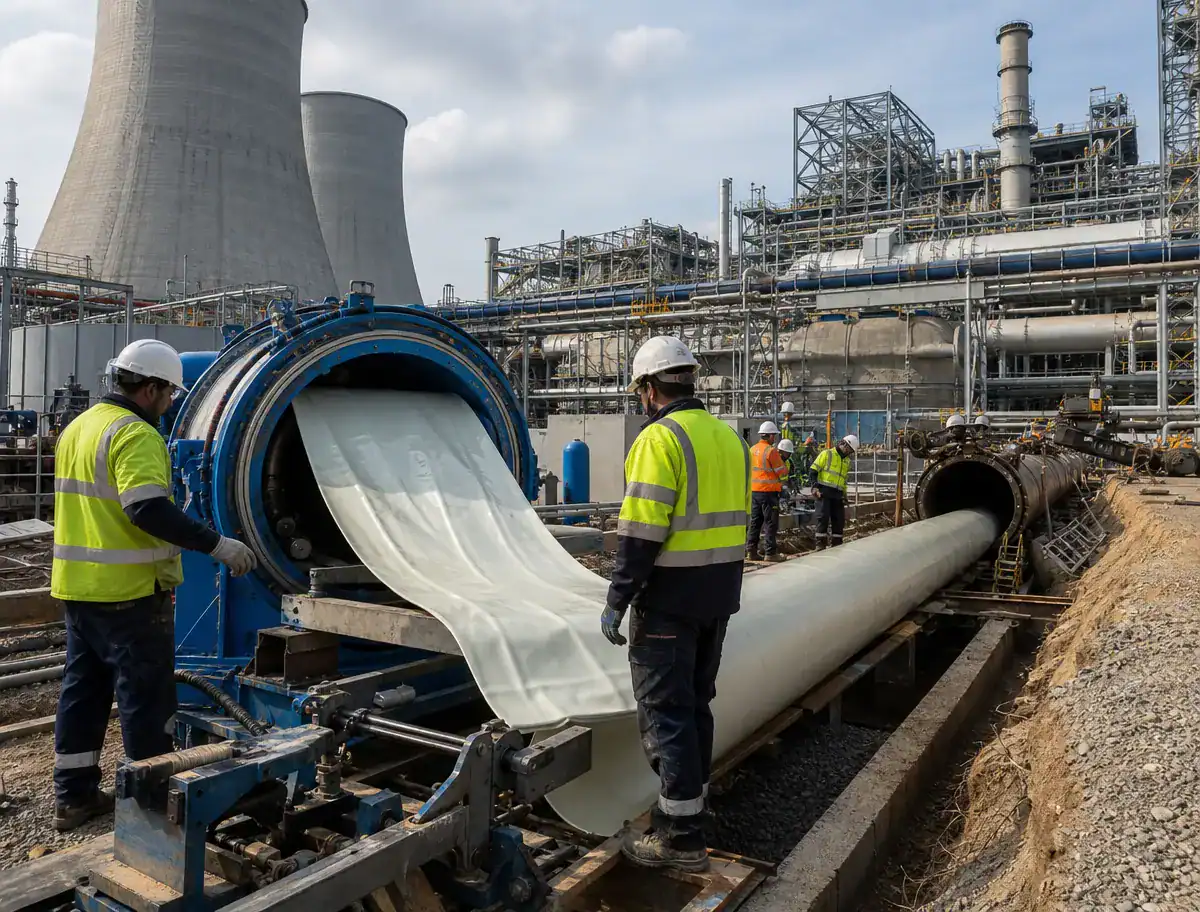
Industrial CIPP lining rehabilitates power plant pipe systems without excavation, using resin-saturated liners cured with heat or UV light. Pelican Underground applies this trenchless method across Louisiana industrial facilities, restoring structural integrity to deteriorated lines while plants remain operational. CIPP is a widely used method in the sewer rehabilitation market, known for delivering structural, leak-free pipe performance for demanding industrial environments.
What Are the Key Takeaways on Power Plant Pipe Lining in Louisiana?
- CIPP technology is a widely used method in the sewer line rehabilitation market.
- Pipe liners create new pipes inside existing ones using advanced structural materials.
- Four classes of CIPP liners offer fully structural rehabilitation for deteriorated pipes.
- Pelican Underground LLC delivers trenchless CIPP solutions in New Orleans, Louisiana.
How Many Power Plants Depend on Louisiana’s Pipe Infrastructure?
Louisiana hosts more than 14 major power generation facilities, spanning natural gas combined-cycle plants, nuclear generating stations, and petrochemical-adjacent industrial sites concentrated along the Mississippi River Industrial Corridor between Baton Rouge and New Orleans. Nuclear facilities including River Bend Station and Waterford 3 anchor the state’s baseload generation, while dozens of natural gas plants support the grid across the Gulf Coast region. Every one of these sites relies on buried drain, wastewater, and stormwater infrastructure that ages under the same soil and moisture stress as any other Louisiana pipe network — infrastructure that rarely gets the same engineering attention as the generating equipment above ground.
Which Power Plant Pipe Systems Qualify for CIPP Lining?
Scope matters as much as method. Power plant pipe lining Louisiana projects apply cured-in-place pipe technology to gravity and low-pressure systems, not the high-pressure steam or process lines that move a plant’s core production media. CIPP is suited to:
- Floor drains throughout turbine buildings, maintenance bays, and equipment rooms
- Cooling water discharge lines carrying treated water away from heat exchange systems
- Process wastewater lines routing non-pressurized effluent to treatment or discharge points
- Stormwater drainage collecting runoff from paved industrial surfaces, best assessed as part of a broader storm water management plan
- Sanitary sewer laterals serving administrative buildings and employee facilities
CIPP does not apply to high-pressure steam lines or pressurized process piping — those systems require mechanical repair or replacement methods engineered for their operating pressures, not a cured resin liner.
📞 Ready to Get Started? Don’t wait for a floor drain or cooling water line to force an unplanned outage. Contact Pelican Underground LLC today for a free camera-inspection quote on power plant pipe lining Louisiana facilities can schedule around planned maintenance.
Why Do Power Plants Need Trenchless Pipe Lining?
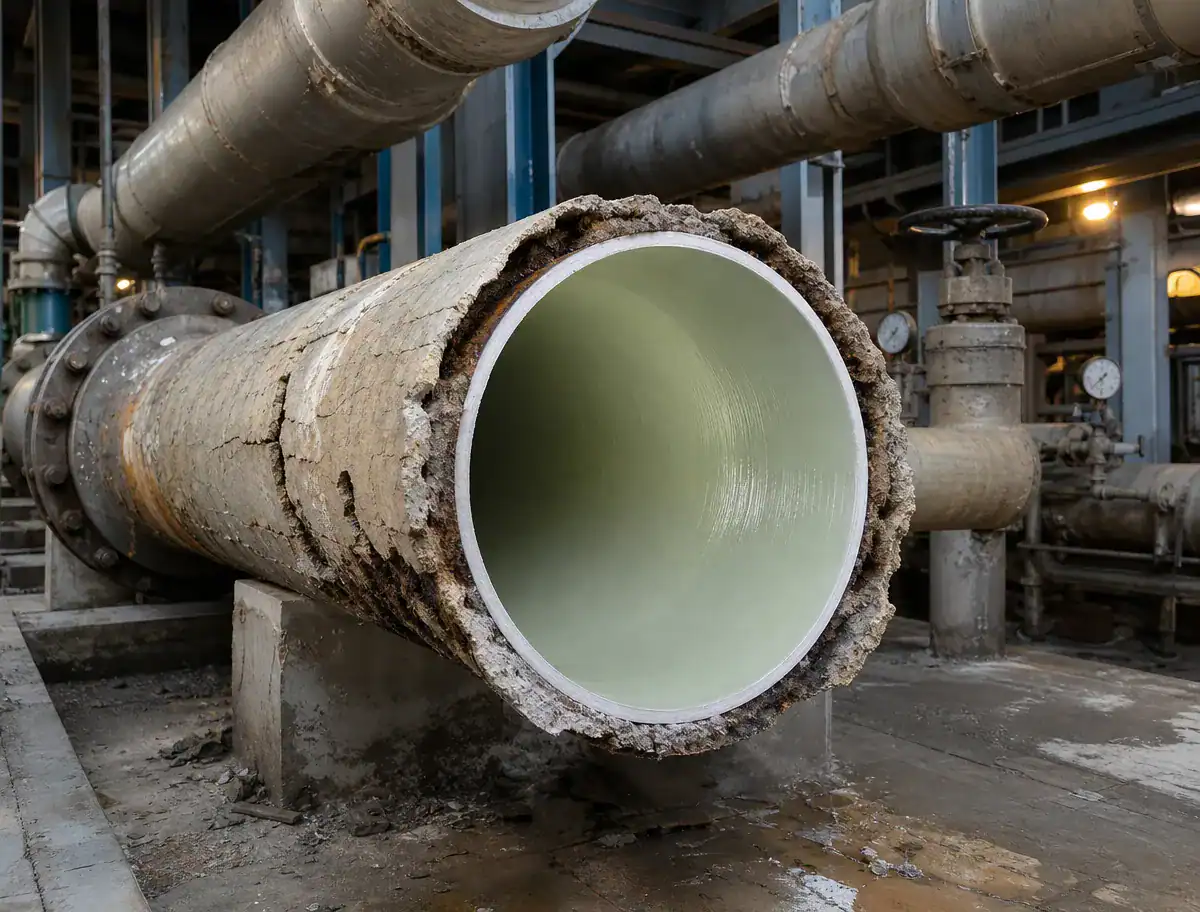
Uninterrupted operations demand pipe repair methods that avoid excavation entirely. Power plants cannot tolerate open trenches crossing access roads, cooling systems, or containment areas without risking costly downtime. Trenchless pipe repair methods repair damaged underground pipe without excavating a trench across facility grounds, protecting continuous plant operations from the disruption that traditional dig-and-replace repair causes.
We deploy power plant pipe lining Louisiana crews equipped with specialized tools that create small access points instead of tearing up paved industrial surfaces. This method preserves the surrounding property, keeps roadways clear, and limits the footprint of any repair work to a fraction of what conventional excavation requires. We schedule lining work during planned maintenance windows, so crews never excavate through process areas or break through concrete floors to reach a failing line.
Does Trenchless Repair Actually Cost Less Than Digging?
Yes. Trenchless repair saves significant time, money, and labor stress compared to traditional excavation-based methods. For facilities where every hour of downtime carries a real operational cost, that difference matters far beyond the repair invoice itself.
Is Cured-in-Place Pipe Reliable Enough for Industrial Use?
Reliability is not a question mark here. Cured-in-place pipe, known as CIPP, already accounts for roughly half of the entire sewer line rehabilitation market nationwide. That market share reflects a proven track record across demanding applications, including facilities with industrial-grade throughput and strict compliance requirements.
Consider what excavation-based repair typically forces on a power plant site:
- Trenches cutting across access roads and equipment staging areas
- Extended downtime while soil is removed and replaced
- Restoration costs for concrete, asphalt, and landscaping
- Elevated safety exposure from open excavation near live equipment
Trenchless lining eliminates each of these liabilities. We plan every project around minimizing disruption to plant operations while restoring pipe integrity to a standard suited for long-term industrial service.
What Is CIPP And How Does It Work?
CIPP stands for cured-in-place pipe, a trenchless repair method that installs a resin liner inside an existing pipe until it cures into a new structural pipe. For power plant asset managers, this process avoids full replacement of degraded piping runs, reducing both downtime and excavation risk near sensitive equipment. We apply CIPP lining services using this same core methodology, adapted for industrial-scale diameters and access constraints, and aligned with NASSCO’s pipeline rehabilitation matrix for selecting the right liner class per pipe condition.
Every project begins with a diagnostic step, not a repair step. We deploy video camera inspection first, documenting pipe condition before any resin or equipment enters the line. This inspection determines whether a section qualifies for lining or requires a different remediation approach entirely.
How Does The Resin Liner Actually Cure Into A New Pipe?
The liner cures through heat, steam, or ultraviolet light, and the method we select depends on pipe diameter and access point configuration. Most curing cycles complete within 2 to 6 hours, a timeline that matters for facilities that cannot tolerate extended line outages. Once cured, the resin hardens into a standalone structural pipe within the host pipe.
Is CIPP The Same As Just Patching A Damaged Section?
No. A cured liner functions as an entirely new pipe built inside the old one, not a temporary patch or coating. It relies on advanced resin materials and controlled curing technology to achieve structural independence from the original pipe wall.
We follow a consistent sequence on every job:
- Camera inspection to assess pipe condition
- Liner selection and resin saturation
- Insertion and curing (2-6 hours, method-dependent)
- Final inspection to confirm structural integrity
This sequence keeps industrial clients informed at each stage, with documented conditions supporting maintenance records and compliance reporting.
How Does Industrial CIPP Differ From Residential Lining?
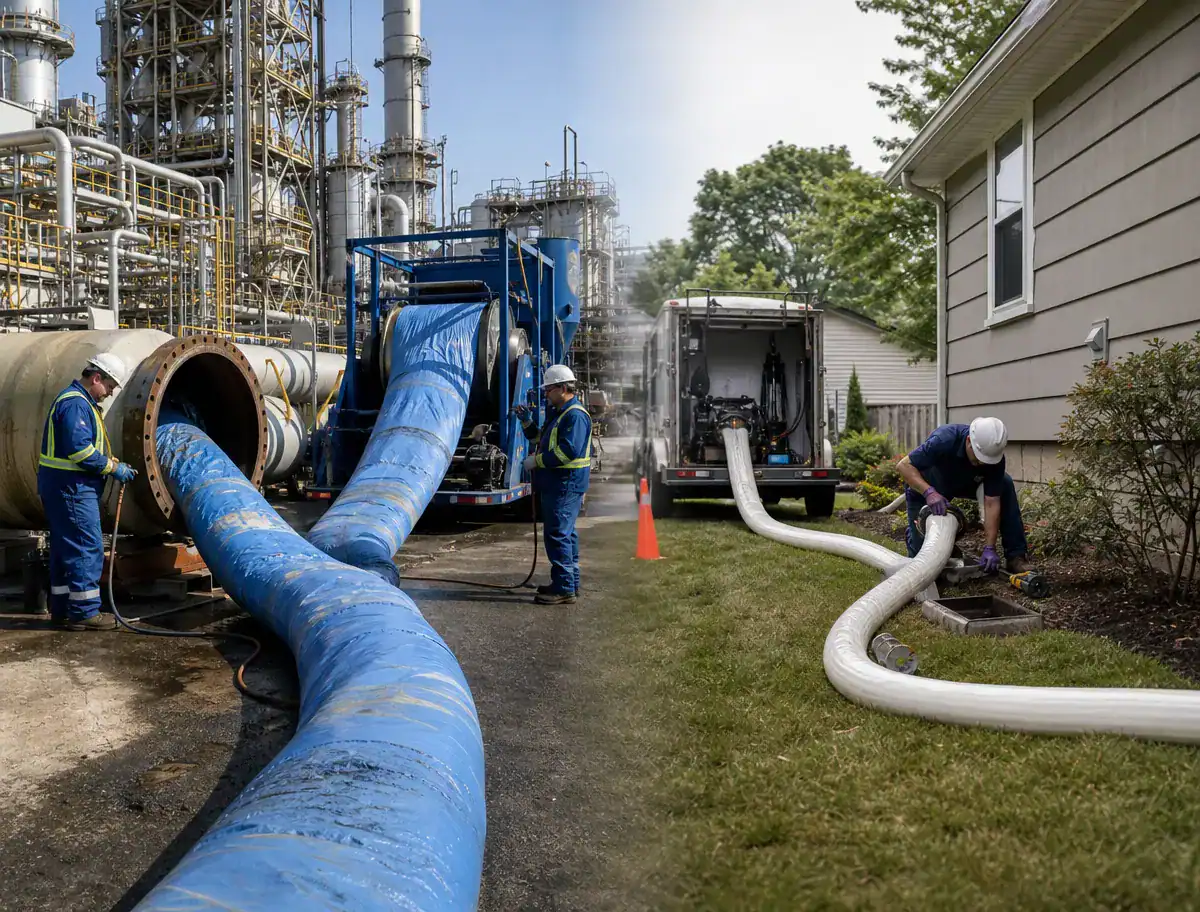
Scale separates industrial cured-in-place pipe work from residential jobs. Power generation facilities operate cooling water lines, process drains, and large-bore conduits that dwarf a typical household sewer line. Residential CIPP addresses pipe diameters of a few inches. Power plant pipe lining Louisiana projects call for systems engineered to handle diameters from 4 inches up to 120 inches. That range covers everything from a branch drain to a major intake or discharge line running beneath a generating station.
Diameter is only part of the equation. Design life matters just as much on a site where unplanned downtime carries real operational cost. We install CIPP lining and pipe bursting as trenchless methods, both engineered for a service life of 50 to 100 years — a lifespan matched to critical infrastructure that cannot tolerate frequent reinvestment. Facilities pursuing broader industrial drain cleaning services alongside lining typically bundle both into the same maintenance window.
When Does Pipe Bursting Replace Lining at a Power Plant?
Bursting becomes necessary once a line has collapsed or degraded past the point lining can restore. Rather than adding a liner inside compromised pipe, this method fractures the old pipe outward while pulling a new one through the same path. We deploy bursting on plant runs where structural failure, not just wear, defines the problem.
How Do We Decide Between Lining and Bursting?
A camera inspection determines the answer before any repair method is chosen. Video assessment reveals whether the existing pipe retains enough structural integrity to accept a liner or whether the line requires full replacement via bursting.
| Factor | CIPP Lining | Pipe Bursting |
| Pipe condition | Intact, deteriorating | Collapsed or failed |
| Diameter range | 4″-120″ | Full replacement scope |
| Method | Liner cured inside existing pipe | Old pipe broken outward, new pipe pulled through |
| Design life | 50-100 years | 50-100 years |
How Does Pipe Lining Support LPDES Permit Compliance?
Louisiana power plants operate under Louisiana Pollutant Discharge Elimination System (LPDES) permits issued through Louisiana DEQ’s water permits division, and failing drain or wastewater infrastructure creates real regulatory exposure. Cracked joints and deteriorated pipe walls allow groundwater infiltration into sanitary lines and wastewater exfiltration into surrounding soil — both conditions that can trigger a Notice of Violation (NOV) during an LPDES compliance inspection.
CIPP lining seals a pipe’s interior into a continuous, jointless structure, closing the infiltration and exfiltration pathways that put a facility’s permit status at risk. Facilities that document lining work as part of their maintenance record demonstrate proactive compliance rather than reactive repair after a violation notice arrives.
Where Do Power Plant Drain Systems Fail Most Often?
Certain drain locations see disproportionate failure across Louisiana power generation sites, largely because they combine constant moisture exposure with heavy operational traffic:
- Cooling tower basin drains — constant moisture and mineral scaling accelerate joint failure and corrosion
- Turbine building floor drains — heavy foot and equipment traffic plus periodic washdown wear these lines faster than most buried runs
- Transformer containment drains — secondary containment structures where pipe condition often gets limited attention until a required inspection cycle
Regular floor drain lining at these three failure points prevents small joint separations from becoming full section replacements.
What Industrial Safety Credentials Does Pelican Underground Bring to Power Plant Sites?
Working inside an active power generation facility requires more than lining expertise. Our crews install to NASSCO’s CIPP best practices standards, carry confined space entry training and equipment for basin and vault access, and complete every plant’s own contractor badging and site orientation before mobilizing. Field teams hold OSHA 10/30 credentials and follow OSHA’s trenching and excavation safety requirements on any portion of a project that involves surface access points, in addition to each facility’s own safety protocols.
Why Does Louisiana’s Environment Challenge Power Plant Pipe?
Soil chemistry, not age alone, drives pipeline failure across Gulf Coast industrial sites. A high water table, salt-laden groundwater, and acidic clay soils combine to cut functional pipe service life to 40-60 years for many buried systems in the region, well short of engineering expectations. We account for this reality on every power plant pipe lining Louisiana project we undertake. Underground conditions dictate the rehabilitation timeline far more than manufacturer ratings do.
Older cast iron infrastructure, common across Louisiana’s industrial base, carries a stated service life of 50-75 years under normal conditions. Normal conditions rarely exist here. Acidic clay and saline groundwater accelerate corrosion, compressing that expected lifespan and forcing earlier intervention than facility engineers typically budget for.
What Early Warning Signs Should Plant Engineers Watch For?
Rust-colored water backup and slow drainage signal advancing deterioration. These indicators apply to industrial drain networks just as they do to any other buried system. Facility maintenance teams should treat either symptom as a trigger for a sewer camera inspection rather than a routine maintenance note.
Does Trenchless Lining Hold Up in Louisiana’s Soil Conditions?
Cured-in-place pipe technology has rehabilitated gravity sanitary sewer and stormwater systems since the 1970s. That five-decade field record covers demanding soil environments comparable to Louisiana’s own, giving plant operators a proven method rather than an unproven experiment.
Louisiana’s underground environment presents a distinct risk profile:
- Elevated water tables that keep buried pipe under constant hydraulic pressure
- Salt-laden groundwater that accelerates metal corrosion in cast iron systems
- Acidic clay soils that chemically degrade pipe walls from the outside in
- Compressed service life windows of 40-60 years versus the 50-75 year national baseline
We factor each condition into our inspection and repair recommendations for industrial and municipal clients alike.
What Should Plant Managers Expect From A Project?
A defined sequence governs every project we undertake, beginning with diagnostic inspection and ending with verified installation. Skipping the diagnostic phase risks misallocating capital toward replacement when lining would suffice — or, worse, toward lining a line that structurally requires replacement. Our sewer camera inspection follows pipe inspection guidelines published by the U.S. Army Corps of Engineers to determine whether a section warrants lining or full replacement before any repair recommendation reaches your desk. That determination shapes every subsequent decision on the project, from material selection to crew scheduling.
How Is A Trenchless Project Priced?
Pricing for power plant pipe lining Louisiana projects varies by project scope; contact us directly for a detailed estimate. A free camera-inspection quote establishes the scope before any commitment is made. Facility engineers can budget with a defined range rather than an open-ended estimate.
What Should A Plant Manager Expect During Execution?
Execution proceeds through a consistent set of stages:
- Camera inspection and scope confirmation
- Written quote based on footage and pipe condition
- Material and equipment staging
- Lining or bursting installation
- Post-installation video verification
We operate from a New Orleans, Louisiana service area and extend service across facilities throughout the Gulf Coast region, so mobilization does not require long-distance contracting delays. Our crews commit to using only the highest-quality materials and equipment available, and staying current on advances in trenchless methods remains a standing operational requirement, not an occasional upgrade. Plant managers should expect documentation at each stage: inspection footage, scope confirmation, and final verification video. Nothing proceeds without a paper trail supporting the decision made.
TL;DR — Power Plant Pipe Lining in Louisiana at a Glance
- CIPP rehabilitates floor drains, cooling water discharge lines, process wastewater lines, stormwater drainage, and sanitary sewer laterals — not high-pressure steam or process lines.
- Louisiana hosts 14+ major power generation facilities, including nuclear plants River Bend and Waterford 3, along the Mississippi River Industrial Corridor.
- Trenchless lining installs during planned maintenance windows, avoiding excavation through process areas or concrete floors.
- Failing drain infrastructure risks LPDES permit violations from infiltration and exfiltration; CIPP lining helps prevent NOVs.
- Pelican Underground brings NASSCO-certified practices, confined space entry experience, and OSHA 10/30-trained crews to every power plant site.
- Next step: Contact Pelican Underground LLC for a free camera-inspection quote on your facility’s drain and process wastewater systems.
Frequently Asked Questions
Can you line pipes under active process areas at a power plant?
Yes. Trenchless CIPP lining installs through small access points and cures inside the existing pipe, so crews never excavate through process floors, equipment pads, or containment areas. Work is scheduled during planned maintenance windows to avoid any interruption to active operations.
What pipe sizes are suitable for power plant CIPP lining?
Power plant pipe lining Louisiana projects cover diameters from 4 inches up to 120 inches, spanning everything from a branch floor drain to a major cooling water discharge or intake line. Diameter and access configuration determine the curing method used.
How do you handle safety requirements on a power plant site?
Crews complete OSHA 10/30 training, confined space entry procedures, and each facility’s contractor badging and site orientation before mobilizing. We follow the plant’s own safety protocols in addition to our own NASSCO-certified installation practices.
Why do power plants choose trenchless repair over excavation?
Trenchless methods repair damaged pipe without digging trenches across access roads or equipment areas, keeping plants operational and avoiding restoration costs for concrete, asphalt, and landscaping that excavation requires.
Who provides power plant pipe lining services in Louisiana?
Pelican Underground LLC, based in New Orleans, Louisiana, delivers trenchless CIPP solutions for industrial and power generation facilities, using video camera inspection first to document pipe condition before installing any liner.
Related Resources
- Commercial Pipe Lining Solutions
- Baton Rouge, LA Service Area
- CIPP Lining Contractor in Baton Rouge
- Pipe Lining vs. Pipe Bursting
- How Long Does Pipe Lining Last?
- Epoxy Pipe Lining in Louisiana
Get a Free Power Plant Pipe Lining Quote
Power plant operators throughout Louisiana confronting aging or compromised drain and process wastewater infrastructure benefit from trenchless CIPP rehabilitation performed by a NASSCO-certified, safety-credentialed contractor. Pelican Underground LLC delivers camera inspection, LPDES-compliant lining, and post-installation verification without excavating through active process areas. Contact Pelican Underground LLC today for a free, no-obligation quote on power plant pipe lining Louisiana facilities can schedule around planned maintenance windows.
About Pelican Underground LLC: Pelican Underground LLC is a NASSCO-certified trenchless pipe rehabilitation contractor based in New Orleans, Louisiana, serving industrial and power generation facilities across the Gulf Coast region with CIPP lining, pipe bursting, and sewer camera inspection services. Contact us for a free, no-obligation quote.