
⚠️ TIME-SENSITIVE: FEMA BRIC FY24-FY25 application deadline is July 23, 2026 at 3:00 PM ET. With $1 billion available, including $757 million in competitive funding, this is the largest pre-disaster mitigation grant cycle in recent years. Louisiana municipalities and parishes must apply through their state Hazard Mitigation Office. Do not miss this window.
Quick Answer: Louisiana municipalities and parishes can fund trenchless sewer and stormwater rehabilitation through four primary federal and state programs: FEMA BRIC (deadline July 23, 2026), the Louisiana Community Development Block Grant Public Facilities program (LCDBG, administered by OCD-LGA), the EPA Sewer Overflow and Stormwater Reuse Municipal Grant program (OSG, $80 million available in 2026), and CDBG-DR for disaster-related infrastructure damage. Each program has different eligibility criteria, cost-share requirements, and eligible project types. CIPP lining and trenchless rehabilitation qualify under all four when the project meets the program’s national objective and cost-effectiveness standards.
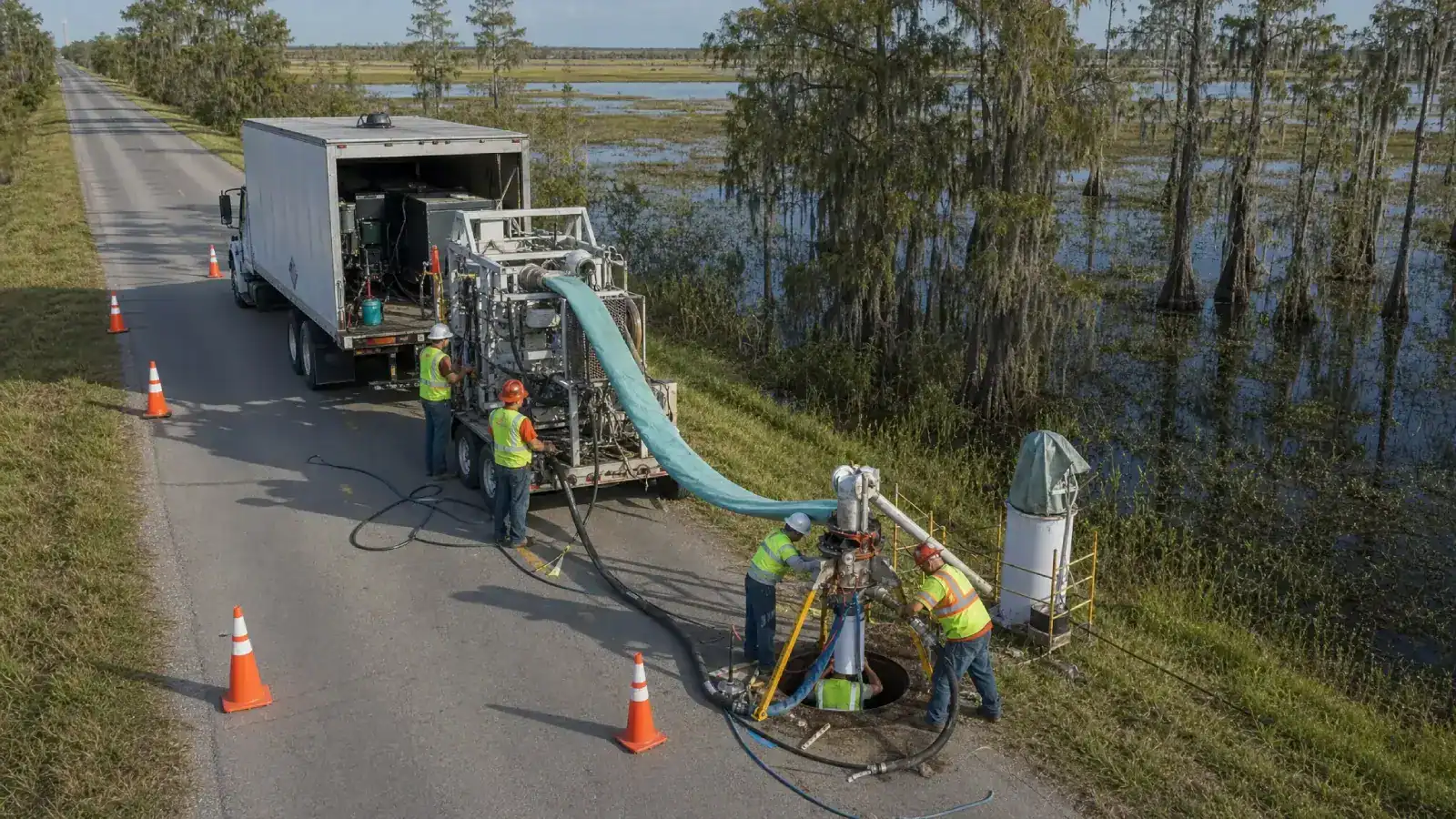
Louisiana’s sewer and stormwater infrastructure faces a double challenge: the Gulf Coast’s climate makes aging underground systems especially vulnerable to flooding and storm damage, and many parish and municipal systems have been deferred for decades due to budget constraints. For public works directors and parish officials looking to move rehabilitation projects forward, the question is rarely whether the need exists — it’s where the money comes from.
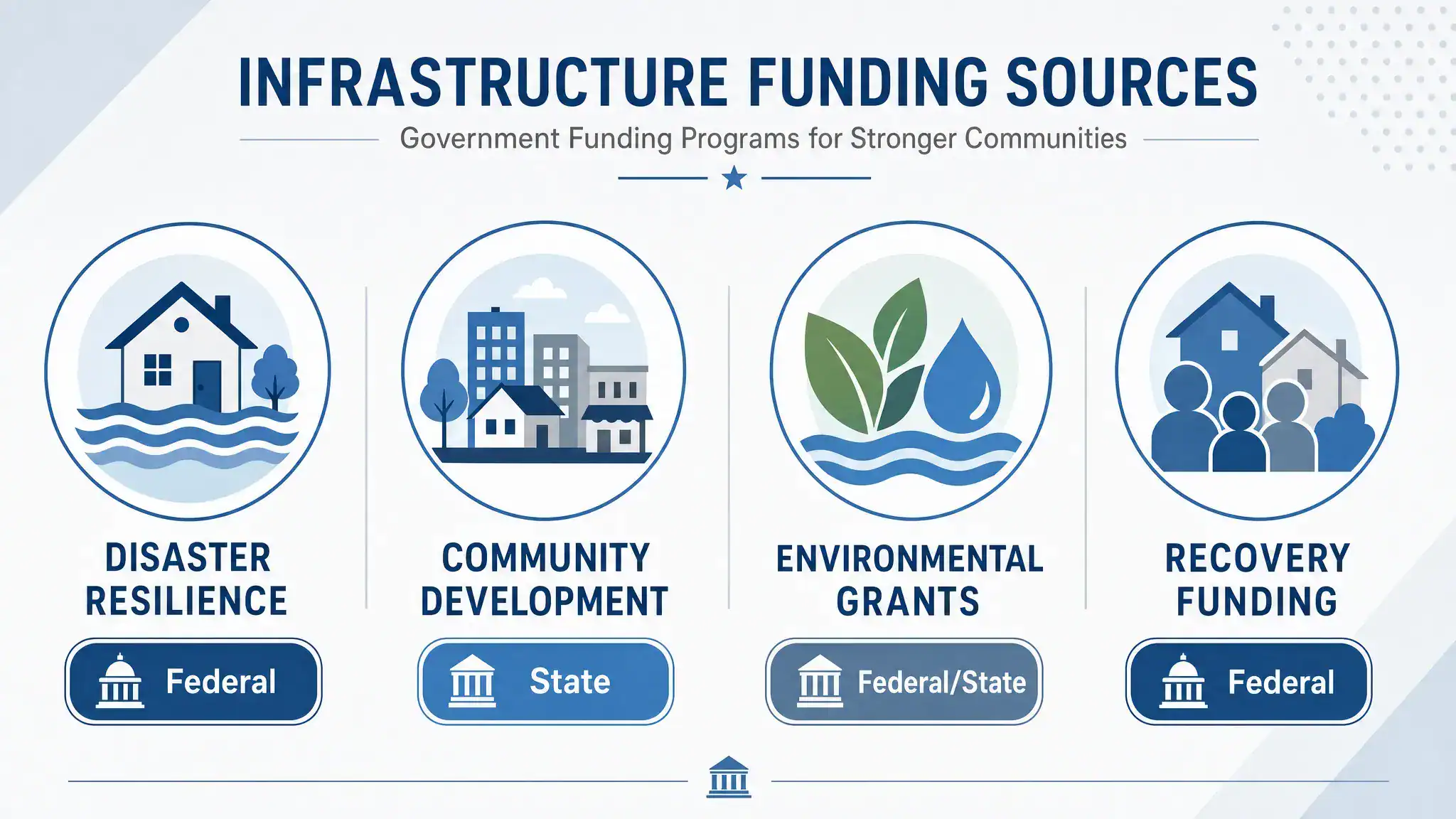
The 2026 federal funding landscape offers a genuine window. FEMA’s BRIC program has been restored with $1 billion available and a July 23, 2026 deadline. The EPA’s Sewer Overflow and Stormwater Reuse Municipal Grant program released $80 million in April 2026. The LCDBG Public Facilities program continues as Louisiana’s primary state-level infrastructure grant source. And CDBG-DR remains available for parishes and municipalities that can document disaster-related infrastructure damage.
This guide breaks down each program — what it funds, who qualifies, how trenchless rehabilitation fits, and what makes a grant application competitive. It’s written for the public works directors, parish engineers, and municipal administrators who are evaluating these programs right now and need actionable information, not boilerplate.
What Grant Programs Are Currently Available to Louisiana Municipalities?
Four programs are the primary funding sources for Louisiana municipal sewer and stormwater rehabilitation in 2026. Each targets a different need and comes with different eligibility requirements, cost-share obligations, and project timelines.
| Program | Administrator | Best For | Federal Share | 2026 Status |
|---|---|---|---|---|
| FEMA BRIC | FEMA / State HMGP Office | Pre-disaster mitigation, infrastructure hardening, stormwater | Up to 75%; 90% for small/impoverished communities | OPEN — deadline July 23, 2026 |
| LCDBG Public Facilities | Louisiana OCD-LGA | Sewer, water, and public infrastructure for non-entitlement communities | ~$11M available statewide; competitive | FY26-27 cycle open |
| EPA OSG | EPA Region 6 / LDEQ | CSO/SSO correction, stormwater management, green infrastructure | Grants to state; 20% non-federal match | $80M announced April 2026 |
| CDBG-DR | HUD / Louisiana OCD-LGA | Disaster-related sewer damage repair or mitigation | Varies; often 100% for disaster recovery activities | Available post-disaster declaration |
What Is FEMA BRIC and Why Does the July 23, 2026 Deadline Matter?
The Building Resilient Infrastructure and Communities program is FEMA’s pre-disaster mitigation grant — the largest competitive federal program specifically for infrastructure hardening before disasters strike rather than after. BRIC was cancelled in 2025, restored by federal court order in early 2026, and the combined FY24-FY25 Notice of Funding Opportunity was published March 25, 2026 with $1 billion available. The deadline is July 23, 2026 at 3:00 PM Eastern.
For Louisiana parishes and municipalities, the practical significance is significant. BRIC’s renewed focus under the current NOFO is on infrastructure construction projects that are shovel-ready — finished designs, completed permits, and documented need. It is not primarily a planning grant in this cycle. Projects that qualify include:
- Utility hardening and sewer system upgrades that reduce flood-related infrastructure failure
- Stormwater system rehabilitation to reduce flood risk to communities
- Critical infrastructure upgrades, including trenchless rehabilitation of deteriorated collection system pipes where failure would worsen flooding or sanitary overflow events
Key application requirements for BRIC: projects must demonstrate cost-effectiveness through a FEMA-approved benefit-cost analysis (BCA) with a ratio of 1.0 or greater. Applicants must have a FEMA-approved local or state Hazard Mitigation Plan. Subapplicants (local governments and parishes) apply through Louisiana’s State Hazard Mitigation Officer and not directly to FEMA.
The federal cost share is up to 75% for most applicants. Small and impoverished communities may qualify for up to 90% federal cost share with reduced or eliminated non-federal match requirements.
Application note: Previous subapplications submitted under the January 2025 BRIC NOFO (which was subsequently cancelled) will NOT be reviewed under the current funding opportunity. If your parish submitted previously and received no award, you must resubmit under the FY24-FY25 NOFO. Contact Louisiana’s State Hazard Mitigation Office immediately — subapplication deadlines to the state may precede the July 23 federal deadline.
How Does the LCDBG Program Support Sewer Rehabilitation Projects?
The Louisiana Community Development Block Grant Public Facilities program, administered by the Louisiana Division of Administration’s Office of Community Development and Local Government Assistance (OCD-LGA), is the state’s primary infrastructure grant source for non-entitlement communities. Louisiana expects to receive approximately $22 million in CDBG funds in the current cycle, with roughly $11 million available specifically for Public Facilities projects.
Eligible applicants are non-entitlement municipalities and parishes — communities that do not receive CDBG funds directly from HUD. Entitlement communities including New Orleans, Baton Rouge, Jefferson Parish, Lafayette Parish, and several others are not eligible for the state LCDBG program.
Eligible project types include sewer system rehabilitation, water system improvements, and other public infrastructure with at least $350,000 in construction costs. Projects must meet one of the CDBG national objectives — most commonly, principal benefit to low- and moderate-income persons (at least 51% of the service area).
The LCDBG program uses a competitive scoring system based on project severity. Sewer projects are scored in part on the condition of the existing system — which is why having documented, objective condition data is essential to a competitive application. A system under a state DEQ or Department of Health compliance order has priority consideration, but documented deterioration even without a compliance order contributes meaningfully to project severity points.
Eligibility check: If your municipality’s sewer system is rated ‘D’ or ‘F’ by Louisiana standards, or is under a DEQ compliance order, you cannot apply for a different type of LCDBG project unless LDH or DEQ approves an exception. This means your sewer rehabilitation project may be the only eligible LCDBG application your community can submit — which makes building the strongest possible application critical.
How Does the EPA Sewer Overflow and Stormwater Reuse Grant Program Work for Louisiana?
The EPA’s Sewer Overflow and Stormwater Reuse Municipal Grant program (OSG) was funded through the Infrastructure Investment and Jobs Act and released $80 million in grants in April 2026 for FY25 and FY26. The program provides grants to states, which in Louisiana are administered through the Louisiana Department of Environmental Quality (LDEQ). Sub-awards flow from LDEQ to eligible local governments.
OSG funds are specifically targeted at projects that address combined sewer overflows (CSOs), sanitary sewer overflows (SSOs), and stormwater management infrastructure. This makes it one of the most directly relevant programs for trenchless sewer rehabilitation — CIPP lining that corrects cracked, infiltrated pipes directly reduces SSO frequency, and stormwater pipe rehabilitation directly addresses the flooding and overflow issues OSG is designed to target.
Key program requirements:
- States must use at least 20% of their allocation for green infrastructure, low-impact development, water and energy efficiency, or other environmentally innovative activities
- Funding is prioritized for small and financially distressed communities — rural Louisiana parishes with aging infrastructure are well-positioned for this program
- A 20% non-federal match is generally required, though this requirement is eliminated for qualifying small and financially distressed communities
- Projects must address documented SSO, CSO, or stormwater infrastructure needs — again making NASSCO PACP condition data directly relevant to the application
Contact for Louisiana’s OSG allocation: EPA Region 6 (covering Louisiana and Arkansas), Miranda Penn at Penn.Miranda@epa.gov, 214-665-7417. For state-level coordination, contact LDEQ’s Clean Water State Revolving Fund program.
When Can CDBG-DR Funds Be Used for Sewer Rehabilitation in Louisiana?
Community Development Block Grant Disaster Recovery funds are appropriated by Congress following specific federally declared disasters and allocated to states for long-term recovery activities. Louisiana has historically been one of the nation’s largest CDBG-DR recipients, given the state’s repeated exposure to major hurricanes and flooding events.
CDBG-DR differs from the other programs in this guide in one critical way: it is reactive rather than proactive. Funds are allocated after a disaster declaration and are specifically tied to damage caused by that disaster. If your parish or municipality has documented sewer or stormwater infrastructure damage from a recent federally declared disaster — Hurricane Ida, the 2016 flooding events, or subsequent storms — CDBG-DR may be available to fund repair, replacement, or mitigation of that specific damaged infrastructure.
Eligible uses under CDBG-DR for infrastructure include repair or replacement of damaged sewer systems, upgrade or rehabilitation of infrastructure to reduce future disaster risk, and construction of stormwater management improvements. Trenchless rehabilitation of disaster-damaged sewer pipe qualifies when the scope can be tied directly to documented disaster damage.
Louisiana’s active CDBG-DR programs are administered through OCD-LGA. Contact OCD-LGA at (225) 342-7412 to confirm current allocation availability for your community and to understand which specific disaster declarations your parish may qualify under.
Which of These Grants Specifically Fund CIPP Lining and Trenchless Rehabilitation?
All four programs can fund CIPP lining and trenchless rehabilitation — but the framing matters. Grant reviewers evaluate projects against program objectives, not construction methods. Here’s how trenchless rehabilitation fits the language of each program:
Framing for BRIC Applications
Frame the project as infrastructure hazard mitigation that reduces the risk of sewer overflow events during storm and flooding conditions. Deteriorated pipe that allows stormwater infiltration to overwhelm the collection system directly contributes to SSOs during flood events — a documented disaster risk. CIPP lining that seals the pipe eliminates that infiltration pathway and reduces future disaster impact. The BCA must quantify this avoided cost.
Framing for LCDBG Applications
LCDBG project scope should be defined by the condition assessment findings and the specific pipe segments requiring rehabilitation. The program doesn’t specify construction methods — it funds the scope of work needed to correct the documented deficiency. Specify trenchless rehabilitation in the engineering report and cost estimate. The project severity package is where the condition data earns points.
Framing for EPA OSG Applications
OSG is the most direct fit for CIPP lining of sewer collection pipes: the program exists specifically to fund SSO and CSO correction, and trenchless rehabilitation of cracked, root-infiltrated, or joint-separated pipe directly reduces SSO frequency. Frame the project around the documented overflow history and the pipe condition data that explains why overflows occur.
Framing for CDBG-DR Applications
CDBG-DR requires a documented nexus to the specific disaster declaration. If the sewer pipe damage is traceable to storm surge, flooding, or ground movement from a covered disaster, CIPP lining or trenchless replacement is an eligible repair method. The engineering report should explicitly link the pipe defects to the disaster event.
How Does a CCTV Condition Assessment Strengthen Your Grant Application?
This is the section most grant guides skip — and it’s the one that most directly determines whether a Louisiana municipality’s application gets funded or passes to an unfunded queue.
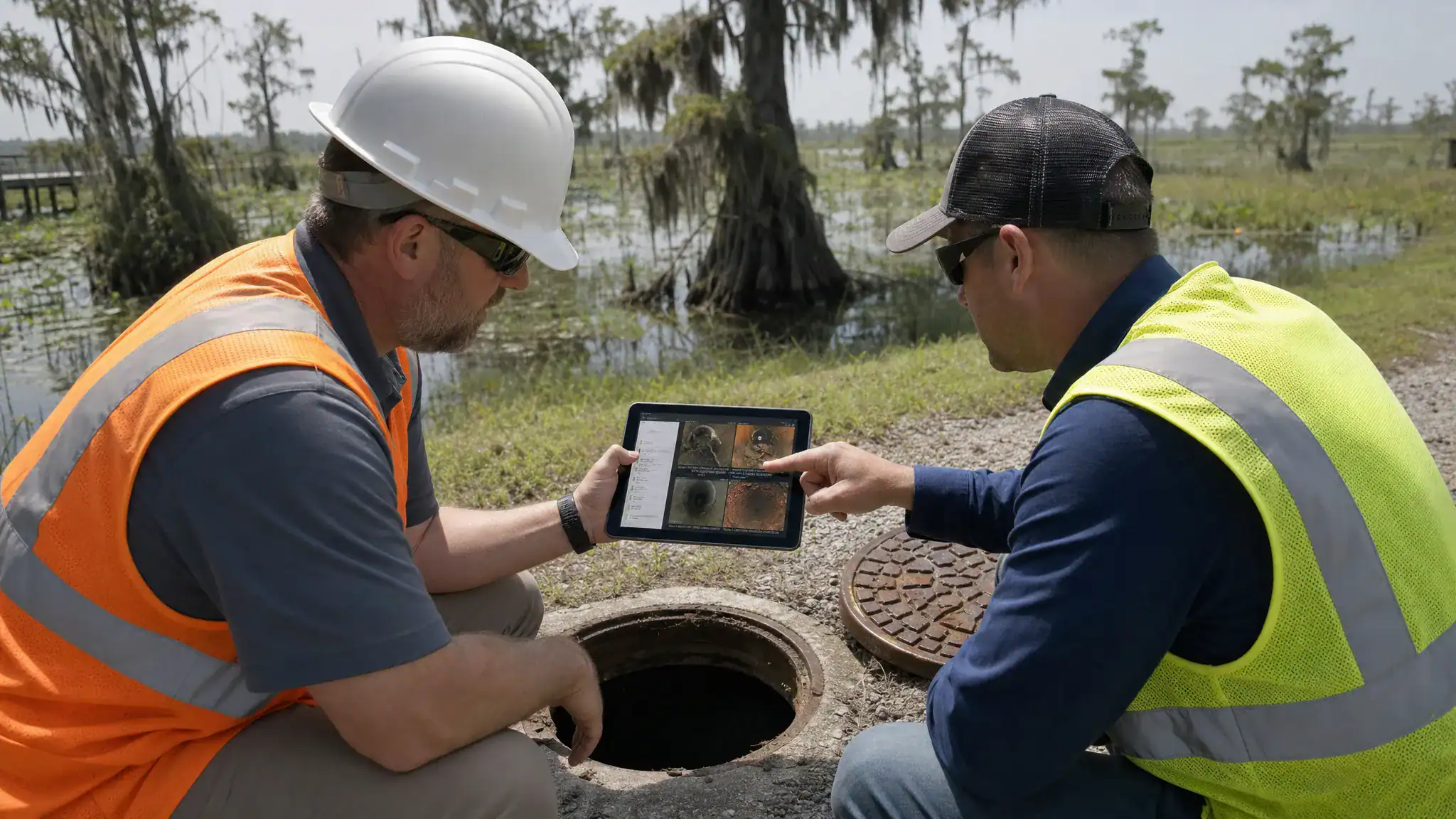
Every major grant program requires applicants to demonstrate that the proposed project addresses a quantified, documented need — not just a perceived one. For sewer rehabilitation, that documentation is a NASSCO PACP-compliant condition assessment report produced from CCTV inspection of the pipe network.
NASSCO’s Pipeline Assessment Certification Program (PACP) is the North American industry standard for coding sewer pipe defects observed during CCTV inspection. Each observed defect is coded using a standardized system and graded on a 1-to-5 severity scale. The resulting report provides:
- A segment-by-segment condition record with standardized defect codes and severity grades
- Quantified data on the extent of infiltration/inflow sources, structural defects, root intrusion, and pipe material condition
- A defensible project scope — specific pipe segments with documented condition grades that justify the rehabilitation method proposed
- Baseline data for the benefit-cost analysis — the BCA required by FEMA cannot be properly constructed without documented pre-project condition data
For BRIC applications specifically, the BCA is the gateway to funding consideration. FEMA will not review a project application that cannot demonstrate a benefit-cost ratio of 1.0 or greater. A condition assessment that documents the frequency and volume of stormwater infiltration, the pipe segments contributing to SSOs, and the estimated cost of future failure provides the quantified foundation the BCA requires.
For LCDBG applications, the project severity scoring system rewards documented condition severity. A NASSCO PACP report with Grade 4 and Grade 5 structural defects across a significant portion of the collection system provides objective, third-party evidence of severity that unsupported engineering opinion cannot.
Pelican’s process: Pelican Underground provides NASSCO-certified CCTV condition assessments and full PACP-compliant reporting for Louisiana municipalities preparing grant applications. We work directly with your engineering team to ensure the condition data is formatted to support both the project severity package and the benefit-cost analysis. A camera inspection conducted before your application deadline is not an overhead cost — it’s the document that gets the grant funded.
How Should You Structure an RFP for a Trenchless Rehabilitation Project?
If your grant application is funded, the next step is procurement. Federal grant funds require compliance with federal procurement standards, and the RFP you issue for trenchless rehabilitation work directly affects grant documentation, contractor qualification, and project delivery.
A well-structured RFP for a CIPP lining or trenchless rehabilitation project should include:
- Scope of work tied to the condition assessment: Reference the NASSCO PACP report by date and inspection contractor. Specify the exact pipe segments, lengths, and diameters included in the project scope based on the condition data.
- Required contractor certifications: For CIPP lining projects, specify that the installation contractor must hold NASSCO ITCP-CIPP certification. This is the industry standard for CIPP installation qualification and supports grant documentation requirements.
- Material standards: For CIPP, specify ASTM F1216 (standard specification for rehabilitation of existing pipelines and conduits by the inversion and curing of a resin-impregnated tube). For pipe bursting, specify ASTM F1573. These ASTM references satisfy federal procurement’s requirement for clear technical specifications.
- Pre-installation cleaning: Specify that all pipe segments must be cleaned by hydrojetting and re-inspected by CCTV before lining installation. Post-CIPP re-inspection with CCTV is typically required for grant documentation.
- Flow bypass requirements: Address how the collection system will handle flow during rehabilitation — bypass pumping specifications are a critical construction planning element that affects cost and bid comparability.
- Warranty terms: Specify a minimum warranty period (typically 10 years for CIPP systems). Document warranty terms in the contract as grant closeout requires verification that the completed work meets the specified scope.
- Prevailing wage requirements: All federally funded projects over applicable thresholds are subject to Davis-Bacon Act prevailing wage requirements. Include the applicable wage determinations in the RFP.
For grants administered through OCD-LGA, the procurement documents must comply with both federal regulations (2 CFR Part 200) and Louisiana state procurement law. OCD-LGA staff review procurement documents as part of the grant agreement process — starting from a solid RFP reduces back-and-forth and accelerates project startup.
TL;DR — Louisiana Municipal Sewer Grant Guide 2026 at a Glance
- FEMA BRIC: $1 billion available, July 23, 2026 deadline, up to 75-90% federal cost share. Best for infrastructure mitigation projects. Subapply through Louisiana’s State Hazard Mitigation Office — don’t wait.
- LCDBG Public Facilities: ~$11 million available statewide for non-entitlement communities. Competitive scoring rewards documented condition severity. Projects must benefit low- and moderate-income populations.
- EPA OSG: $80 million in 2026 specifically for SSO, CSO, and stormwater infrastructure. Priority for small and financially distressed communities. Administered through LDEQ in Louisiana.
- CDBG-DR: Available post-disaster for documented infrastructure damage. All programs can fund CIPP lining and trenchless rehabilitation when properly framed.
- A NASSCO PACP condition assessment is the single most important document for any of these applications — it provides the quantified project scope, supports the benefit-cost analysis, and creates a defensible grant record.
- Contact Pelican Underground to schedule a free camera inspection for your municipality — we provide NASSCO-certified CCTV inspections and PACP-compliant reports and work directly with Louisiana municipalities and their engineering consultants to build the documentation foundation that gets grant applications funded.
Frequently Asked Questions
Does FEMA BRIC fund trenchless sewer rehabilitation like CIPP lining?
Yes, when the project is properly framed as infrastructure hazard mitigation. CIPP lining of deteriorated sewer pipes that contribute to sanitary sewer overflows during storm events qualifies as an eligible infrastructure construction project under the FY24-FY25 BRIC NOFO. The application must demonstrate a benefit-cost ratio of 1.0 or greater using FEMA’s approved BCA methodology, and the project must be tied to a FEMA-approved Hazard Mitigation Plan. The deadline to apply is July 23, 2026.
Which Louisiana municipalities are eligible for LCDBG sewer grants?
Non-entitlement municipalities and parishes are eligible for the LCDBG Public Facilities program. Entitlement communities — including Alexandria, Baton Rouge, Bossier City, Hammond, Jefferson Parish, Kenner, Lafayette Parish, Lake Charles, Monroe, New Orleans, and St. Tammany Parish — receive CDBG funds directly from HUD and are not eligible for the state LCDBG program. For the current FY26-27 cycle, contact OCD-LGA at (225) 342-7412 to confirm your community’s eligibility status.
How does a CCTV condition assessment help with a grant application?
A NASSCO PACP-compliant condition assessment transforms CCTV footage into structured, scored condition data for each pipe segment. For BRIC, this data is essential to constructing a valid benefit-cost analysis. For LCDBG, it directly contributes to project severity scores. For EPA OSG, it documents the SSO-contributing infrastructure being rehabilitated. Condition data is one of the most significant differentiators between funded and unfunded sewer rehabilitation applications — it replaces subjective need claims with objective, third-party evidence.
Can CDBG-DR funds be used for sewer rehabilitation in Louisiana?
Yes, when the infrastructure damage is tied to a specific federally declared disaster. Louisiana has received CDBG-DR allocations following multiple major disasters, and eligible uses include sewer and stormwater infrastructure repair, rehabilitation, and mitigation. Trenchless rehabilitation qualifies when the scope is tied to documented disaster damage. Contact OCD-LGA to confirm which disaster declarations your community may qualify under and what allocations remain available.