
Trenchless sewer repair in Louisiana, Mississippi, and Alabama typically costs between $3,500 and $15,000 for a standard residential job. That is significantly less than traditional open-cut excavation, which can run $11,000–$38,000 once you factor in excavation, backfill, pavement restoration, and landscape repair.
This guide covers real 2026 price ranges for every trenchless repair method, what drives costs up or down, state-by-state context for Louisiana, Mississippi, and Alabama, and how to get an accurate estimate for your property.
| Method | Cost Per Linear Foot | Typical Residential Total | Completion Time |
|---|---|---|---|
| CIPP Lining | $80–$250 | $4,000–$12,000 | 1 day |
| Pipe Bursting | $60–$200 | $3,500–$10,000 | 1–2 days |
| Sewer Camera Inspection | N/A | $250–$500 | 1–2 hours |
| Hydro Jetting | N/A | $300–$800 | 2–4 hours |
| Point Repair | N/A | $500–$2,500 | 2–4 hours |
| Traditional Excavation (for comparison) | $50–$150 pipe only | $8,000–$25,000+ total | 3–7 days |
Trenchless methods save homeowners 30–50% overall compared to open-cut replacement once all costs are included — not just the pipe work, but excavation, labor, pavement resurfacing, and landscape restoration.
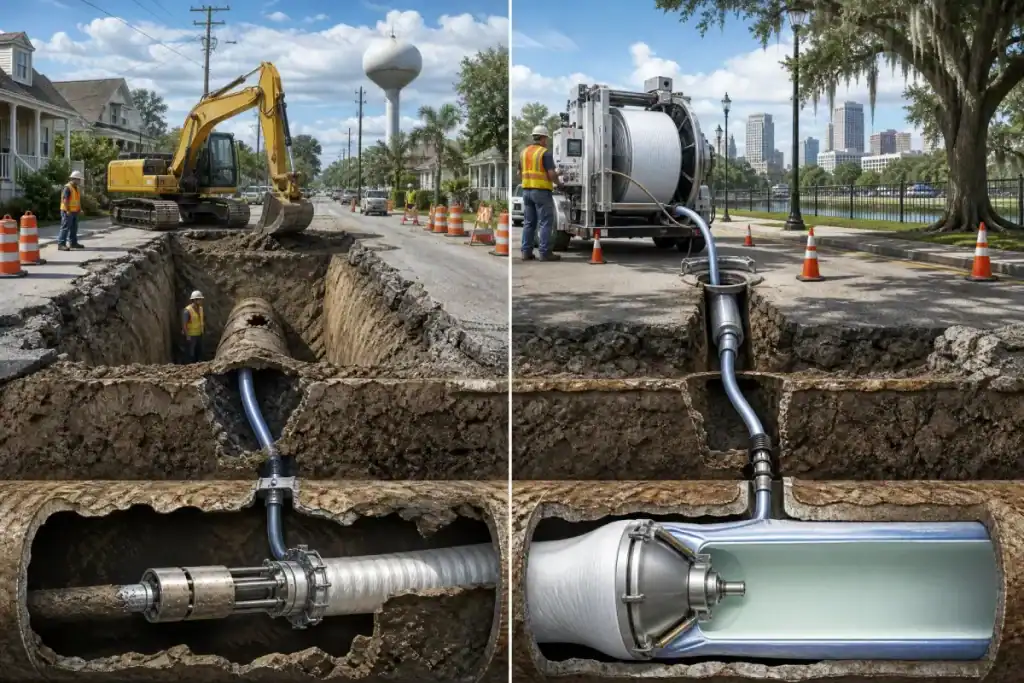
CIPP lining — cured-in-place pipe lining — inserts a resin-saturated liner into your existing pipe and cures it to form a seamless new pipe inside the old one. It is the most common trenchless repair method and works on cast iron, clay, concrete, and HDPE pipes.
What you will pay:
All CIPP installations by Pelican Underground comply with ASTM F1216 standards for pipeline rehabilitation, ensuring structural integrity for 50+ years.
What pushes the cost higher:
Pipe bursting is used when the host pipe is collapsed, severely offset, or structurally incapable of accepting a liner. A bursting head fractures the old pipe outward while simultaneously pulling a new HDPE pipe into place — requiring only two small access pits, no excavation trench.
What you will pay:
What pushes the cost higher:
Every trenchless repair starts with a sewer camera inspection. There is no accurate way to quote a repair without first seeing the condition, location, and material of the damaged pipe.
What you will pay:
Pelican Underground applies the inspection fee toward your repair cost when you proceed with service. NASSCO-certified technicians conduct all inspections using PACP, MACP, and LACP assessment protocols.
Hydro jetting uses high-pressure water to clear grease, roots, scale, and debris from sewer lines. It is often performed before CIPP lining to prepare the pipe surface, and as a standalone service for blockage clearance.
What you will pay:
Point repairs target a single damaged section of pipe rather than the full run. When damage is isolated to one area — a cracked joint, a root entry point, or a small collapse — a point repair is the most cost-effective solution.
What you will pay:
This is where trenchless methods deliver their biggest advantage. Traditional open-cut pipe replacement is priced per linear foot for the pipe work alone. The full cost picture includes excavation, backfill, pavement restoration, and landscape repair.
| Cost Category | Trenchless | Traditional Excavation |
|---|---|---|
| Pipe repair or replacement | $4,000–$15,000 | $5,000–$15,000 |
| Excavation and backfill | Included (2 small pits only) | $3,000–$8,000 |
| Pavement or driveway restoration | $0 | $2,000–$10,000 |
| Landscape restoration | $0 | $1,000–$5,000 |
| Project duration | 1–2 days | 3–7 days |
| Typical total cost | $4,000–$15,000 | $11,000–$38,000 |
For New Orleans-specific pricing including neighborhood-level cost factors, see our detailed Trenchless Sewer Repair Cost Guide for New Orleans.
Pipe length — Most residential sewer laterals run 40–100 feet from your home to the municipal main. Longer runs cost more, but cost per foot typically decreases on longer jobs.
Pipe diameter — Standard residential sewer pipe is 4–6 inches in diameter. Commercial and municipal pipe runs 8–36 inches and requires more liner material and specialized equipment.
Pipe depth — Pipes buried deeper than 8 feet require more time and equipment to set up access pits, increasing overall labor cost.
Pipe condition — A pipe with moderate cracking is straightforward to line. A pipe with severe root intrusion needs robotic cutting first. A fully collapsed pipe requires pipe bursting instead of lining.
Access difficulty — Pipes under concrete slabs, paved driveways, or roads require more complex access setup than pipes under lawn or landscaping.
Number of bends — Multiple bends in the pipe run increase liner installation complexity. Each significant bend adds time and cost.
Cure method — Ambient cure CIPP is the least expensive option. Steam cure and UV cure are faster and may be required for certain applications, adding 10–20% to the liner cost.

Louisiana has some of the most challenging underground infrastructure conditions in the country. A combination of high water tables, expansive clay soils, aging cast iron pipe systems, and hurricane-related ground movement creates higher pipe deterioration rates than most U.S. states — and increases the complexity of trenchless repairs.
Louisiana cost factors:
Typical Louisiana price ranges:
Pelican Underground is licensed through the Louisiana State Licensing Board for Contractors for all underground infrastructure work across the state.
Mississippi’s Gulf Coast cities — Biloxi, Gulfport, and Ocean Springs — share similar coastal soil challenges with Louisiana. Inland Mississippi cities like Madison, Ridgeland, and Oxford deal more with clay soil movement and aging clay pipe systems installed during the 1950s and 1960s.
Mississippi cost factors:
Typical Mississippi price ranges:
Alabama’s coastal markets — Mobile and Gulf Shores — mirror Louisiana and Mississippi Gulf Coast conditions with tidal groundwater fluctuation and saltwater corrosion. Inland Alabama generally has lower water tables, making access simpler and costs slightly lower than coastal Louisiana.
Alabama cost factors:
Typical Alabama price ranges:
A proper written estimate from Pelican Underground breaks down:
Estimates given over the phone without a camera inspection are not accurate quotes. Any contractor quoting a trenchless repair without first inspecting the pipe is guessing.
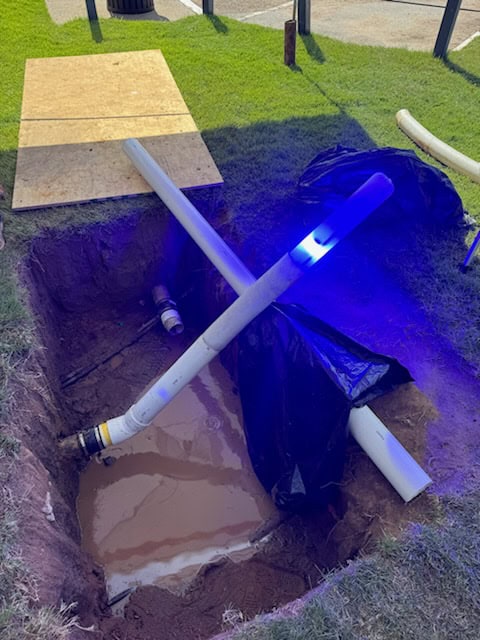
Every trenchless repair at Pelican Underground starts with a sewer camera inspection. This is the only way to accurately identify the pipe material, location of damage, and correct repair method before any pricing is provided.
Our NASSCO-certified technicians provide a written, itemized estimate after the inspection — breaking down material, labor, and access costs with no surprises at the end of the job.
Ready to get a real number? Call us at (504) 387-9909 or request a free inspection online. We serve Louisiana, Mississippi, and Alabama — see our full service areas.
CIPP lining costs $80–$250 per linear foot depending on pipe diameter, depth, access difficulty, and cure method. Most residential jobs in Louisiana, Mississippi, and Alabama total $4,000–$12,000.
Yes — in almost every case. While the pipe work itself is comparable in price, trenchless methods eliminate $3,000–$18,000 in excavation, pavement restoration, and landscape repair costs that open-cut jobs require.
It depends on your policy. Standard homeowners insurance typically does not cover sewer line repair, but sewer line coverage riders are available from most insurers. Read more in our guide on whether homeowners insurance covers sewer line repair.
CIPP lining carries a 50-year material warranty and is rated for 50–75 years of service life under ASTM F1216. Pipe bursting installs HDPE pipe rated for 50+ years. Read more about how long pipe lining lasts.
Homeowners are responsible for the sewer lateral — the pipe running from your home to the municipal main. The city or parish owns the main sewer line. Read our full guide on who is responsible for sewer line repair.