
Quick Answer: Power plant drain cleaning in Louisiana calls for high-pressure hydrojetting because cooling tower drift deposits scale, coal and ash handling systems generate heavy slurry, and turbine building floor drains collect oil and metal particulate that ordinary snaking cannot remove. Industrial hydrojetting runs at 10,000 PSI or higher with high water volume (GPM) to fully scour pipe walls without excavation. Because power plants involve confined spaces and live electrical infrastructure, every job follows confined space entry, arc flash, and hot work permit protocols coordinated with plant safety officers — procedures Pelican Underground LLC already knows before arriving on site.
Why Do Power Plants Generate Recurring Drain Cleaning Needs?
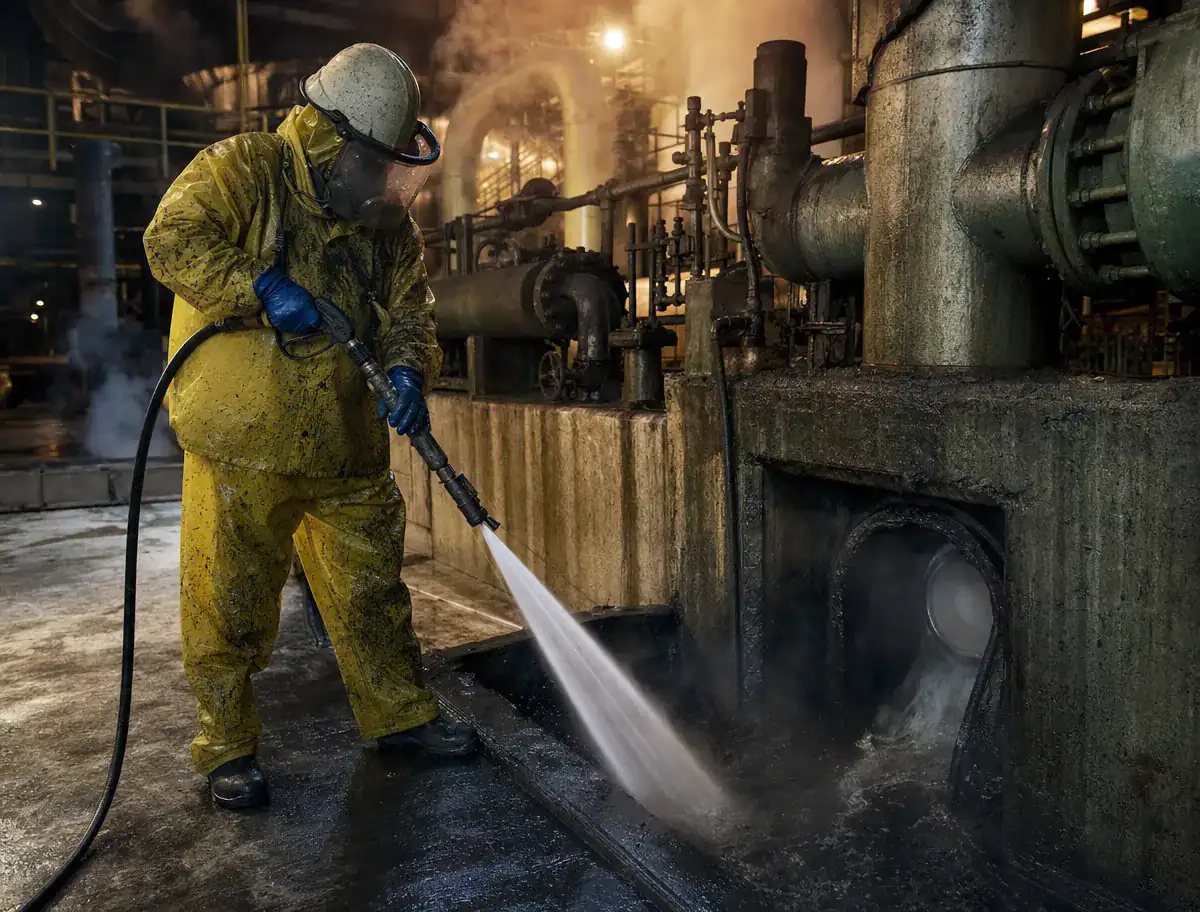
Unlike a typical commercial building, a power plant produces three distinct waste streams that overwhelm drains on a predictable cycle. Cooling tower drift carries dissolved minerals into discharge drains, where evaporation concentrates calcium and silica into hard scale that narrows pipe diameter month over month. Coal and ash handling systems move slurry — a mix of fine particulate and water — through floor drains and sumps that were never designed for continuous heavy-solids flow. Turbine building floor drains, meanwhile, collect lubricating oil, hydraulic fluid, and metal shavings from routine maintenance, creating a coating that ordinary detergent-and-snake service cannot fully clear.
Because these piping systems fall under standards such as ASME’s B31.1 Power Piping Code, plant engineers expect a documented maintenance record, not a one-time reactive fix. That is why scheduled industrial drain cleaning services built around routine hydrojetting, rather than emergency calls, keep turbine, cooling tower, and ash-handling drains compliant year-round.
How Does Industrial-Scale Hydrojetting Differ From Residential Pressure Washing?
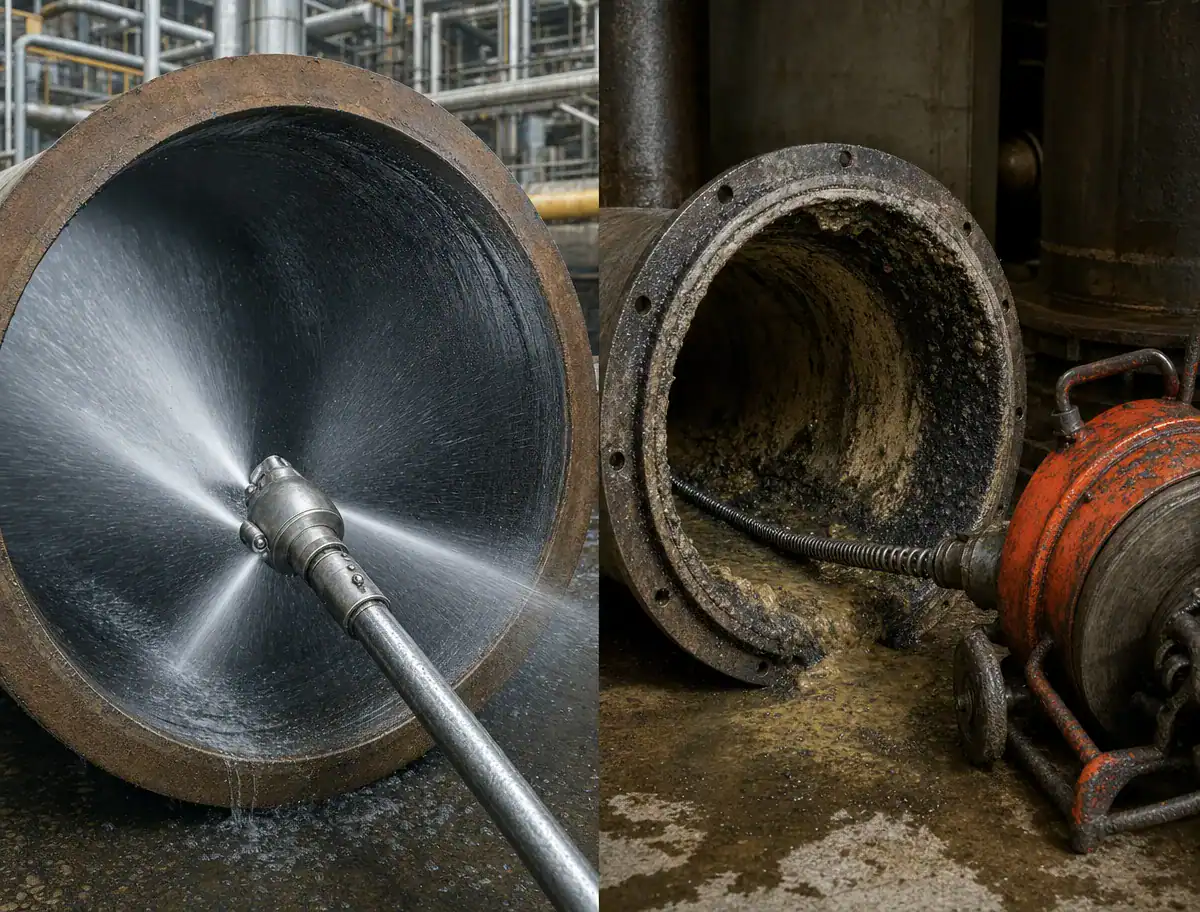
Pressure alone does not clean a power plant drain — volume finishes the work pressure starts. Residential and light-commercial hydrojetting runs 3,000 to 4,000 PSI, enough for grease and root intrusion in a 4-inch home lateral. Industrial power plant lines call for 10,000 PSI or higher, paired with a water volume (GPM) rated to match pipe diameter and blockage density, because scale, slurry, and cured sludge require sustained flow to fully clear the pipe wall rather than punch a narrow channel through it.
- Residential / light-commercial: 3,000-4,000 PSI, lower GPM, small-diameter lines
- Industrial / power plant: 10,000+ PSI, high GPM, large-diameter and heavy-solids lines
- Pressure clears the path; GPM carries the loosened debris out of the line
- Undersized GPM at high pressure can leave residual buildup even when a line “looks” clear on camera
Our high-pressure hydrojetting equipment is calibrated to the pipe material and diameter documented during the pre-service camera inspection, consistent with the operating ranges outlined in OSHA’s Technical Manual on high-pressure water jetting.
What Safety Protocols Govern Drain Cleaning Inside a Power Plant?
A power plant is not a typical hydrojetting jobsite. Many of the drains that need cleaning sit inside confined spaces — sumps, pits, and below-grade vaults — that require atmospheric testing, ventilation, and a documented entry permit before any crew member goes below grade. Live electrical infrastructure throughout the turbine and switchyard areas means every technician on our crews maintains arc flash awareness and keeps the minimum approach distances specified in OSHA’s electric power generation safety standard (29 CFR 1910.269). Any work involving grinding, cutting, or open flame near a drain line requires a hot work permit signed off by your facility before we begin.
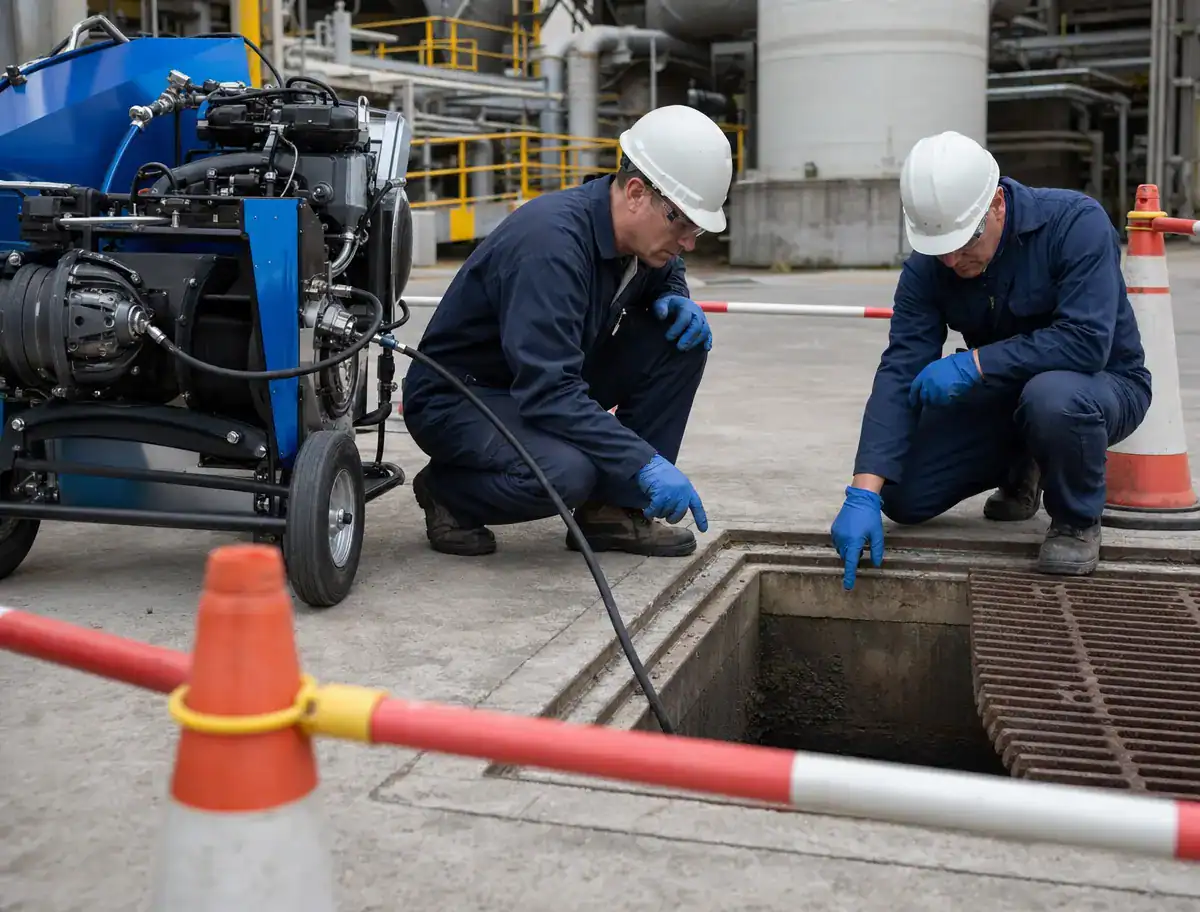
We build our field procedures around the same inspection and hazard-recognition framework OSHA’s enforcement directive for electric power facilities uses when evaluating power generation sites, and we draw on CDC NIOSH’s engineering controls research when recommending containment for higher-pressure operations. In practice, that means our project lead checks in with your plant safety officer before mobilizing equipment, confirms lockout/tagout status on any adjacent electrical gear, and stages the job so hydrojetting never proceeds until every permit — confined space, hot work, and electrical clearance — is signed.
Need Drain Cleaning That Already Knows Your Safety Protocols?
Pelican Underground LLC’s crews arrive with confined space, arc flash, and hot work training already in place, so there is no onboarding delay before we can start. Contact us to schedule a site walk with your plant safety officer.
What Preventive Maintenance Schedule Keeps Power Plant Drains Clear?
Reactive drain service costs more than scheduled maintenance once a plant accounts for unplanned downtime. We build preventive maintenance schedules around how fast each drain type fouls:
| Drain Type | Recommended Cleaning Frequency | Primary Concern |
|---|---|---|
| Turbine building floor drains | Monthly | Oil, hydraulic fluid, metal particulate |
| Cooling tower discharge drains | Quarterly | Calcium / mineral scale from drift |
| Storm drains | Annually | Sediment, debris, seasonal buildup |
Facilities running heavier ash or slurry volumes may need to shorten these intervals, and our team adjusts the schedule after the first CCTV inspection establishes a baseline. Storm drain systems in particular benefit from a documented annual check — see our storm drain maintenance service for the inspection standard we apply.
Why Does CCTV Inspection Follow Every Hydrojetting Service?
Hydrojetting clears what is inside a pipe; it does not tell you the condition of the pipe wall underneath. After every industrial cleaning pass, we run a CCTV sewer camera inspection to document the line’s interior and determine whether the drain simply stays on its maintenance schedule or whether scale and corrosion have thinned the wall enough to warrant lining. Where the footage shows a structurally sound but heavily scaled or pitted line, CIPP pipe lining restores a smooth, corrosion-resistant interior without excavation — a common outcome for older cast-iron and steel drain runs inside Louisiana power plants.
What Do We Find Inside Power Plant Drains?
Every industrial facility has its own signature buildup, and camera inspection consistently turns up three materials that residential and light-commercial jobs rarely produce:
- Resin/epoxy curing waste — residue from previous coating or lining work, or from nearby industrial processes, that hardens inside the drain if it isn’t flushed before it sets.
- Calcium carbonate scale — mineral deposits concentrated by cooling tower evaporation, which narrow pipe diameter and eventually restrict flow enough to back up floor drains.
- Iron oxide sludge — corrosion byproduct from aging cast-iron and steel piping, often mixed with sediment, that accumulates at low points and bends in the line.
Identifying which of these is driving a given clog changes both the cleaning approach and the disposal requirements, which is also why waste characterization matters as much as the hydrojetting itself (see the FAQ below).
Frequently Asked Questions
How do you handle hazardous waste from drain cleaning at an industrial facility?
Industrial drain cleaning at a power plant generates wastewater and residuals — flue gas desulfurization byproducts, ash transport water, oily sludge — that can qualify as regulated discharge under EPA’s Steam Electric Power Generating Effluent Guidelines and EPA’s 2024 final rule on power plant wastewater discharge. We containerize and characterize every waste stream on-site and dispose of it according to Louisiana DEQ’s Water Permits Division requirements rather than routing it into a storm drain or sanitary line.
Do you provide waste disposal manifests?
Yes. Every industrial job includes documented chain-of-custody paperwork for waste removal, following Louisiana DEQ’s industrial wastewater discharge permit instructions and, where a short-term or emergency discharge applies, Louisiana’s general water discharge permit regulations, so your facility’s environmental compliance file is complete before we leave the site.
How often should power plant drains be inspected and cleaned?
As a baseline: turbine building floor drains monthly, cooling tower discharge drains quarterly, and storm drains annually. Facilities with heavier ash or slurry handling often need shorter intervals, which we confirm after the first CCTV inspection.
What PSI and GPM do you use for power plant hydrojetting?
Industrial hydrojetting for power plant drains typically runs at 10,000 PSI or higher, well above the 3,000-4,000 PSI used for residential lines, paired with water volume (GPM) calibrated to pipe diameter — flow volume moves debris out of the line, so pressure alone isn’t the full story.
Do you coordinate with our plant safety officers before every job?
Yes. Our crews complete confined space entry, arc flash awareness, and hot work permitting before mobilizing, and our project lead checks in with your plant safety officer to confirm lockout/tagout status and site-specific requirements before equipment goes on-site.
TL;DR — Power Plant Drain Cleaning in Louisiana at a Glance
- Cooling tower drift, coal/ash slurry, and turbine floor drain oil residue are the three recurring causes of power plant drain buildup in Louisiana.
- Industrial hydrojetting runs 10,000+ PSI with high GPM — well beyond residential 3,000-4,000 PSI equipment.
- Confined space entry, arc flash awareness, and hot work permits are standard on every power plant job, coordinated with your plant safety officer.
- A preventive schedule (turbine monthly, cooling tower quarterly, storm drains annually) prevents most emergency calls.
- CCTV inspection after every cleaning determines whether a drain needs lining — contact Pelican Underground LLC to get your facility on a maintenance schedule.
Related Resources
- Pipe Lining Services
- Industrial Drain Cleaning in New Orleans, LA
- Epoxy Pipe Lining in Louisiana
- CIPP Lining Contractor in Baton Rouge
- Vertical Stack Lining in Louisiana
- How Long Does Pipe Lining Last?
Get a Free Power Plant Drain Cleaning Quote in Louisiana
Pelican Underground LLC brings NASSCO-credentialed technicians, confined space and arc flash training, and 10,000+ PSI hydrojetting equipment to power plants across Louisiana. Contact us to schedule a site assessment with your plant safety officer and get a preventive maintenance schedule built around your turbine building, cooling tower, and storm drain systems.
About Pelican Underground LLC — Pelican Underground LLC is a New Orleans, LA-based trenchless pipe rehabilitation contractor serving industrial and commercial facilities across Louisiana, Mississippi, and the Gulf Coast. Our NASSCO-credentialed technicians provide high-pressure hydrojetting, CCTV sewer camera inspection, CIPP pipe lining, and pipe bursting services built around each facility’s safety protocols and compliance requirements.
