
Quick Answer: Paper mill pipe lining in Louisiana uses cured-in-place pipe (CIPP) to rebuild corroded black liquor drains, pulp washing drains, effluent treatment piping, cooling water drains, and chip yard stormwater lines from the inside, without excavating active mill grounds. A resin-saturated liner, typically chemical-resistant vinyl ester for alkaline kraft waste, cures into a jointless pipe-within-a-pipe that stops infiltration and exfiltration. Work fits planned outages or runs with bypass pumping, helping mills protect production and NPDES and LPDES permit compliance. CIPP is not used for high-pressure steam or white liquor lines.
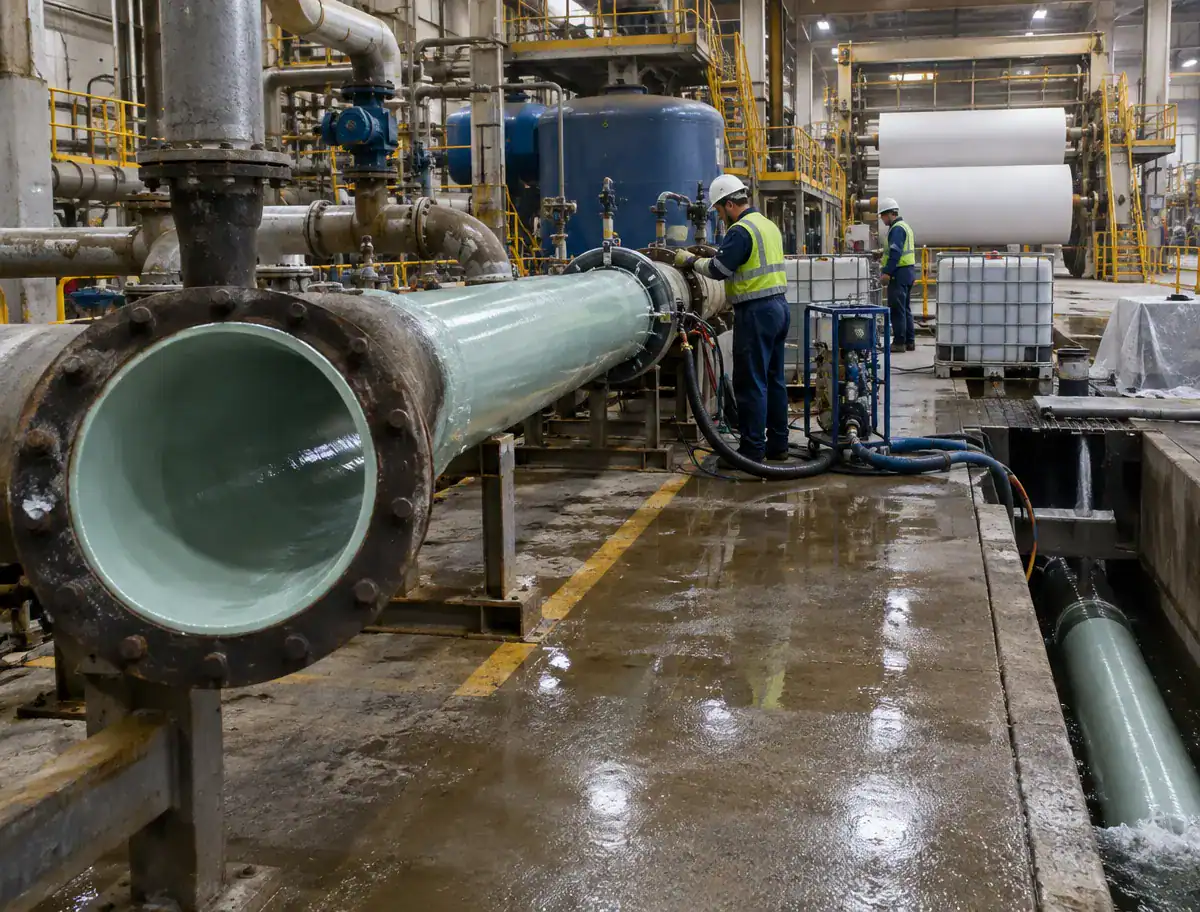
Paper mill process effluent lines in Louisiana demand corrosion-resistant rehabilitation, and cured-in-place pipe (CIPP) lining delivers that protection. We install resin-saturated liners that cure into jointless, structural pipe-within-a-pipe systems, reducing infiltration and chemical degradation. Our crews hold NASSCO PACP/MACP/LACP credentials, ensuring compliant, camera-verified results for industrial and municipal wastewater infrastructure across Louisiana facilities.
Louisiana’s pine timber resources support active kraft and containerboard production, with major pulp and paper facilities in Bogalusa, Bastrop, and the Shreveport area. The kraft process relies on sodium hydroxide and sodium sulfide, so the drain systems beneath these mills carry highly alkaline waste streams that attack unprotected pipe. Good CIPP candidates in a mill include black liquor drainage, pulp washing drain systems, effluent treatment plant piping, cooling water drains, chip yard stormwater drainage, and building sanitary systems. High-pressure steam and white liquor lines are not lining candidates. Technical guidance from the Technical Association of the Pulp and Paper Industry (TAPPI) is a useful reference for mill engineers comparing process conditions.
What Are the Key Takeaways for Paper Mill Pipe Lining?
- CIPP technology rehabilitates over 19,000 miles of wastewater infrastructure globally with proven effectiveness.
- Pelican Underground LLC serves New Orleans with advanced pipe lining for sanitary sewers and storm systems.
- CIPP process restores force mains, electrical conduit, vent stacks, and municipal gravity sewers without full replacement.
- Wastewater effluent systems benefit from CIPP rehabilitation, extending pipeline lifespan and reducing infrastructure replacement costs.
Why Do Paper Mill Effluent Lines Fail in Louisiana?
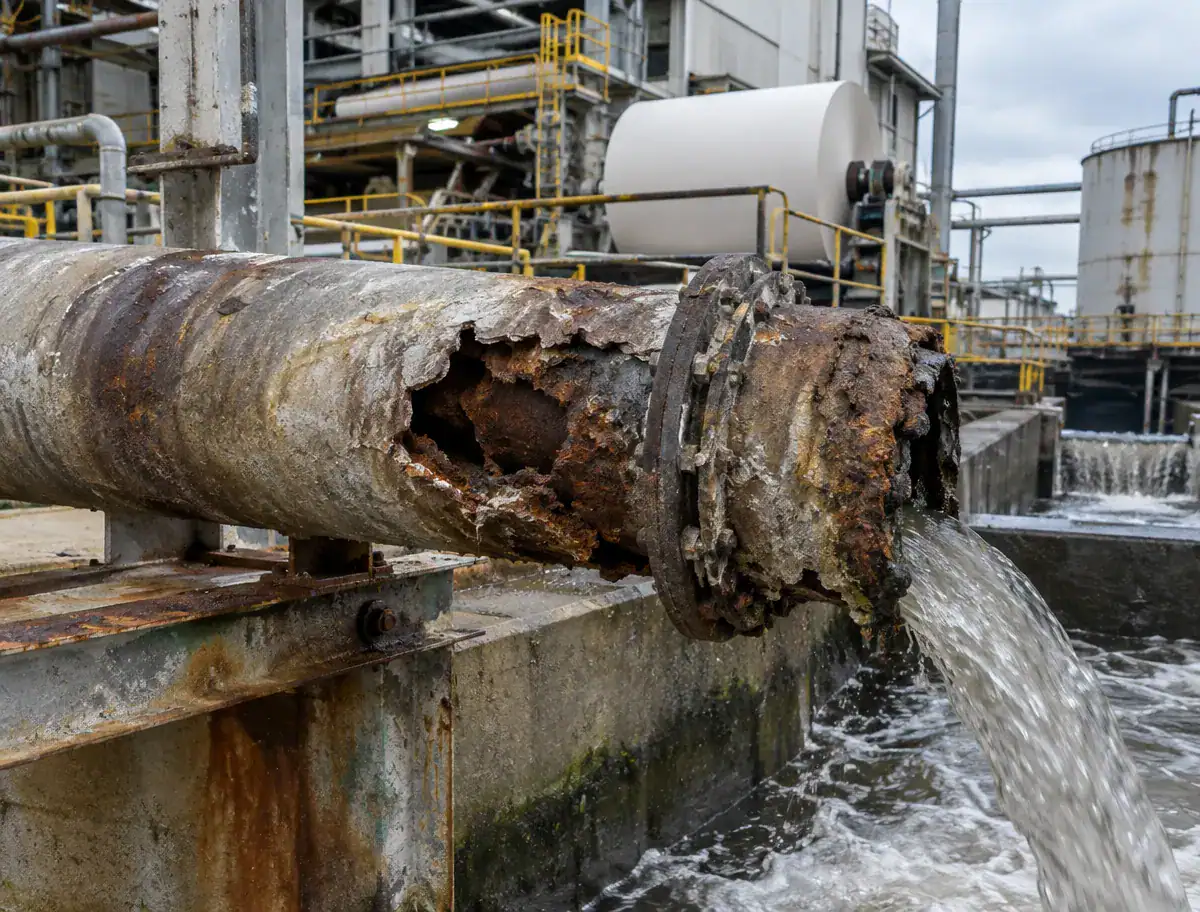
Corrosive chemical exposure, constant high-volume flow, and aging pipe networks combine to break down effluent lines at pulp and paper facilities across Louisiana. Process wastewater at these plants carries acidic byproducts and abrasive solids that erode traditional pipe materials year after year. Left unaddressed, a single failed segment shuts down production lines and triggers costly regulatory scrutiny.
Louisiana holds a distinct place in the science behind trenchless repair. Research on cured-in-place pipe performance traces back to the Trenchless Technology Center at Louisiana Tech University, one of the state’s own institutions. That foundation gives Louisiana facility managers access to engineering data grounded close to home, not imported from unrelated regions.
Paper mill pipe lining Louisiana applications work because cured-in-place pipe, or CIPP, was engineered specifically for wastewater pipeline repair. The method rehabilitates sanitary sewers, storm sewers, force mains, and vent stacks, all lines that mirror the sanitary and process effluent networks running beneath mill floors.
Drain failures also carry a regulatory cost. Paper mills discharge under federal National Pollutant Discharge Elimination System (NPDES) permits and state-issued LPDES permits, and must meet the EPA’s pulp, paper, and paperboard effluent guidelines. Groundwater infiltration into drain systems, or exfiltration of process waste out of them, can trigger permit violations and fines, which makes lining both a maintenance and a compliance solution.
Can Lining Handle Large Industrial Pipe Diameters?
Yes. Recent engineering advances now allow trenchless lining across a diameter range spanning two inches up to 36 inches and above in certain cases. That range covers the oversized process effluent trunk lines typical of heavy industrial operations, not just residential-scale plumbing.
Common failure points we encounter in industrial effluent systems include:
- Chemical degradation from acidic or caustic process discharge
- Root intrusion at joint connections in older clay or cast-iron runs
- Sediment buildup from pulp fiber and process solids
- Joint separation caused by ground shifting under heavy plant loads
We evaluate each of these conditions before recommending a lining approach for Louisiana mill infrastructure.
📞 Planning a Mill Drain Rehab? Pelican Underground LLC inspects and lines pulp, process, and effluent drains at Louisiana paper mills, scheduled around your planned outages. Request a paper mill drain assessment to get a camera-verified condition report and lining plan.
What Happens During the CIPP Lining Process?
Cured-in-place pipe rehabilitation applies a resin-saturated liner inside a deteriorated pipe, then cures it into a durable replacement without excavation. We install this technology for pulp, paper, and heavy industrial facilities across Louisiana that cannot afford extended shutdowns or torn-up process yards. The method traces back to a company called Insituform, which pioneered the original CIPP process now applied across industrial and municipal pipelines alike. Today, inversion-installed liners are specified under ASTM F1216, the standard practice for rehabilitating pipelines with a resin-impregnated tube.
Our crews follow a defined sequence for every paper mill pipe lining Louisiana project:
- Inspection: We run sewer camera inspection diagnostics to confirm pipe condition and confirm the lining plan.
- Preparation: Technicians clean the pipe interior with hydro-jetting to remove scale, grease, and debris.
- Liner insertion: A resin-saturated felt tube gets pulled or inverted into the host pipe.
- Curing: Heat, steam, or UV light hardens the liner into a rigid, jointless replacement pipe.
- Final inspection: We re-inspect with camera equipment to confirm structural integrity before returning the line to service.
Which pipe types can CIPP rehabilitate at an industrial site?
CIPP rehabilitation applies to sanitary sewers, storm sewers, force mains, electrical conduit, and vent stacks. This range covers most pipe categories present in a mill’s effluent and process water system. Facility managers overseeing mixed piping networks in Louisiana benefit from a single method addressing multiple line types rather than coordinating separate repair contractors.
Is CIPP proven technology for heavy industrial use?
Global adoption exceeding 19,000 miles of installed CIPP demonstrates a long operating history across piping infrastructure worldwide. Engineering advances now allow lining across diameters from small process lines to large-bore discharge pipe, spanning roughly 2 inches up to 36 inches and beyond in select applications. This diameter range supports work on both branch effluent lines and main discharge runs within a single mill facility, giving compliance officers a documented, repeatable process rather than an unproven repair approach.
How Does CIPP Compare to Open-Cut Repair?
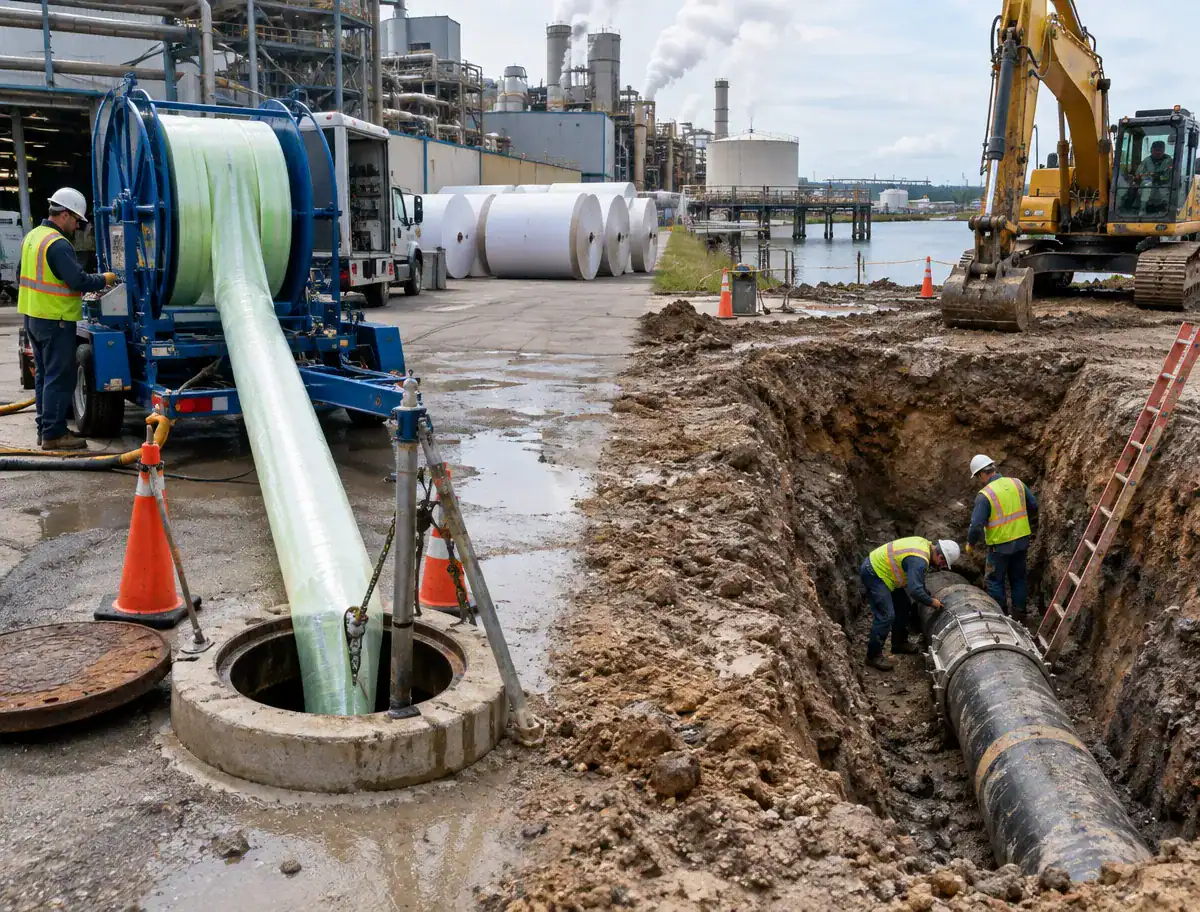
Cured-in-place piping avoids the excavation that open-cut pipeline installation requires, cutting both environmental disruption and total project cost. For Louisiana mills running continuous processes, that distinction carries operational weight. Digging up plant grounds to reach a failed line forces production stoppages, restoration expenses, and site disturbance that few facilities can absorb without measurable losses.
We treat paper mill pipe lining Louisiana projects as an alternative to that disruption. Trenchless rehabilitation reaches degraded pipe sections without tearing up foundations, roadways, or process areas built around fixed equipment. Open-cut methods, by contrast, demand full removal and replacement of the surrounding surface, extending downtime and multiplying restoration costs across a facility’s footprint.
Two trenchless methods dominate the field: cured-in-place piping and spray-applied pipe lining. Both renew existing pipe from the inside, but each suits different pipe conditions and diameters. We evaluate which method fits a given line before recommending either approach.
| Factor | Open-Cut Repair | Trenchless Lining |
|---|---|---|
| Site disruption | Extensive excavation | Minimal surface disturbance |
| Restoration cost | Higher, due to surface rebuild | Lower, no dig required |
| Production downtime | Extended | Reduced |
| Environmental impact | Greater soil and site disturbance | Minimized |
Is CIPP Reliable for Long-Term Industrial Use?
Performance data drawn from research conducted at Louisiana Tech University’s Trenchless Technology Center supports confidence in cured-in-place piping over time. Retrospective evaluation of CIPP installations in municipal gravity sewers has tracked how lined pipe holds up under sustained service conditions. We apply those findings when advising Louisiana industrial clients on rehabilitation strategy, since aging infrastructure at pulp and paper sites faces demands comparable to municipal systems under continuous load.
What Safety Risks Must Be Managed During Installation?
Chemical exposure ranks among the most serious hazards facing crews performing paper mill pipe lining in Louisiana. Documented incidents elsewhere in the industry show that liner curing releases chemical byproducts, including styrene gas, at concentrations capable of causing severe harm to workers inside confined pipe spaces. Pulp and paper facilities across Louisiana operate extensive effluent and process piping networks, many running through confined trenches and tight-access vaults. That combination of chemical curing agents and confined-space entry raises the stakes considerably for any crew performing trenchless rehabilitation on-site.
Regulatory scrutiny of these risks is not theoretical. Federal workplace safety authorities have investigated cured-in-place pipe installation practices following a documented worker fatality, resulting in significant financial penalties against the contractor involved. We treat that history as a baseline requirement, not a suggestion, when we plan work at Louisiana industrial sites.
What precautions reduce chemical exposure risk during lining work?
Ventilation, air monitoring, and controlled curing procedures limit worker exposure to styrene and other liner byproducts. We build these controls into every installation plan before crews enter a confined pipe segment. Facility managers should expect documented safety protocols, not verbal assurances, from any contractor handling process piping.
Why does crew experience matter for industrial pipe safety?
Complex industrial effluent systems demand crews who understand both the chemistry and the mechanics of trenchless rehabilitation. We staff projects with personnel knowledgeable in current trenchless technology, reducing the chance of procedural errors that lead to exposure incidents. Our approach includes:
- Confined-space entry protocols aligned with occupational safety standards
- Continuous air monitoring during resin curing
- Pre-installation hazard briefings for facility personnel
- Documented compliance records available for audit
We hold these standards as fixed obligations, not optional add-ons, across every Louisiana industrial engagement.
What Are the Warning Signs of Paper Mill Drain Pipe Failure?
Mill drain systems usually show symptoms well before a segment collapses. Maintenance teams should schedule a camera inspection when they notice any of the following:
- Recurring drain blockages from pulp fiber accumulation, even after routine industrial drain cleaning
- Visible corrosion, scaling, or spalling at cleanouts and manhole access points
- Ground subsidence, sinkholes, or pavement settlement along known drain routes
- Effluent odor or staining near buried pipe paths, a sign of possible exfiltration
Catching these signs early keeps the repair in lining territory rather than full excavation. The Water Environment Federation publishes wastewater collection guidance that mill environmental teams can use alongside inspection results when prioritizing repairs.
How Should Louisiana Mills Plan a Lining Project?
Successful pipe lining for paper mills in Louisiana starts with a documented condition assessment, a defined scope of work, and a realistic production shutdown window. Facility engineers who build these three elements into the front end of planning avoid the two costliest project failures: unplanned downtime and change-order overruns.
A mill scoping effort should map every effluent, cooling water, and process drain line before a single vendor quote arrives. Pelican Underground LLC maintains a New Orleans, LA base, which positions the company to reach pulp and paper operations throughout the state without long mobilization delays. That geographic footprint matters for mills running continuous production schedules, where a delayed contractor response translates directly into lost output. Because paper mills run 24/7, we schedule lining during brief planned outages or keep lines in service with temporary bypass pumping.
Multi-site operators face an added layer of complexity. Facilities with plants scattered across parish lines, or with sister sites in neighboring states, need a provider ready to handle sewer and drain challenges across Louisiana and bordering regions on a consistent basis, rather than a patchwork of local contractors with varying standards. Our commercial and industrial pipe solutions are built for exactly that kind of multi-facility program.
Should a mill choose trenchless lining or full pipe replacement?
Trenchless rehabilitation generally costs less and disrupts operations far less than open-cut replacement. Research comparing the two methods found trenchless techniques reduce both total project cost and environmental impact compared to excavating and reinstalling pipe. For an active mill, that difference often decides whether a repair happens during a scheduled outage or forces an unplanned line shutdown.
A practical planning checklist includes:
- Confirming pipe material, diameter, and known defect locations
- Scheduling work around production or seasonal outage windows
- Verifying contractor licensing and insurance coverage before award
- Requesting a written scope with defined completion milestones
Frequently Asked Questions
Why do paper mill effluent lines fail in Louisiana?
Corrosive chemical exposure, high-volume flow, and aging pipe networks break down these lines over time. Acidic byproducts and abrasive solids in process wastewater erode traditional pipe materials at Louisiana pulp and paper facilities.
What diameter range does CIPP lining cover for industrial pipes?
Trenchless lining spans two inches up to 36 inches and above in certain cases. This range covers oversized process effluent trunk lines typical of heavy industrial mill operations.
Can CIPP handle the pH levels in paper mill waste streams?
Yes, when the resin system is matched to the waste stream. Kraft process drains carry highly alkaline flows containing sodium hydroxide and sodium sulfide, so the liner resin is selected against the mill’s actual pH and temperature data before installation. CIPP is used for gravity drain and effluent systems, not high-pressure steam or white liquor lines.
What liner material is specified for alkaline paper mill drains?
Vinyl ester resin is the typical specification for alkaline, caustic drain service because it resists chemical attack better than standard polyester resins. Liner wall thickness and structural design still follow ASTM F1216 practice for the host pipe’s diameter and loading.
How long is a paper mill drain out of service during lining?
Most drain segments can be cleaned, lined, and cured within a planned outage window, with the exact duration set by pipe length, diameter, and cure method. Where a line cannot come offline, temporary bypass pumping keeps flow moving so the mill stays in production.
TL;DR — Paper Mill Pipe Lining in Louisiana at a Glance
- CIPP lining rebuilds black liquor, pulp washing, effluent treatment, cooling water, and chip yard stormwater drains without excavating mill grounds.
- Alkaline kraft waste streams call for chemical-resistant liners, typically vinyl ester resin.
- Sealing infiltration and exfiltration helps mills stay within NPDES and LPDES permit limits.
- Lining fits planned outages or runs with bypass pumping, so production keeps moving.
- CIPP suits gravity drain and effluent systems, not high-pressure steam or white liquor lines.
- Next step: Book a camera inspection so Pelican Underground LLC can scope a lining plan for your mill.
Related Resources
- Trenchless Pipe Repair Services
- CIPP Lining in Baton Rouge, LA
- Choosing a CIPP Lining Contractor in Baton Rouge
- Epoxy Pipe Lining in Louisiana
- Pipe Lining vs. Pipe Bursting
- How Long Does Pipe Lining Last?
Get a Free Paper Mill Pipe Lining Quote
Paper mill operations depend on reliable effluent systems to maintain regulatory compliance and operational continuity. Cured-in-place pipe lining addresses the corrosion, infiltration, and structural degradation that threaten these critical drainage networks without extensive excavation or production shutdowns. Pelican Underground LLC delivers CIPP solutions engineered for the demanding conditions of Louisiana industrial environments, combining advanced video inspection diagnostics with licensed, certified installation to restore pipe integrity and protect both infrastructure and environmental standards. Contact Pelican Underground LLC today for a free, no-obligation quote.
About Pelican Underground LLC: Pelican Underground LLC is a New Orleans, LA-based trenchless pipe rehabilitation contractor serving paper mills, industrial plants, municipalities, and commercial facilities across Louisiana, Mississippi, and Alabama. Our NASSCO-credentialed crews provide sewer camera inspection, hydro-jetting, CIPP lining, pipe bursting, and point repairs that restore buried infrastructure with minimal excavation and downtime.
