
Quick Answer: How long does trenchless sewer repair last? Cured-in-place pipe (CIPP) liners are commonly designed around a 50-year design life, and industry sources typically estimate 40 to 60 years of real-world service for well-installed residential liners. In Louisiana, actual lifespan depends on host-pipe cleaning, full resin curing, camera-verified installation, and site conditions such as expansive clay soil and a high water table. These figures are typical design-life estimates, not guarantees.
Louisiana’s sewer lines sit in some of the most demanding ground in the country: reactive clay, saturated soils, and a water table that can sit just a few feet below the surface. This guide explains what CIPP durability estimates actually mean, which Louisiana soil conditions affect them, and how trenchless lining compares with other repair methods.
What Is Trenchless CIPP Sewer Repair?
Cured-in-place pipe (CIPP) lining forms a new pipe inside an existing, deteriorated sewer line, greatly reducing the need for trench excavation. Louisiana properties built on reactive clay soils, from Baton Rouge subdivisions to coastal parishes near the Gulf, often carry aging clay or cast-iron sewer lines prone to cracking and root intrusion. CIPP addresses that deterioration from within the original pipe rather than replacing it outright.
The process begins with a resin-saturated liner inserted into the damaged pipe. Heat, steam, or ultraviolet light then cures that liner until it hardens into a seamless, tight-fitting surface. Once cured, the new interior pipe is designed to resist root penetration and corrosion and to tolerate the soil shifting common across Louisiana’s humid, flood-prone terrain.
How Long Is a Trenchless Sewer Repair Designed to Last?
How long does trenchless sewer repair last once installed in a Louisiana home or commercial building? Modern trenchless methods, including CIPP lining, are commonly engineered for decades of service life, often around 50 years, when installation and maintenance meet proper standards. That performance outlook matters for municipal utility directors and commercial property managers weighing long-term infrastructure budgets against repeated excavation costs.
What Makes CIPP Different From Traditional Pipe Replacement?
CIPP largely avoids the trenching, landscaping damage, and concrete removal associated with conventional pipe replacement. Instead of digging up a yard or parking lot, crews access the line through existing openings and rehabilitate it from the inside. For Gulf Coast properties where lawns, hardscaping, and storm drainage systems represent significant investments, that distinction carries real financial weight.
How Long Does Trenchless Sewer Repair Last?
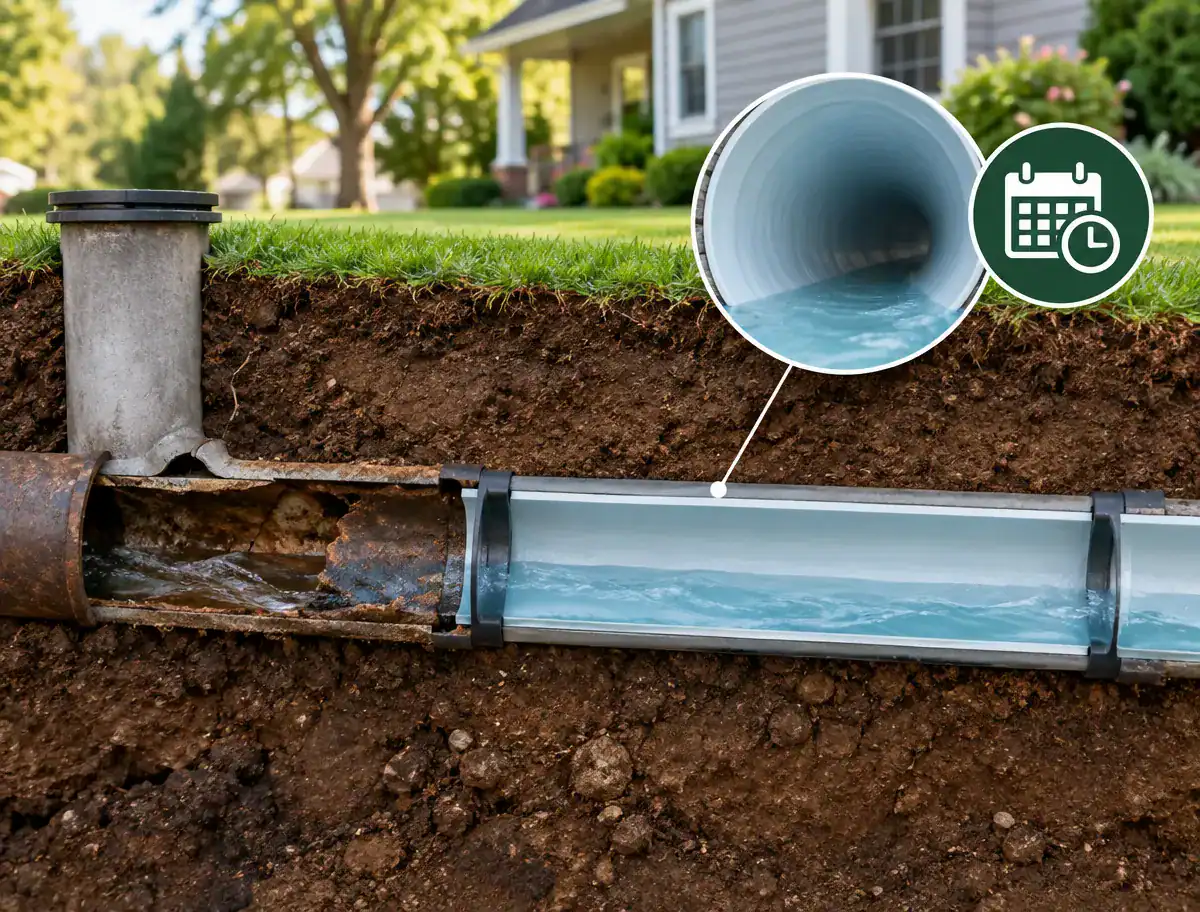
Trenchless sewer repair in Louisiana is commonly designed for a service life of about 50 years when crews install cured-in-place pipe (CIPP) liners following ASTM F1216, the industry standard practice for CIPP rehabilitation, whose design guidance is typically applied to a 50-year design life. That figure is a typical design-life estimate from industry sources, not a guarantee, and it matters in a region where aging clay and cast-iron lines sit under humid, shifting soil. When proper curing or camera verification is skipped, real-world lifespan can fall well short of that estimate, leaving property owners facing another repair much sooner than expected.
Industry sources commonly estimate real-world performance for well-installed residential CIPP liners at 40 to 60 years, provided the host pipe is cleaned thoroughly, often with hydro jetting, and the resin cures fully before the line returns to service. Some industry sources cite a wider realistic range of 20 to 50 years, depending heavily on installation quality and ongoing maintenance. Sewer camera inspection before and after lining helps verify the installation and supports outcomes toward the upper end of that range for homeowners, commercial properties, and municipal systems alike.
| Method | Typical Estimated Lifespan* |
|---|---|
| CIPP lining (verified install) | 50+ years (common design life) |
| CIPP lining (variable quality) | 20–50 years |
| Pipe bursting (HDPE pipe) | 50–100 years |
*Typical design-life estimates from industry sources, not guarantees. Actual service life depends on installation quality, site conditions, and maintenance.
What Shortens CIPP Liner Life in Louisiana Pipelines?
Poor host-pipe cleaning before lining, incomplete resin curing, and skipped camera inspection can all reduce liner longevity well below the 40–60 year residential estimate. Louisiana’s high water tables and the tree-root intrusion common along Gulf Coast parishes make pre-lining prep especially critical. Industry groups such as NASSCO publish guidance on inspecting a new cured-in-place pipe so owners and contractors can catch installation defects early.
Is Pipe Bursting More Durable Than CIPP Lining?
Pipe bursting with HDPE pipe is often estimated to last 50 to 100 years, which can exceed the upper end of typical CIPP estimates. For Louisiana properties replacing severely collapsed or undersized lines, pipe bursting offers a longer-rated alternative with minimal open trenching.
📞 Not Sure How Much Life Your Sewer Line Has Left? A camera inspection shows the real condition of your existing pipe and whether CIPP lining or another trenchless option is the right fit. Contact Pelican Underground LLC to schedule an assessment anywhere in Louisiana.
What Factors Affect Lining Longevity in Louisiana?
Four variables determine lining longevity across Louisiana properties: material quality, existing pipe condition, installation precision, and ongoing usage patterns. Cured-in-place pipe, known as CIPP, is commonly engineered around a 50-year design life under standardized design methods. That design figure, however, is an estimate rather than a guarantee, especially given Louisiana’s high water table and expansive clay soils.
Determining how long trenchless sewer repair lasts on any given property requires looking past the manufacturer’s rating. Published field evaluations, including EPA-sponsored research, have reported CIPP liners still performing after 25 or more years in service, a result that supports durability even under variable ground conditions like those found in southern Louisiana parishes. Real-world performance still depends on installation conditions specific to each site, including host pipe cleaning, resin curing, and soil behavior around the line.
Does Soil Type in Louisiana Shorten Liner Life?
Soil composition influences liner performance more than most homeowners expect. Expansive clay and periodic flooding stress a host pipe differently than stable, well-drained ground, which changes how a liner bonds and cures over time. The USDA’s Understanding Soil Risks and Hazards guide explains how shrink-swell clays and corrosive soils affect buried structures, and property owners can look up the mapped soils under their own lot with the USDA Web Soil Survey.
What Else Shortens or Extends a Liner’s Working Life?
Several conditions interact to shape long-term durability. We account for each factor before issuing a project recommendation.
- Material grade: resin and felt quality used in the liner itself
- Host pipe condition: cracking, offset joints, or root intrusion prior to lining
- Installation workmanship: cleaning, curing, and camera-verified placement
- Usage habits: grease disposal, root growth near the line, and flow volume
These factors, taken together, explain why two similar Louisiana homes can see different outcomes from the same lining material. For a closer look at local ground conditions, see how environmental conditions in New Orleans affect piping longevity.
How Does CIPP Compare to Other Methods?
Cured-in-place pipe lining generally carries a longer rated service life than epoxy coating but a shorter one than fully excavated replacement pipe. For Louisiana homeowners and facility managers comparing options across Baton Rouge, New Orleans, and the surrounding Gulf Coast parishes, the lifespan gap between methods matters more than the sticker price.
How long does trenchless sewer repair last depends heavily on which method a property uses. Epoxy pipe lining, a thinner resin coating applied to the interior of an existing pipe, is commonly rated for roughly 30 to 50-plus years. CIPP lining, which cures a resin-saturated liner into a new structural pipe wall, is typically designed for about 50 years or more. Traditional excavated PVC replacement still sets the upper benchmark, with estimates of 75 to 100 years of service life. NASSCO’s pipe rehabilitation technologies matrix and the EPA’s state-of-technology review of pipe rehabilitation both offer a broader look at how these methods are defined and evaluated.
| Method | Typical Rated Service Life* |
|---|---|
| Epoxy pipe coating | 30–50+ years |
| CIPP lining | About 50+ years (common design life) |
| Excavated PVC replacement | 75–100 years |
*Typical design-life estimates from industry sources, not guarantees.
Does Any Trenchless Product Match Excavated Pipe?
Some manufacturers publish design-life ratings of up to 100 years for certain gravity sewer liner systems. Those are manufacturer estimates rather than guarantees, but they place select liner systems closer to traditional dig-and-replace pipe, without the trench.
For Louisiana’s clay soils and aging infrastructure in older parish systems, these ratings guide realistic planning. We weigh soil conditions, pipe material, and system use when evaluating which method fits a given property’s timeline.
What Should Louisiana Owners Expect Long Term?

Louisiana property owners facing aging clay or cast iron lines expect durability that matches the decades their homes and buildings have already stood. Cured-in-place pipe rehabilitation, when installed correctly, is designed to provide decades of additional service from clay and cast iron lines that are often already 50 to 80 years old across Baton Rouge, New Orleans-area suburbs, and Gulf Coast parishes alike.
Louisiana’s humid climate, shifting soil, and hurricane-season flooding place extra strain on old pipe networks, and aging buried pipe is a challenge nationwide, as the EPA’s white paper on managing deteriorating buried infrastructure describes. Owners rightly want a solution resolved once, not a patch requiring repeat digging and repeat invoices. We operate as a New Orleans, LA-based provider traveling throughout Louisiana, applying trenchless rehabilitation methods built for that exact concern.
How Long Does Trenchless Sewer Repair Last for Louisiana Properties?
Service life depends on installation quality, host pipe condition, and material cure. Owners across Louisiana can generally expect these outcomes:
| Factor | Long-Term Expectation |
|---|---|
| Correctly cured liner | Decades of added service (commonly estimated around 50 years) |
| Patch-style fixes | Higher risk of repeat failure and repeat excavation |
| Trenchless rehabilitation | Addresses the issue with minimal recurring yard damage |
Frequently Asked Questions
How long does CIPP sewer lining last in Louisiana?
CIPP liners are commonly designed around a 50-year design life, and industry sources typically estimate 40 to 60 years of real-world service for well-installed residential liners. These are typical estimates from industry sources, not guarantees; actual lifespan depends on pipe preparation, full resin curing, and site conditions.
What makes CIPP durable in Louisiana’s soil conditions?
The resin-saturated liner cures into a jointless pipe-within-a-pipe that helps resist the root intrusion and corrosion common in Gulf Coast soil. With no joints for roots or groundwater to work into, the liner is well suited to the humid, flood-prone, reactive clay conditions found across many Louisiana parishes.
Does CIPP liner performance hold up over decades of actual use?
Published field evaluations, including EPA-sponsored research, have found CIPP liners still performing after 25 or more years in service. That real-world data is consistent with the roughly 50-year design life commonly used for CIPP, although results always depend on installation quality and maintenance.
Can Louisiana’s clay soil and high water table shorten a liner’s life?
They can. Expansive clay that shrinks and swells and a high water table add stress to the host pipe and make pre-lining cleaning and full curing more critical. A thorough camera inspection and proper site preparation help a liner reach the upper end of its expected lifespan.
How do I know if my lined sewer line is still in good condition?
A sewer camera inspection is the most direct way to check a liner’s condition from the inside. Periodic inspections, along with keeping grease out of drains, help catch problems early and protect the liner over its service life.
TL;DR — Trenchless Sewer Repair Lifespan at a Glance
- CIPP sewer liners are commonly designed around a 50-year design life using the design guidance associated with ASTM F1216 (a typical estimate, not a guarantee).
- Industry sources typically estimate 40–60 years of real-world service for well-installed residential CIPP liners in Louisiana.
- Published field evaluations, including EPA-sponsored research, have found CIPP liners still performing after 25+ years in service.
- Louisiana’s expansive clay soils and high water table make host-pipe cleaning, full curing, and camera verification especially important.
- Trenchless sewer repair minimizes yard excavation while providing decades of protection against sewage backups and damage.
- Next step: Contact Pelican Underground LLC to schedule a sewer camera inspection and find out whether CIPP lining fits your property.
Related Resources
- Trenchless Pipe Repair
- New Orleans, LA Service Area
- How Long Does Pipe Lining Last?
- Pros and Cons of Trenchless Sewer Repair
- What Is Trenchless Sewer Repair?
- Pipe Lining vs. Pipe Bursting
Get a Free Trenchless Sewer Repair Quote
Louisiana property owners confronting aging sewer infrastructure can plan with more confidence when they choose trenchless rehabilitation methods designed to outlast the original pipe they restore. CIPP lining, when installed with proper site preparation and verified through camera inspection, is designed to deliver decades of reliable service across the state’s challenging soil and climate conditions. Trenchless solutions help break the cycle of repeated excavation and repair, protecting both property and budget over the long term. Selecting the right method and installer often determines whether a sewer repair resolves the problem once or becomes a recurring expense.
Contact Pelican Underground LLC today for a free, no-obligation quote.
About Pelican Underground LLC: Pelican Underground LLC is a trenchless pipe rehabilitation contractor serving residential, commercial, and municipal clients across Louisiana, Mississippi, and Alabama. Services include CIPP lining, pipe bursting, sewer camera inspection, hydro jetting, and sewer line repair. Contact Pelican Underground for a free, no-obligation quote.
