
Quick Answer: For most Louisiana buildings, drain stack replacement vs lining comes down to the pipe’s structural condition. Cured-in-place (CIPP) lining is the faster, less disruptive choice for stacks with corrosion or scaling but intact walls, restoring the pipe from the inside and extending service life by up to 50 years without demolition. Full replacement becomes necessary only when a cast iron stack has structural collapse, offset joints, or wall loss beyond what a resin liner can reinforce. Pelican Underground evaluates each stack with camera inspection before recommending a path.
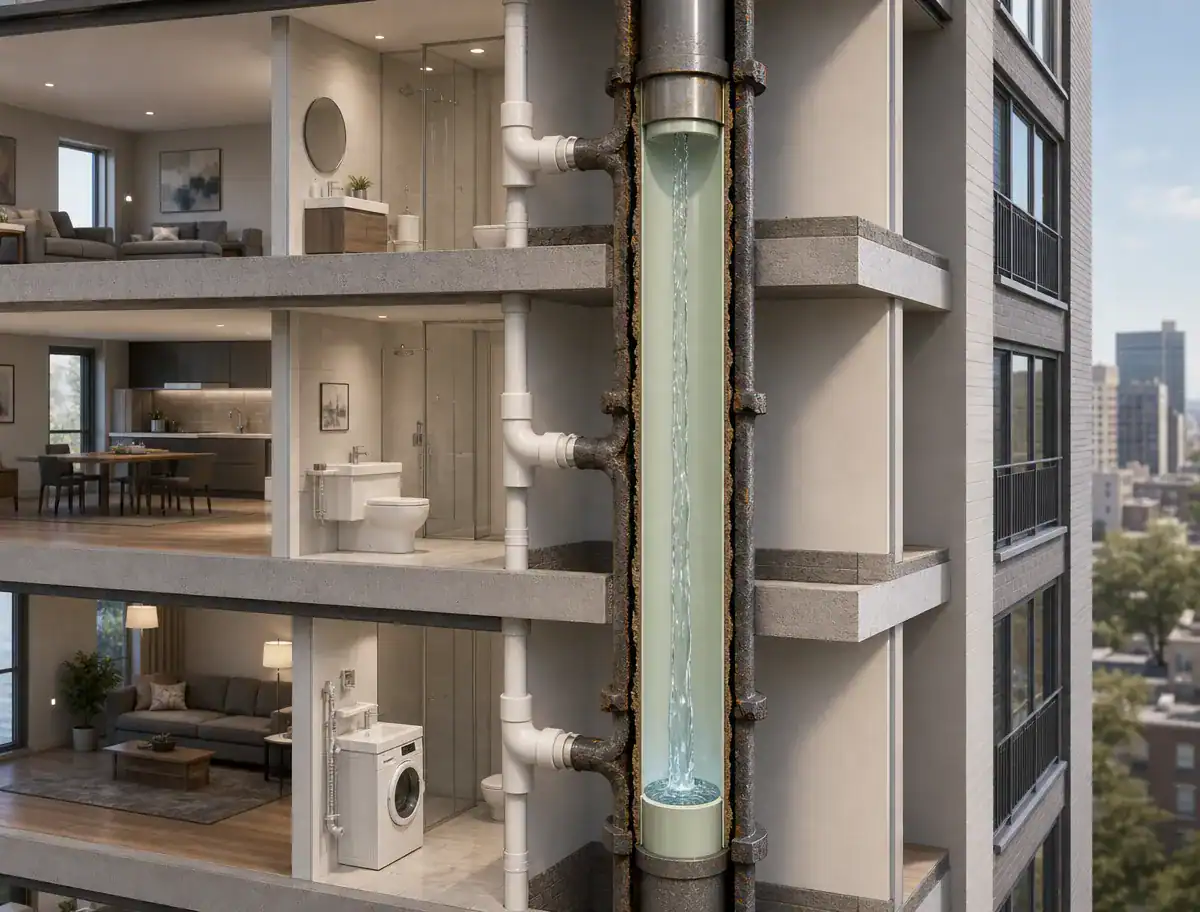
Cast iron drain stack lining restores deteriorating pipes without demolition, while full replacement removes and rebuilds the line entirely. For Louisiana buildings, CIPP lining is often recommended first, but the best choice depends on the specific condition of the stack. We reserve replacement for stacks with structural collapse beyond lining tolerances.
What Are the Key Takeaways on Drain Stack Replacement vs Lining?
- Drain stack replacement involves excavation and complete pipe removal, while lining preserves existing infrastructure with minimal disruption.
- Pelican Underground LLC serves Louisiana with certified pipe restoration for mains, laterals, stacks, and sanitary systems across residential and commercial properties.
- Cured-in-place pipe lining technology eliminates cast iron sewer pipe deterioration without full excavation, reducing labor costs and property damage.
- Call us for professional drain assessment to determine whether replacement or lining suits your Louisiana property’s specific drainage needs.
Why Are Louisiana’s Cast Iron Drain Stacks Failing?
Age drives the deterioration of cast iron plumbing across Louisiana’s older commercial buildings and historic properties. Maintenance concerns compound as these systems approach and exceed the design life originally intended for cast iron piping. We track this pattern across the multi-story properties, HOAs, and historic structures we serve throughout the state.
Municipal water systems provide a useful benchmark for scale. Some public infrastructure records document cast iron water distribution pipes reaching 80 years of service before requiring intervention. Vertical drain stacks in Louisiana’s commercial buildings and condominiums often carry comparable age and corrosion risk, without the inspection schedules municipal systems receive. Ongoing research at Louisiana’s dedicated trenchless technology research center continues to refine best practices for rehabilitating aging cast iron infrastructure statewide.
What Decision Do Building Owners Face Once Cast Iron Stacks Start Failing?
Owners confront a defined choice once deterioration reaches a critical stage. The options are conventional pipe replacement, which requires demolition and reconstruction, or cured-in-place lining, which rehabilitates the pipe from within. This is the core decision behind drain stack replacement vs lining. It shapes cost, downtime, and disruption to tenants or residents.
We summarize the underlying pressures driving this decision below:
| Failure Driver | Effect on Cast Iron Stacks |
| Pipe age | Corrosion accelerates as systems exceed decades of continuous service |
| Deterioration rate | Interior scaling and pitting reduce flow capacity over time |
| Lack of proactive inspection | Failures often surface as emergencies rather than planned repairs |
Pelican Underground LLC, based in New Orleans, LA, evaluates these conditions for building owners across Louisiana before recommending a repair path.
Drain Stack Replacement Vs Lining: What’s The Difference?
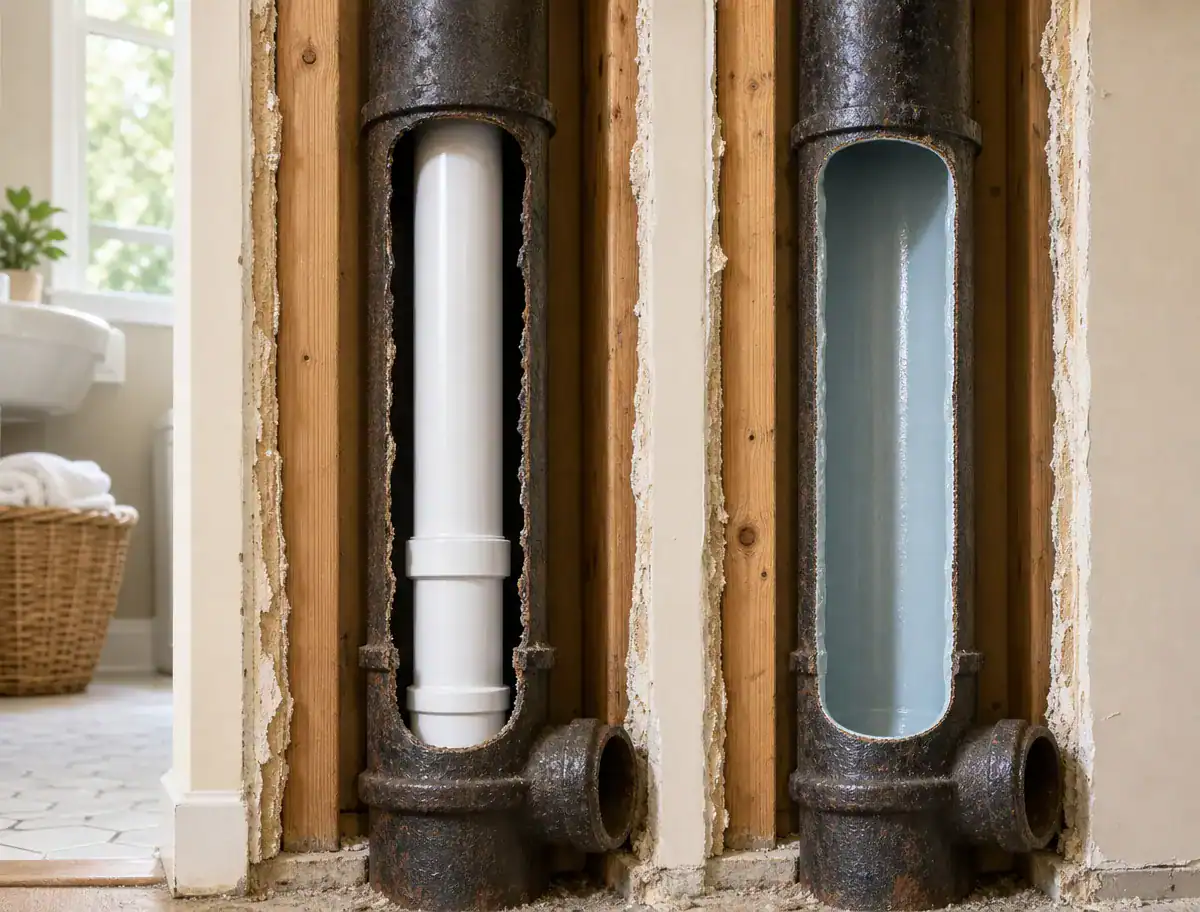
Two distinct repair methods govern the fate of a failing cast iron stack: full removal and replacement, or trenchless restoration through cured-in-place lining. Louisiana facility owners face steep losses when this choice is made poorly — flooded units, condemned floors, and tenant relocation costs that dwarf the repair itself. Drain stack replacement vs lining is not a matter of preference alone. It is a trade-off among investment, installation time, durability, and operational downtime.
We evaluate each stack on those four factors before recommending a path forward.
Which Method Costs Less Over Time?
Replacement demands demolition, new pipe, and full restoration of walls, floors, and finishes. Lining avoids that destruction entirely, which typically shortens installation time and limits downtime for occupied buildings, hotels, and multi-tenant properties across Louisiana.
When Is Lining The Only Viable Option?
Certain deteriorated stacks cannot tolerate demolition without compromising a structure’s historic fabric or occupied floors above and below. In those circumstances, lining stands as the only practical method to restore usefulness and extend service life for the pipe.
Trenchless technology was not built for horizontal lines alone. The same lining process rehabilitates mains, horizontal laterals, and vertical stacks alike, making it suitable for the multi-story cast iron systems common in Louisiana’s older commercial and residential buildings.
| Factor | Replacement | Lining |
| Investment | Higher, includes demolition and restoration | Lower, no excavation or demolition |
| Installation time | Longer | Shorter |
| Downtime | Extended | Minimal |
| Durability | New pipe, full lifespan | Restored structural integrity |
Pelican Underground holds NASSCO certification and provides trenchless pipe rehabilitation to Louisiana buildings weighing these options. Our assessments identify which method preserves structure and budget without sacrificing long-term reliability.
📞 Ready to Get Started? Don’t wait until a failing stack forces an emergency shutdown. Contact Pelican Underground LLC today for a fast, free assessment of your Louisiana building’s drain stacks — call 800-652-7604.
How Does Vertical Stack Lining Protect Multi-Story Buildings?
Vertical stack lining seals deteriorating cast iron pipe from the inside, using resin that cures into a new structural layer without opening walls or floors. Multi-story buildings across Louisiana rely on this method because it protects occupied units while restoring pipe integrity. We apply cured-in-place resin coatings that extend the service life of sewer and drainage stacks by as much as 50 years, giving hotel owners, condominium boards, and historic property managers a long-term alternative to full replacement. For a closer look at how this applies to downtown high-rises, see our guide to high-rise pipe lining in New Orleans.
Failing stacks in older buildings do not announce themselves gradually. Leaks appear behind walls, corrosion weakens joints, and by the time staining reaches a ceiling, the pipe has often been failing for years. Louisiana’s aging cast iron infrastructure, common in commercial and residential high-rises built decades ago, makes proactive lining a practical safeguard against emergency failures during peak occupancy. Because CIPP resin curing can release vapors during installation, Pelican Underground follows documented occupational exposure safety guidance for handling cured-in-place pipe materials.
Is lining less disruptive than replacing a stack?
Yes. Drain stack replacement vs lining comes down largely to occupant impact, and lining wins decisively on that measure. Replacement requires demolition access to multiple floors, displacing tenants and shutting down units for days. Lining works through existing access points, causing less disruption to occupants and lowering restoration costs compared to conventional excavation-based replacement.
| Factor | Traditional Replacement | Stack Lining |
| Occupant disruption | High — demolition required | Low — no-dig access |
| Restoration cost | Higher | Lower |
| Service life gained | Full pipe replacement | Up to 50 years |
Who performs vertical stack lining in Louisiana?
Certified trenchless contractors serve properties throughout the state, including markets like Lafayette, LA, delivering professionally trained, code-compliant work in line with the State Plumbing Board of Louisiana’s rules and regulations. Our technicians hold NASSCO certification, supporting vertical stack rehabilitation for hotels, multi-tenant buildings, and historic properties statewide. We travel to Louisiana job sites prepared to document pipe conditions and execute lining without excavation.
When Does Full Replacement Beat Lining In Louisiana?
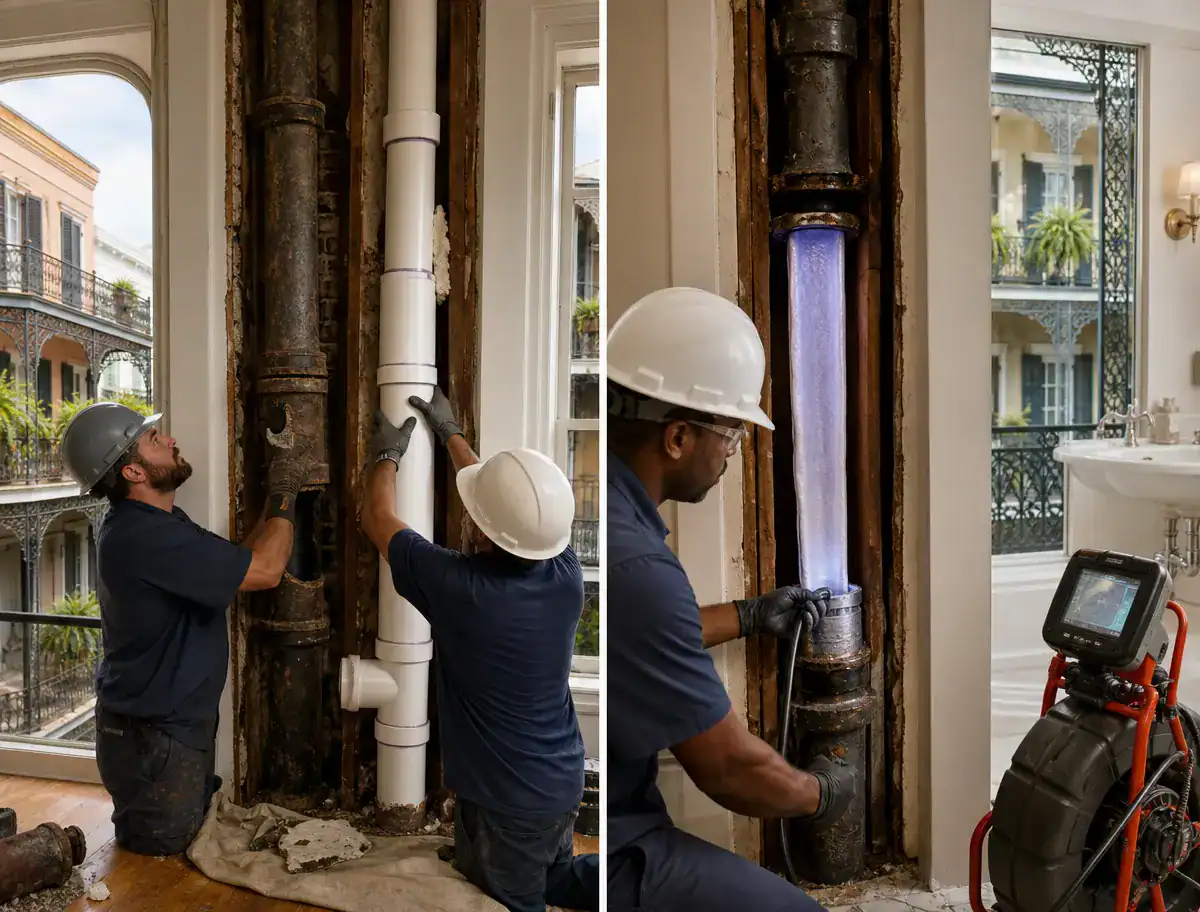
Full replacement outranks lining when a cast iron stack has lost structural integrity beyond what a resin liner can reinforce. Weighing drain stack replacement versus lining requires evaluating investment, installation time, durability, and operational downtime for every Louisiana property under our review.
Cost alone rarely settles the question. A stack riddled with cracks, offset joints, or collapsed sections demands excavation or full-column removal, regardless of the price gap between methods. Lining restores a pipe wall; it cannot rebuild a wall that no longer exists.
How Do We Decide Between Lining And Replacement?
We assess each stack individually, drawing on experience across numerous relining and replacement projects throughout Louisiana. Condition, not convenience, drives the recommendation. Before comparing bids, many owners also research typical vertical stack lining costs to budget accordingly.
- Wall loss and pitting: Severe corrosion beyond a certain threshold rules out lining.
- Joint misalignment: Offset or separated joints often require physical replacement.
- Downtime tolerance: Facilities with strict occupancy schedules may still prefer lining’s faster turnaround.
- Long-term durability needs: Historic properties and high-rises weigh restoration life span against renovation cycles.
Does Property Type Affect The Decision?
Property type shapes scale, not the underlying engineering logic. Our trenchless approach extends to industrial sites, municipal buildings, and federal facilities across Louisiana that require repair strategies capable of scaling from a single residential stack to a multi-building complex.
HOA boards and facility directors managing aging cast iron systems should treat this decision as a structural assessment first, a budget exercise second. Pelican Underground, based in New Orleans, LA, advises commercial owners and historic property managers throughout Louisiana on which stacks qualify for lining and which require full replacement, backed by camera inspection findings rather than assumption.
What’s The Next Step For Louisiana Property Managers?
Property managers across Louisiana face a decision that shapes both operating budgets and building uptime: repair aging cast iron stacks now or wait for a failure that forces emergency work. Certified trenchless contractors already serve Louisiana communities, including Lafayette, with crews trained and credentialed specifically for this work. Pelican Underground LLC, headquartered in New Orleans, LA, extends that same certified service to HOA boards, historic property managers, and facility directors throughout the state.
The core decision comes down to a comparison of drain stack replacement vs lining methods for deteriorating vertical pipe runs. Each approach carries distinct tradeoffs in upfront investment, installation time, expected durability, and disruption to tenants or residents.
How Long Does Stack Lining Extend Pipe Life?
Lining a failing cast iron stack extends its service life by as much as 50 years in many installations. This method also limits occupant disruption, since crews typically access pipes through existing openings rather than demolishing walls or floors.
What Should Louisiana Property Managers Compare Before Deciding?
We recommend weighing four factors side by side before authorizing any rehabilitation contract:
| Factor | Consideration |
| Initial investment | Lining generally requires less material removal than full replacement |
| Installation time | Lining crews finish faster with less occupant displacement |
| Durability | Lining can extend service life up to 50 years |
| Operational downtime | Replacement often demands longer building or unit closures |
Louisiana property managers should request a written comparison of these four factors before selecting a method or contractor.
Frequently Asked Questions
Should you replace or line a failing drain stack in Louisiana?
CIPP lining is often recommended first, but the best choice depends on the specific condition of the stack. Replacement is reserved for stacks with structural collapse beyond lining tolerances.
Why do Louisiana’s cast iron drain stacks fail?
Age drives deterioration in older commercial buildings and historic properties as systems exceed their intended design life. Corrosion accelerates without the inspection schedules municipal systems typically receive.
Who evaluates whether a stack needs replacement or lining?
Pelican Underground LLC, based in New Orleans, LA, evaluates pipe age, deterioration rate, and inspection history for building owners across Louisiana before recommending a repair path.
How long does drain stack lining last compared to replacement?
Cured-in-place lining can extend a cast iron stack’s service life by up to 50 years, comparable to the lifespan of a fully replaced pipe. Replacement resets the clock entirely with new pipe, while lining restores the existing pipe’s structural integrity.
How much does drain stack replacement vs lining cost in Louisiana?
Lining is generally the lower-cost option because it avoids excavation, demolition, and full restoration of walls and floors. Replacement carries higher upfront investment but may be the only option for stacks with severe structural damage.
TL;DR — Drain Stack Replacement vs Lining at a Glance
- Lining rehabilitates a failing cast iron stack from the inside; replacement removes and rebuilds it entirely.
- Lining is typically faster, less disruptive, and lower-cost, and can extend service life by up to 50 years.
- Replacement is reserved for stacks with structural collapse, wall loss, or offset joints beyond what lining can reinforce.
- Pelican Underground evaluates every Louisiana stack with camera inspection before recommending a path.
- Both methods deliver code-compliant, durable results when performed by NASSCO-certified professionals.
- Next step: Call 800-652-7604 for a free drain stack assessment.
Related Resources
- Vertical Stack Lining Services
- Baton Rouge, LA Service Area
- Vertical Stack Lining in Louisiana
- Vertical Stack Pipe Lining in New Orleans
- Building Drain Riser Lining Contractor
- Multi-Unit Building Drain Lining in Louisiana
Get a Free Drain Stack Assessment
In closing, the choice between drain stack replacement and lining depends upon the specific condition of your system, the scope of damage, and your operational priorities. Both methodologies deliver durable, code-compliant results when executed by qualified professionals. Pelican Underground LLC applies rigorous inspection protocols and transparent assessment to guide Louisiana property owners toward the most effective solution for their infrastructure needs, ensuring reliable performance and long-term protection. Contact Pelican Underground LLC today for a free, no-obligation quote.
About Pelican Underground LLC: Pelican Underground LLC is a New Orleans, LA-based trenchless pipe rehabilitation company, specializing in NASSCO-certified cured-in-place (CIPP) lining and drain stack replacement for residential, commercial, and municipal properties across Louisiana. Contact us at 800-652-7604 for a free, no-obligation quote.