
Quick Answer: Cooling water pipe lining uses cured-in-place pipe (CIPP) technology to rehabilitate the large-diameter lines that move cooling water through Louisiana power plants and heavy-industrial facilities, without excavation. Pelican Underground LLC installs chemical-resistant liners rated for treated cooling water containing biocides and scale inhibitors, plus thermally stable resins for discharge temperatures up to 140°F. Because a cooling water failure halts production immediately, lining projects are scheduled around planned turnaround windows, restoring pipe from 24 inches up to 96 inches and larger without a weeks-long shutdown.
Why Do Cooling Water Pipe Failures Threaten Louisiana Industrial Operations?
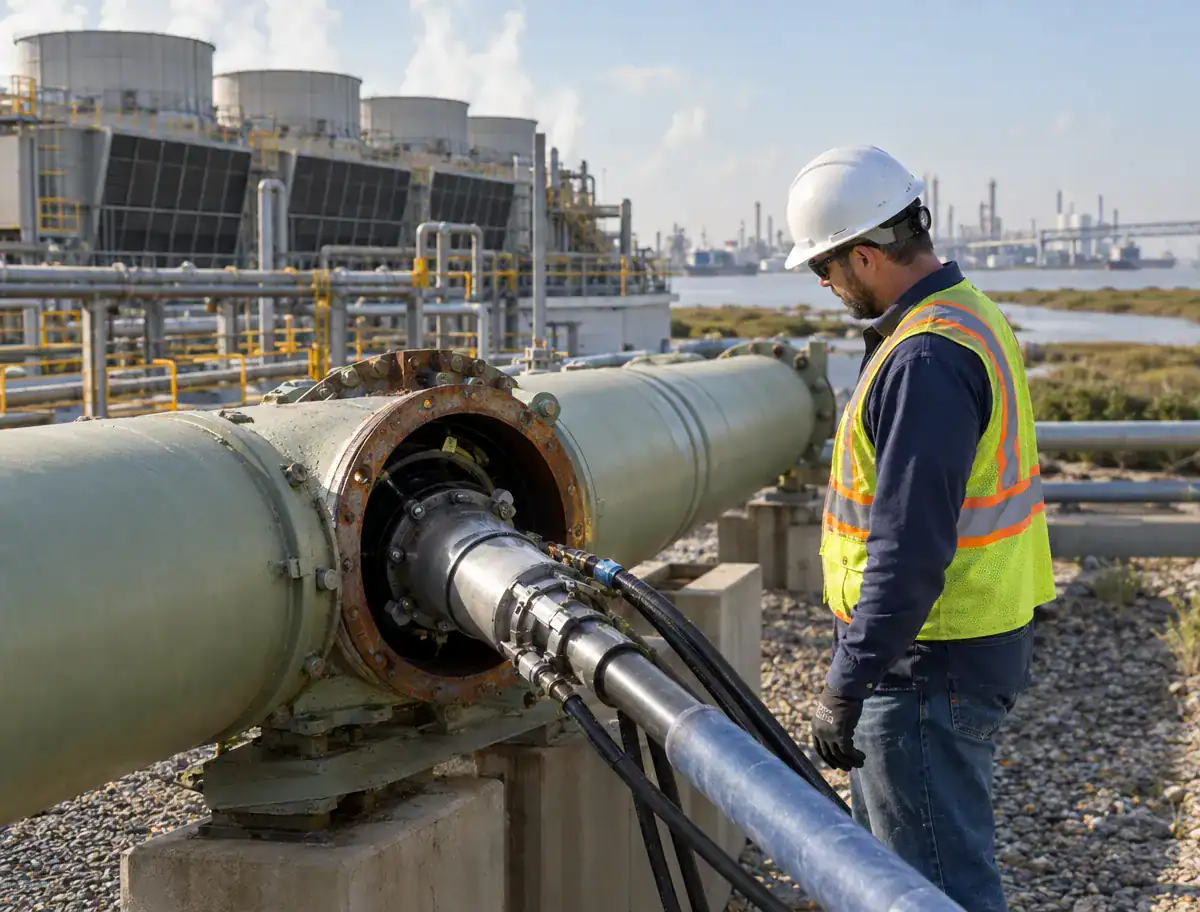
Cooling water systems move thousands of gallons per minute through supply and return lines that keep turbines, condensers, and process equipment within safe operating temperatures. That volume changes the stakes of a pipe failure. A leaking drain line is an inconvenience; a failed cooling water line is an immediate production problem, because the equipment it serves often cannot run without it.
Louisiana’s industrial corridor along the Mississippi River and Gulf Coast concentrates power generation, petrochemical processing, and heavy manufacturing in facilities that depend on continuous cooling water flow. Pipe failures at these sites do not just cost repair dollars — they cost production hours, and in some cases trigger unplanned equipment shutdowns that take far longer to restart than the pipe repair itself.
What Happens When a Cooling Water Line Fails Mid-Production?
A cooling water line failure forces an immediate operational decision: reduce throughput, shut down the affected equipment, or divert flow through a backup path if one exists. None of those options is free. Facility engineers typically have far less flexibility with a cooling water outage than with a sanitary or storm drain issue, because the cooling loop is tied directly to production equipment rather than to a building convenience system.
Why Do Cooling Water Systems Face Different Risks Than a Standard Drain Line?
Cooling water lines run continuously under pressure and often at elevated temperatures, and they carry treated water with chemical additives rather than gravity-fed wastewater. That combination — constant flow, higher temperature, and treatment chemistry — accelerates certain failure modes and narrows the window for scheduling a repair, since a full shutdown is usually required rather than a brief flow interruption.
What Causes Cooling Water Pipes to Fail in Louisiana Industrial Plants?
The material a cooling water line is built from determines how it fails, and that failure mode determines whether cured-in-place lining is the right rehabilitation method. Pelican Underground evaluates each of the following materials differently before recommending a repair approach.
| Pipe Material | Common Failure Mode | How It Shows Up | CIPP Suitability |
|---|---|---|---|
| Reinforced concrete pipe | Corrosion & joint separation | Spalled interior, exposed rebar, leaking joints | High — liner bridges joint gaps, restores a continuous wall |
| Ductile iron pipe | Tuberculation & graphitization | Rough interior nodules restrict flow; iron becomes brittle | High — smooths interior, restores strength without full replacement |
| FRP (fiberglass-reinforced plastic) | Delamination | Resin layers separate; wall thins over time | Moderate to High — liner choice depends on remaining structural wall |
| Older steel pipe | Pitting corrosion & pinhole leaks | Localized wall thinning; small leaks under pressure | High — liner seals pinholes and adds a corrosion-resistant barrier |
FRP (fiberglass-reinforced plastic) pipe fails primarily through delamination, where the resin-bonded layers that give the pipe its strength begin to separate, thinning the wall from the inside out. Older steel cooling water pipe most commonly fails through pitting corrosion, which eats through the wall in isolated spots rather than uniformly, producing pinhole leaks that can appear well before a section shows visible wall loss on the outside. AWWA’s water main rehabilitation resources document this same aging-infrastructure pattern across the water utility sector, where pipe installed decades ago now needs rehabilitation faster than it can practically be replaced.
Why Does Reinforced Concrete Pipe Corrode and Separate at the Joints?
Reinforced concrete pipe used in cooling water service is vulnerable to corrosion of the concrete matrix and the embedded steel reinforcement, particularly where joint gaskets age and allow infiltration or exfiltration. Once a joint separates, the gap widens under repeated pressure cycling, and the surrounding soil or bedding can migrate into the line. CIPP lining addresses this by installing a continuous liner that bridges the joint gap and restores a single uninterrupted pipe wall. The USACE Engineer Manual on conduits, pipes, and culverts catalogs this same joint-separation and internal-erosion failure pattern in pressurized pipe running through Louisiana’s levee and flood-control infrastructure.
What Is Tuberculation and Graphitization in Ductile Iron Cooling Lines?
Tuberculation is the buildup of corrosion nodules on the interior wall of ductile iron pipe, which restricts flow area and increases friction loss over time. Graphitization is a related process in which the iron matrix corrodes selectively, leaving a graphite shell that looks structurally intact but has lost most of its strength and can fail suddenly under load. Lining smooths the interior surface and adds a structural barrier without requiring full pipe replacement. The National Transportation Library’s Culvert Repair Practices Manual documents similar structural-lining approaches used to rehabilitate large pipe and culvert structures without full excavation.
How Does CIPP Lining Rehabilitate Industrial Cooling Water Pipe?
Cured-in-place pipe lining installs a resin-saturated liner inside the existing cooling water line, then cures it in place to form a new structural pipe wall bonded to the host pipe. The process works through existing access points — vaults, manholes, or cleanouts — so crews do not need to excavate above the line or shut down adjacent equipment to reach it. The EPA’s fact sheet on trenchless sewer rehabilitation outlines the same core CIPP process used industry-wide, adapted here for the larger diameters and higher operating temperatures of industrial cooling water lines.
Planning a cooling water lining project? Talk to Pelican Underground about industrial CIPP lining scheduled around your plant’s outage window — not around ours.
Can CIPP Improve Hydraulic Efficiency in a Cooling Water Line?
Yes. A cured-in-place liner produces a smoother interior surface than a corroded, tuberculated, or scaled host pipe, which reduces friction loss and can improve hydraulic efficiency across the line. For a cooling water system already running near its design flow, that reduction in friction loss can matter as much as stopping the leak itself. Pelican Underground selects chemical-resistant liners rated for treated cooling water — water dosed with biocides to control microbial growth and scale inhibitors to limit mineral deposition — so the new liner does not degrade under the same chemistry that damaged the original pipe.
Can Pelican Underground Line Large-Diameter Cooling Water Pipe?
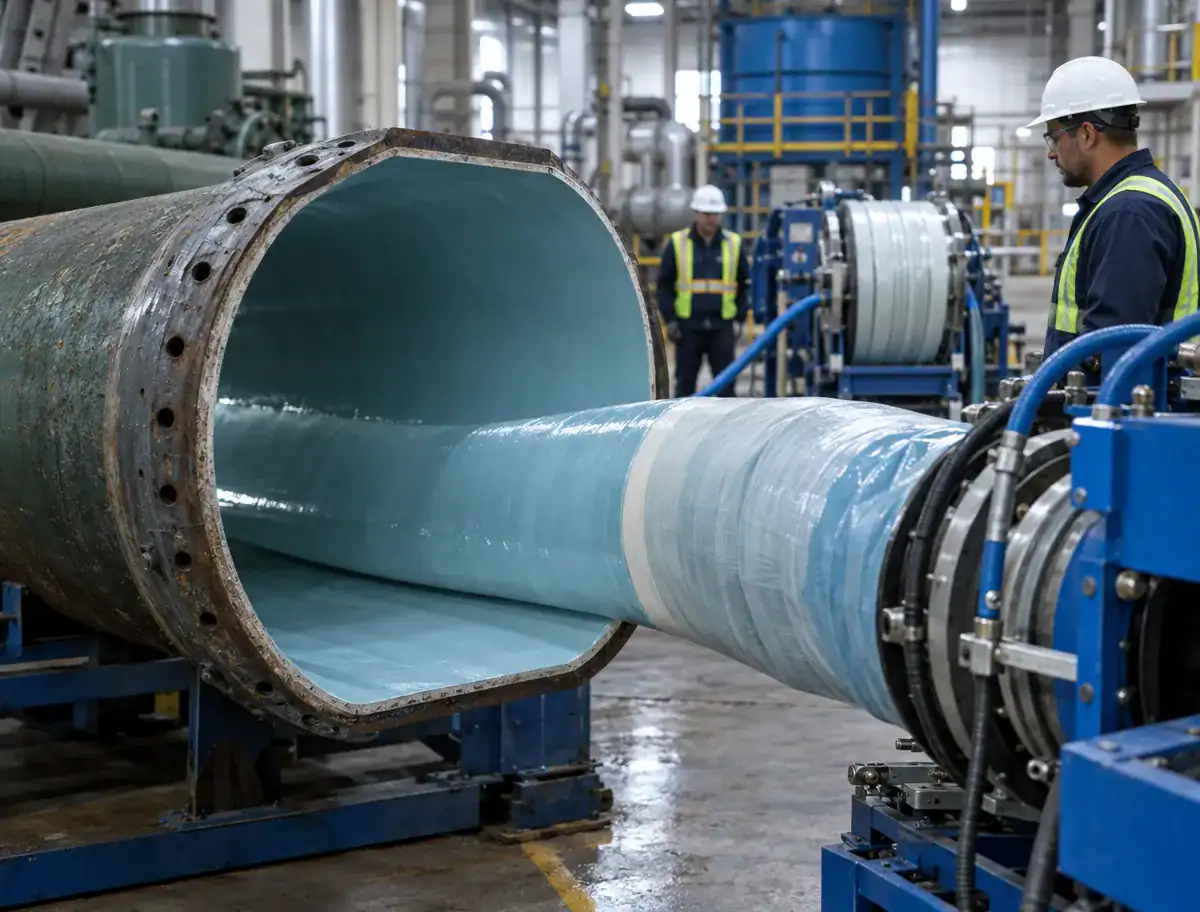
Industrial cooling water mains are often significantly larger than a typical sewer or storm line. Pelican Underground lines cooling water pipe from 24 inches up to 96 inches and larger in diameter, using equipment and installation methods calibrated specifically for that scale. Large-diameter lining is not simply a bigger version of small-diameter residential or commercial CIPP work — resin volumes, cure times, and inversion or pull-in methods all have to be recalculated for the pipe’s actual dimensions, or the liner will not cure to a consistent thickness.
What Equipment Does Large-Diameter CIPP Installation Require?
Large-diameter cooling water lining requires calibrated resin-saturation equipment sized to the liner volume, curing systems capable of managing heat or UV exposure across a much greater liner mass, and access planning suited to pipe that may not fit through a standard-size manhole or cleanout. Getting the resin volume right matters more at this scale: an under-saturated liner leaves voids, while over-saturation adds unnecessary cure time and cost. Pelican Underground calculates resin volume against the pipe’s verified internal dimensions before installation begins, following the same rigor the FHWA’s sample trenchless technology specifications set out for large-scale trenchless installation quality control.
How Does Liner Material Handle High-Temperature Cooling Water Discharge?
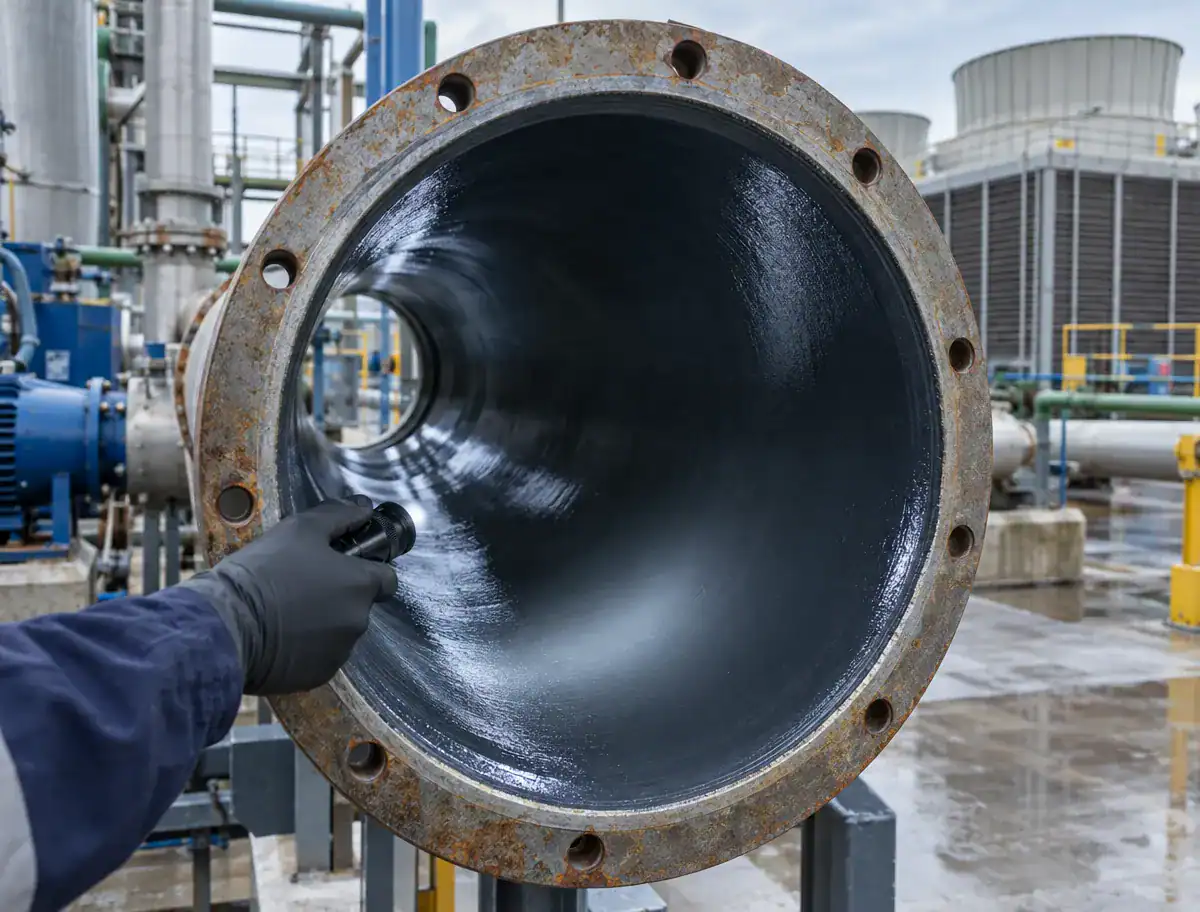
Cooling water discharge in Louisiana industrial systems can run as hot as 140°F, depending on the process it serves. That temperature range affects which liner resin is appropriate: a resin system suited to ambient-temperature sewer service is not automatically suited to sustained 140°F cooling water. Pelican Underground selects liner resins for thermal stability at the facility’s actual operating temperature, so the liner does not soften, distort, or lose bond strength once the line returns to service.
Which Liner Resins Hold Up to Biocides and Scale Inhibitors?
Treated cooling water typically carries biocides to control biological growth and scale inhibitors to limit mineral buildup on heat-transfer surfaces. Both additive classes can be aggressive toward the wrong liner chemistry over years of continuous exposure. Pelican Underground matches liner resin to the facility’s actual water treatment program rather than defaulting to a single resin system across every project.
How Does Pelican Underground Plan Cooling Water Lining Around Plant Turnarounds?
Louisiana power plants and heavy-industrial facilities typically schedule major maintenance during spring and fall outage windows, when equipment can be taken offline without the production or seasonal-demand impact of a summer or winter shutdown. Cooling water pipe lining almost always requires the line to be out of service, so it fits naturally into that same turnaround schedule rather than competing with it.
When Should Louisiana Plants Schedule Lining Work?
Pelican Underground works with facility engineers well ahead of a planned turnaround — starting with sewer camera inspection and scope-of-work planning before the outage window opens — so that liner materials, crew scheduling, and access logistics are ready the moment the line is taken out of service. That advance planning is what keeps a lining project from extending a turnaround that was scheduled for other maintenance work.
Frequently Asked Questions
How long is a cooling water line out of service during lining?
Out-of-service time depends on pipe diameter, length, and liner cure method, but most single-run lining projects return the line to service within one to a few days once the outage begins — far faster than excavation and replacement of the same run. Pelican Underground provides a project-specific timeline after inspecting the line, since large-diameter or long runs take longer to saturate and cure than smaller sections.
Can you line a cooling water pipe that is actively leaking?
In many cases, yes. CIPP lining is routinely used on pipe that is already leaking or showing joint separation, since the liner itself becomes the new structural wall. The line still needs to be taken out of service and dewatered for installation, and active groundwater infiltration at the leak site may require additional preparation before the liner is installed.
What is the minimum flow stoppage required for CIPP lining?
Cooling water flow through the section being lined must be fully stopped for the installation and cure process — CIPP is not installed with water actively flowing through the pipe. The minimum stoppage window is scoped per project based on pipe diameter and cure method, and Pelican Underground plans that window to align with your turnaround rather than requiring a separate shutdown.
What pipe diameters can Pelican Underground line?
Pelican Underground lines cooling water pipe from 24 inches up to 96 inches and larger, using equipment and resin calculations calibrated to large-diameter industrial lines rather than standard residential or commercial CIPP equipment.
How long does a cured-in-place liner last in cooling water service?
Service life depends on the liner resin selected, the operating temperature, and the water treatment chemistry it’s exposed to, which is why Pelican Underground matches resin selection to each facility’s actual conditions rather than installing a single standard liner across every cooling water project.
TL;DR — Cooling Water Pipe Lining at a Glance
- Cooling water systems move thousands of GPM, so a pipe failure means immediate production impact, not just a maintenance ticket.
- Failure mode follows material: reinforced concrete corrodes and separates at joints, ductile iron develops tuberculation and graphitization, FRP delaminates, and older steel pits and pinholes.
- CIPP lining rehabilitates the pipe from the inside without excavation, using chemical-resistant liners rated for biocides and scale inhibitors.
- Pelican Underground lines pipe from 24″ up to 96″+ and selects resin for thermal stability up to 140°F cooling water discharge.
- Lining projects are scheduled around spring and fall turnaround windows, not around a separate shutdown.
- Ready to plan a project? Request a cooling water pipe lining consultation from Pelican Underground.
Related Resources
- CIPP Pipe Lining Services
- Louisiana Service Areas
- CIPP Lining Contractor in Baton Rouge
- Epoxy Pipe Lining in Louisiana
- Pipe Lining vs. Pipe Bursting: Which Method Fits Your Project
- How Long Does Pipe Lining Last?
Get a Free Cooling Water Pipe Lining Quote
Cooling water pipe failures do not wait for a convenient maintenance window, but the repair can be planned around one. Pelican Underground LLC evaluates industrial drain cleaning and cooling water lines across Louisiana’s power generation and heavy-industrial facilities, then builds a large-diameter CIPP lining scope around your turnaround schedule instead of forcing a separate shutdown. Contact Pelican Underground to schedule an inspection and get a project quote.
About Pelican Underground LLC
Pelican Underground LLC provides trenchless pipe rehabilitation, including CIPP lining, industrial drain cleaning, and sewer camera inspection, to industrial, municipal, and commercial facilities across Louisiana. The company specializes in large-diameter cooling water and process pipe lining for power plants and heavy-industrial sites, planning projects around plant turnaround schedules rather than requiring separate shutdowns. Learn more at pelicanunderground.com
