
Updated February 2026
Trenchless sewer lining works by inserting a resin-saturated liner through existing pipes without excavation. The 7-step CIPP (Cured-In-Place Pipe) process includes camera inspection, pipe cleaning, liner preparation, insertion, inflation, heat/UV curing, and final inspection. The liner hardens into a seamless, corrosion-resistant pipe within your old pipe, completing in 1-3 days with a 50+ year warranty.
Trenchless sewer lining, technically known as Cured-In-Place Pipe (CIPP) technology, is a no-dig method of repairing damaged sewer and drain pipes. Instead of excavating your yard to remove and replace the old pipe, CIPP lining creates a new pipe inside the existing damaged one.
The process uses a flexible, resin-saturated liner that's inserted into your pipe through small access points. Once in position, the liner is inflated and cured with heat or UV light, forming a structural, jointless pipe that's stronger than the original.
Think of CIPP lining like adding a hard shell inside a cracked eggshell. The new liner doesn't replace the old pipe—it reinforces it from the inside, creating a completely smooth, seamless interior that lasts 50+ years. According to the EPA's comprehensive study on trenchless technologies, CIPP installations have demonstrated exceptional longevity with minimal failure rates across diverse soil conditions.
Traditional sewer repair requires digging a trench along the entire pipe length, removing the damaged pipe, installing new sections, backfilling, and restoring your landscape. This process takes 7-14 days and costs $8,000-$32,000 including restoration.
Trenchless pipe repair requires only two small access points (typically 4x4 feet each) and completes in 1-3 days. The process preserves your landscaping, driveway, and property while delivering a superior 50+ year solution for $3,500-$12,000.
Understanding each step of the trenchless lining process helps demystify this advanced technology. Here's exactly how professional pipe lining works from start to finish:
Technicians insert a high-definition camera through a cleanout or access point to inspect your entire pipe system. This reveals:
The camera inspection footage is recorded and measurements are taken to custom-manufacture the liner to exact specifications.
Before liner installation, the pipe interior must be completely clean. Technicians use:
Proper cleaning is critical—the liner must bond to a clean surface to achieve maximum strength and longevity.
A custom-length fiberglass or polyester felt liner arrives pre-manufactured to your pipe's exact dimensions. The liner is:
The resin-saturated liner remains flexible and workable for several hours, allowing proper installation time.
The prepared liner enters the damaged pipe using one of two methods:
Technicians carefully monitor the insertion to ensure proper positioning and coverage of all damaged areas, including connection points.
Once inserted, the liner is inflated to press firmly against the host pipe's interior walls. This step:
The inflation medium (water or air) maintains constant pressure during the curing process, typically 5-15 PSI depending on pipe diameter.
The resin-saturated liner hardens through controlled heat or UV light application:
The curing process transforms the flexible liner into a rigid, structural pipe with strength exceeding the original pipe material.
After the liner fully cures and cools:
Total downtime for your sewer system is typically 4-12 hours. Your plumbing is fully operational the same day or next morning.
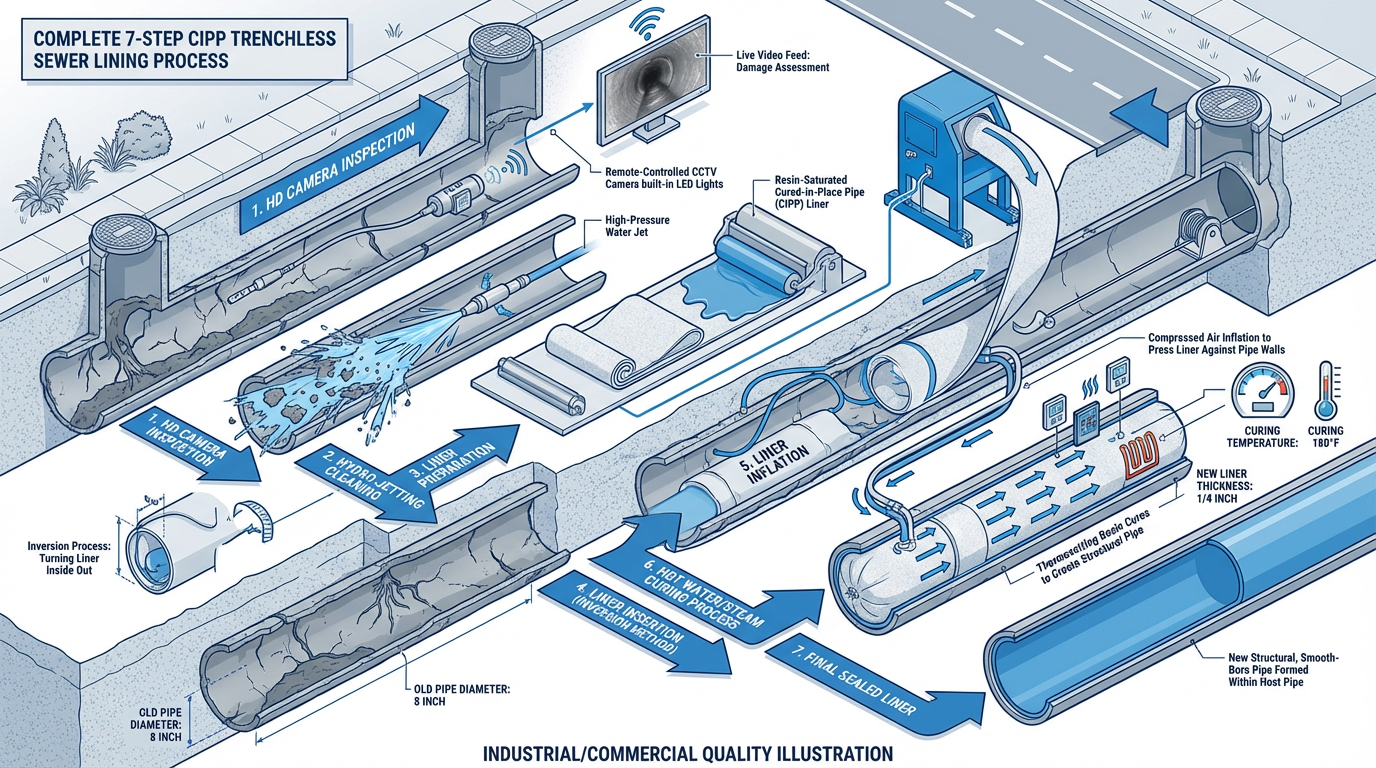
Modern CIPP technology combines materials science, hydraulic engineering, and precision manufacturing to deliver superior pipe rehabilitation. Here's what makes it work:
CIPP liners use advanced thermosetting resins that undergo chemical transformation when heated or exposed to UV light. The three primary resin types are:
Epoxy Resins: The most common choice for sewer applications, epoxy resins provide excellent chemical resistance to sewage, acids, and solvents. They cure at temperatures between 140-180°F and create a rigid, impermeable barrier. Epoxy-based CIPP liners typically achieve compressive strengths of 8,000-12,000 PSI when fully cured.
Polyester Resins: Used for shorter residential applications, polyester resins cure faster than epoxy but offer slightly less chemical resistance. They're ideal for straightforward repairs where rapid installation is prioritized. Polyester liners achieve strengths of 6,000-9,000 PSI.
Vinyl Ester Resins: A hybrid option combining benefits of epoxy and polyester, vinyl ester resins provide superior chemical resistance for industrial applications or pipes exposed to harsh conditions. They cure at 180-210°F and reach 10,000-14,000 PSI compressive strength.
The curing process involves cross-linking—individual resin molecules bond together to form a three-dimensional polymer network. This transformation is irreversible, meaning the cured liner will never soften or degrade from heat or chemicals within its service temperature range.
CIPP liners are engineered composites designed for maximum strength and durability. The construction includes:
Carrier Material: The base layer is typically polyester felt or fiberglass fabric. Polyester felt (3-15mm thick) provides flexibility for navigating bends and irregular pipes, while fiberglass offers higher tensile strength for structural applications. Some manufacturers use multiple layers with different properties—a flexible inner layer for conformity and a rigid outer layer for strength.
Resin Saturation: The carrier material is impregnated with resin under controlled vacuum conditions to ensure complete saturation with no air pockets. The resin-to-fabric ratio is precisely controlled—too little resin compromises strength, while excess resin increases weight and cost without benefit. Optimal saturation achieves 60-75% resin content by weight.
Protective Coatings: Some liners include a thin polyurethane or polyethylene coating on the interior surface to provide additional chemical resistance and improve hydraulic flow characteristics. This smooth coating reduces friction and prevents future debris accumulation.
Thickness Calculations: Liner thickness is engineered based on pipe diameter, existing pipe condition, soil loading, groundwater pressure, and expected service life. Residential sewer lines typically use 4-6mm liners, while larger commercial or municipal pipes may require 8-15mm or thicker. The ASTM F1216 standard provides calculation methods for determining minimum liner thickness based on specific site conditions.
Three primary curing methods are used in modern CIPP installations, each with distinct advantages:
Hot Water/Steam Curing: The most traditional method circulates heated water or steam through the liner to initiate and maintain the curing reaction. A boiler unit heats water to 160-210°F and pumps it through the sealed liner. Temperature is continuously monitored via sensors to ensure uniform curing. This method works well for long pipe runs (100+ feet) but requires 3-8 hours depending on diameter and resin type. The gradual temperature ramp-up and cool-down prevents thermal shock and ensures complete cure throughout the liner thickness.
UV Light Curing: A more recent innovation uses ultraviolet LED arrays mounted on a specialized train that travels through the pipe. The UV light triggers photochemical curing of specially formulated resins in just 30-90 minutes—significantly faster than thermal methods. UV curing offers several advantages: no heat means no steam, no waiting for cool-down, and work can proceed in occupied buildings. However, it requires specialized photo-reactive resins and works best in straight runs or pipes with gentle curves. The UV equipment can't navigate tight bends (under 45°) effectively.
Ambient Curing: Some epoxy formulations cure at ambient temperatures over 24-48 hours without external heat. While this method eliminates the need for heating equipment, the extended cure time limits its use to small-diameter residential applications where extended service interruption is acceptable. Ambient curing is common for lateral connections and smaller drain repairs.
Professional contractors select the curing method based on pipe configuration, access limitations, time constraints, and cost considerations. Many companies now use UV curing for accessible residential lines and hot water curing for complex commercial installations.
A professional CIPP installation requires specialized equipment and materials designed specifically for trenchless pipe rehabilitation:
| Equipment | Purpose | Specifications |
|---|---|---|
| HD Sewer Camera | Pre and post-installation inspection | 1080p+ resolution, LED lights, 200-400 ft cable, recording capability |
| Hydro-Jetting System | Pipe cleaning and root removal | 3,000-4,000 PSI pressure, 8-18 GPM flow, multiple nozzle attachments |
| Inversion Equipment | Liner insertion via water/air pressure | Calibration tank, pressure controls, monitoring systems |
| Curing System | Heat or UV application for resin curing | Boiler (steam), hot water unit, or UV LED train with power generator |
| Robotic Cutter | Open lateral connections and trim liner | Remote-controlled, diamond-coated cutting wheels, camera-equipped |
| Air Compressor | Inflation and pressure maintenance | 10+ CFM capacity, pressure regulation, moisture removal |
The quality of materials directly impacts the liner's performance and longevity:
Quality Assurance: Professional contractors use materials certified to ASTM standards (F1216 for CIPP installation, F1743 for rehabilitation materials). Always verify your contractor uses certified materials and can provide material test reports.
One of CIPP's biggest advantages is rapid completion compared to traditional excavation. Here's the realistic timeline for each phase:
Total Timeline: 1-3 days with your plumbing out of service for just 8-12 hours on the installation day. Most homeowners can use their plumbing normally the same evening or next morning.
UV light curing technology can reduce installation time to a single day for residential applications. The rapid 30-90 minute cure time eliminates the extended waiting period required for thermal curing, allowing crews to complete inspection, installation, curing, and restoration in one 8-hour workday.
CIPP technology successfully rehabilitates most common pipe materials and configurations. Here's what qualifies for trenchless lining:
Common in homes built before 1975, cast iron pipes are ideal for CIPP lining. The rigid structure provides excellent support for the liner during curing. Cast iron typically develops rust pinholes, joint separations, and scale buildup—all perfectly addressed by lining.
Typical Issues Resolved: Corrosion pitting, joint leaks, rust scale buildup, root intrusion through joints
Success Rate: 95%+ when pipe maintains structural integrity
Expected Liner Life: 50-70 years
Vitrified clay pipe is highly susceptible to root intrusion through joints and can crack from ground movement. CIPP creates a seamless interior that eliminates all joints—the primary entry point for roots.
Typical Issues Resolved: Root intrusion, joint separation, cracks from settling, bellied sections
Success Rate: 90%+ for pipes with intact structure
Expected Liner Life: 50+ years
Special Note: Clay pipes must retain enough structural integrity to support the liner during installation. Severely crushed sections may require spot excavation before lining.
While PVC is durable, it can crack from ground movement, root pressure, or improper installation. CIPP effectively repairs cracked or separated PVC sections without excavation.
Typical Issues Resolved: Longitudinal cracks, joint separation, root intrusion, improper grade
Success Rate: 85-90% depending on damage severity
Expected Liner Life: 50+ years
Orangeburg (bituminous fiber) pipes common in 1950s-1970s homes present challenges. These compressed tar paper pipes often collapse completely, losing the round shape necessary for liner installation.
When CIPP Works: Orangeburg pipes that maintain at least 70% of original diameter can sometimes be lined after careful assessment and possible pipe rounding.
When It Doesn't: Severely flattened or collapsed Orangeburg typically requires excavation and replacement or pipe bursting.
Success Rate: 40-60% depending on collapse severity
CIPP technology accommodates various pipe diameters:
Not Suitable For: CIPP cannot line pipes that are completely collapsed (less than 30% open), actively moving/shifting, or have sections missing. A thorough camera inspection determines if your pipe qualifies for lining.
Beyond avoiding excavation, CIPP technology delivers performance advantages that traditional pipe replacement cannot match:
Traditional pipe replacement uses 10-20 foot sections joined together with couplings or glued joints. These joints remain vulnerable to root intrusion, leaks, and separation over time. CIPP creates one continuous pipe with zero joints—eliminating the primary failure points of conventional pipes.
Cured epoxy liners are impervious to sewage acids, hydrogen sulfide gas, and corrosive chemicals that gradually degrade cast iron and concrete pipes. The chemically inert surface prevents future corrosion, scaling, and bacterial growth.
The glass-smooth epoxy surface (Manning's coefficient of 0.009-0.012) provides better hydraulic flow than new cast iron (0.013-0.015) or rough concrete (0.013-0.017). This means better drainage and fewer backups even though the liner slightly reduces the pipe's internal diameter.
A properly installed CIPP liner doesn't just repair the pipe—it strengthens it. The composite structure of liner + host pipe often exceeds the original pipe's strength. Engineers can design fully structural liners that bear all loads independently if the host pipe is severely deteriorated.
The two small access points (8-16 square feet total) versus a 3-6 foot wide trench stretching 40-100 feet preserves landscaping, driveways, patios, pools, and mature trees. There's no need to remove and reinstall fences, irrigation systems, or decorative features.
CIPP liners navigate bends, offsets, and elevation changes that would require multiple excavations with traditional methods. The flexible liner insertion can work around obstacles and follow complex pipe routing through foundations and under structures.
Quality CIPP installations come with 50-75 year warranties—significantly longer than typical 10-year warranties on traditional pipe replacement. The liner won't corrode, crack from ground movement, or fail at joints because there are no joints to fail.
Studies of CIPP installations from the 1970s and 1980s show liners still performing excellently after 40+ years with no signs of degradation. The technology has only improved since then with better resins, materials, and installation methods. This proven longevity makes CIPP a true permanent solution.
Pelican Underground specializes in trenchless CIPP sewer lining throughout Louisiana, Mississippi, and Alabama. Our certified technicians deliver professional installations with 50+ year warranties and minimal disruption to your property.
Schedule Your Free Camera Inspection"Pelican Underground lined our entire sewer in one day with their UV curing system. No digging up our new landscape, no mess, and it's warrantied for 50 years. Absolutely amazing technology!"
- Michael T., Baton Rouge, LA