
When a fellow contractor took on a customer with a rotten cast iron sewer line buried under a finished basement, he didn't gamble on a complex, multi-bend repair in-house—he called in specialists. Pelican Underground was subbed onto the job, and it turned out great.
A homeowner had a cast iron sewer line that had rotted through—and it ran beneath a finished basement, with multiple turns along its path. The contractor handling the property recognized this as specialist work and brought Pelican Underground in as a subcontractor. Rather than default to tearing out finished living space, our crew diagnosed the line and restored it, leaving the partnering contractor’s customer with a fully functioning system.
Property Type:
Residential — older home with a finished basement
Problem:
Rotted, failing cast iron sewer line
Location of Line:
Beneath a finished basement (limited access, high disruption risk)
Multiple bends and turns along the run
Subcontracted by a partnering contractor
Specialist diagnosis and repair of the failed cast iron line
Line restored, job completed successfully
Cast iron is durable, but after decades it corrodes and rots from the inside out. This line had failed—and its position under a finished basement, combined with several directional changes, made it exactly the kind of job many contractors would rather hand off.
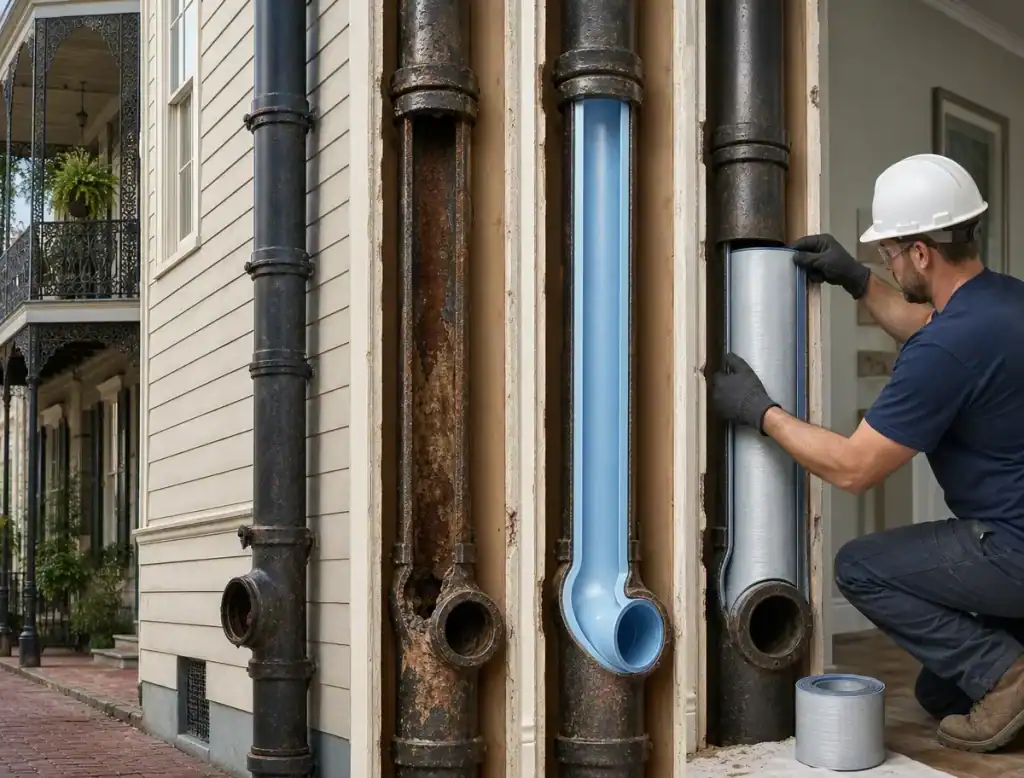
The cast iron pipe had rotted through and reached the end of its service life. Because it ran beneath a finished basement, there was no simple way to reach it without risking demolition of finished space. Aging cast iron like this is a common failure point in older homes—see our breakdown of cast iron stack lining in Louisiana.
The line included multiple turns and bends, which complicates both mechanical repair and trenchless rehabilitation. Add a rotted, fragile pipe and finished flooring overhead, and the margin for error narrows considerably. This is the point where experience with older systems matters most—and why it pays to hire a sewer repair specialist.
A conventional excavate-and-replace approach would have meant tearing into the finished basement—significant cost, mess, and downtime for the homeowner, and reputational risk for the contractor who owned the relationship. The goal was to solve the problem without destroying the space above it.
Pelican Underground was subbed in precisely because complex cast iron work under finished space is our lane. We approach jobs like this the same way every time: diagnose thoroughly, then match the method to what the line can actually support.
It starts with a sewer camera inspection to map the full run, locate the rotted sections, and record every bend—so the repair plan is based on evidence, not guesswork.
Our crew specializes in aging cast iron and in methods that avoid unnecessary demolition. We work multi-bend layouts methodically and keep the partnering contractor informed from start to finish, so they always know where the job stands.
We bring a full range of trenchless pipe repair capabilities to bear—CIPP lining, pipe bursting, pipe lining, and targeted point repairs—so the fix fits the pipe and the property, not the other way around. (What is trenchless sewer repair?)
We run an HD sewer camera to map the line end to end, pinpoint the rotted sections, and document each turn before touching anything.
With the layout confirmed, we identify where the pipe has failed and how to reach it while protecting the finished basement above.
Our crew carries out the repair, methodically working the line’s multiple turns until the rotted sections are resolved and the run is sound again.
We re-run the camera to confirm clear, restored flow, document the result, and hand a finished job back to the partnering contractor.
A complex job that could have turned into a demolition project was resolved cleanly—so the contractor kept his customer happy.
We slot in as a reliable specialist sub, keep the lead contractor informed throughout, and hand back a completed job—no surprises, no loose ends.
A specialist repair like this avoids the cost and disruption of tearing out finished living space that a dig-and-replace would otherwise require—protecting both the homeowner’s property and the contractor’s relationship with them.
The restored line is documented on camera, and any remaining aging pipe can be addressed later with the same trenchless options—no need to disturb finished areas.
“These fellas are the best in their field. We had a customer with a cast iron sewer under a finished basement that was rotten. Very complex job with a lot of turns. We subbed Pelican and the job turned out great.”
— Nathan Terry, Contractor Partner
Complex cast iron under finished space rewards specialist experience. Here’s the difference in approach.
Factor | Excavate & Replace (typical) | Pelican Underground |
Access to the line | Demolish finished basement | Specialist repair that works around finished space |
Method | Dig out & replace cast iron | Trenchless and targeted repair options |
Handling multiple bends | More demolition, more risk | Experienced with complex, multi-turn runs |
Property disruption | Significant (finished space lost) | Minimized |
Outcome | — | Line restored, job completed successfully |