
Pipe lining: smarter, faster repairs for New Orleans homes and businesses
At Pelican Underground, we’ve seen pipe lining change the way New Orleans repairs damaged pipes. Instead of big, disruptive excavations, trenchless lining repairs pipes from the inside — saving time, cutting costs, and protecting yards and sidewalks. This article walks through the technical benefits, cost and time savings, environmental and safety advantages, and local examples that show why pipe lining is often the better choice for homeowners and businesses. We’ll also cover warranties and what to look for when picking a trusted local provider.
Technical advantages: how pipe lining stacks up against traditional repairs
Trenchless pipe lining — most commonly Cured-In-Place Pipe (CIPP) — delivers clear technical advantages over digging-and-replacing. A resin-saturated liner is fed into the existing pipe and cured in place, creating a continuous, joint-free inner pipe. The result is a corrosion-resistant, durable pipe-within-a-pipe that handles soil movement and common causes of failure much better than patched or replaced sections. Industry standards such as ASTM F1216 govern proper CIPP installation practices, ensuring quality and consistency across projects.
How CIPP technology improves durability
CIPP uses proven materials and a controlled curing process to form a tough, seamless inner layer. That lining resists corrosion, roots, and common wear — and when installed correctly, it can extend a pipe’s useful life by decades. For a closer look at longevity, see our guide on how long pipe lining lasts. In short: fewer leaks, fewer call-backs, and more reliable plumbing for property owners.
Why pipe lining keeps disruption to a minimum in New Orleans
One of the biggest benefits of lining is that it’s non-invasive. Rather than tearing up lawns, driveways, or historic sidewalks, technicians work through small access points. In a city like New Orleans — where outdoor space and historic streets matter — that means less mess, lower restoration costs, and faster return to normal for residents and businesses. If you’re curious about how the process works, our overview of what pipe lining is covers the basics.
Cost and time: why lining is usually faster and more cost-effective than excavation
Compared with open excavation, pipe lining typically finishes sooner and reduces labor and restoration expenses. Dig-and-replace jobs can balloon once you factor in landscaping, hardscape repairs, and longer on-site crews. Trenchless pipe repair concentrates work inside the pipe, so projects move quickly and with fewer surprises — which often translates to lower total cost over the life of the repair.
Independent research supports the time-and-cost advantages of trenchless methods like CIPP versus traditional open-cut repairs.
Trenchless vs. open-cut: time–cost efficiency in sewer projects
A study published in Water Resources Management analyzed 70 sewerage projects completed in Chicago between 1994 and 2002 — 21 using trenchless technology and 49 using traditional open-cut methods. The analysis found a statistically significant effect of construction technology on the time–cost relationship and derived time–cost models for both approaches. The paper also tested an alternative model using time normalized by project cost to offer further insight into the schedule performance of open-cut and cured-in-place lining methods. (Sousa & Meireles, 2018)
How costs compare: pipe lining versus traditional repair in New Orleans
Costs depend on damage extent and pipe length, but many local property owners find that lining’s longer lifespan and lower restoration needs provide better value over time. Traditional repairs may have lower upfront material costs in some narrow cases, but repeated repairs and restoration bills can make them more expensive in the long run. Lined pipes generally require less ongoing maintenance, which adds up to savings. For New Orleans-specific pricing details, read our breakdown of pipe lining costs in New Orleans.
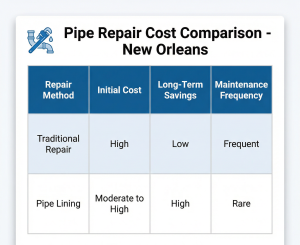
| Repair Method | Initial Cost | Long-Term Savings | Maintenance Frequency |
| Traditional Repair | High | Low | Frequent |
| Pipe Lining | Moderate to High | High | Rare |
The table summarizes the typical financial trade-offs: lining can require a similar or modestly higher initial outlay in some cases, but its reduced maintenance and longer life lead to stronger savings over time. Our guide on key cost factors for pipe lining projects explains the variables that shape your estimate.
How pipe lining shortens project timelines
Lining projects generally complete much faster than full excavation. Where open-cut repairs can take days or weeks because of digging and restoration, a lining job is often done in a day or two depending on scope. That speed means less downtime for businesses and less disruption for households.
Environmental and safety benefits of trenchless pipe repair
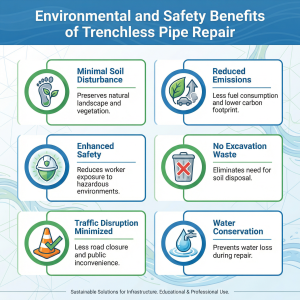
Trenchless repairs reduce the need for heavy digging, which lowers fuel use, protects landscaping and urban trees, and minimizes disturbance to local ecosystems. The smaller work footprint also reduces safety risks associated with large excavations, making lining a safer option for crews and property owners. The EPA’s Handbook on Sewer System Infrastructure Analysis and Rehabilitation recognizes trenchless rehabilitation as a cost-efficient approach that reduces environmental disruption compared with conventional replacement.
How pipe rehabilitation protects Louisiana’s environment
By preserving existing surfaces and avoiding large equipment and spoil piles, lining helps protect soil, plants, and urban habitats. Many lining materials are chosen for durability and low long-term environmental impact, which further reduces the project’s footprint compared with repeat excavations. New Orleans faces unique environmental pressures — our article on environmental conditions and piping longevity explains how local soil and moisture affect pipe health.
Why lining is often the safer choice for homeowners and businesses
Trenchless methods cut down on open trenches, heavy machinery, and prolonged on-site work — all factors that lower the risk of injuries and accidental damage to nearby structures. The materials used in CIPP lining are industry-tested and safe when installed by trained professionals, giving property owners added peace of mind. Learn more about the pros and cons of trenchless sewer repair to see if it’s the right fit for your situation.
What local New Orleans case studies show about pipe lining’s effectiveness
Projects across New Orleans — from residential homes to restaurants and commercial buildings — demonstrate lining’s ability to restore service quickly while preserving site features. These real examples show that, when applied correctly, lining solves common sewer and drain problems with minimal interruption. For broader context, our New Orleans sewer infrastructure crisis study examines the systemic challenges driving demand for rehabilitation solutions.
Commercial and residential projects that highlight lining success
Local businesses and homeowners have used lining to avoid lengthy closures and expensive site restorations. For example, a restaurant facing persistent sewer problems chose lining and was back to full service quickly, avoiding the extended downtime and customer disruption that comes with open excavation.
What customers say about pipe lining in New Orleans
Homeowners and commercial clients frequently praise lining for its speed, low disruption, and durable results. Many note the relief of not having a yard or storefront torn up — and that the long-term performance met or exceeded expectations. You can read firsthand accounts on our reviews and testimonials page.
How warranties and maintenance help lining perform for the long term
Warranty and maintenance options are important when choosing a lining system. Reputable installers stand behind their work with material and labor warranties, and simple maintenance habits help keep lined pipes performing well.
Typical warranty options for pipe lining in New Orleans
In the New Orleans area, lining warranties commonly range from about 5 to 25 years depending on the product and installer. These warranties cover materials and workmanship and give property owners confidence in the repair.
Simple maintenance tips to extend lined pipe life
Keep lined systems healthy by scheduling periodic inspections, avoiding harsh drain chemicals, and maintaining proper water pressure. A sewer camera inspection is one of the easiest ways to catch small issues before they become expensive problems. These straightforward steps help detect issues early and protect the lining over time.
Why choose Pelican Underground for pipe lining in New Orleans?
Pelican Underground combines local knowledge with trenchless expertise to deliver efficient, long-lasting repairs. We focus on doing the job right the first time — with minimal disruption and clear communication throughout the process.
What sets Pelican Underground apart from other local companies
Our team pairs experienced technicians with modern equipment and quality materials. We prioritize transparent estimates, careful site protection, and workmanship that meets regional expectations — which is why hiring a sewer repair specialist matters for a job this important. Homeowners and businesses trust us for their pipe lining needs.
How we use trenchless technology to complete repairs efficiently
We specialize in CIPP lining and other trenchless solutions that restore pipes without large excavations. That means faster turnaround, less site restoration, and a cost-effective path back to reliable plumbing. When you choose Pelican Underground, you get a smooth, professional process from inspection through warranty.
Frequently Asked Questions
Can pipe lining be used on all types of pipe materials?
CIPP lining works on a wide range of pipe materials commonly found in New Orleans homes, including cast iron, clay, concrete, PVC, and even Orangeburg pipe. The key factor isn’t the material itself but the structural condition of the existing pipe — it needs to be intact enough to support the liner. A sewer camera inspection confirms whether lining is the right fit before any work begins.
Does pipe lining reduce the inside diameter of my pipe?
Yes, the liner does slightly reduce the pipe’s internal diameter — typically by a few millimeters. However, the new surface is significantly smoother than the original corroded or rough interior, which actually improves flow capacity in most cases. The net effect is often better drainage performance despite the marginally smaller opening.
Do I need a permit for pipe lining in New Orleans?
In New Orleans, plumbing work — including pipe rehabilitation — generally requires a permit filed through the Sewerage & Water Board by a licensed master plumber. A reputable contractor handles the permitting process for you, so this shouldn’t add stress to your project. If you’re unsure about who is responsible for sewer line repair on your property, we can help clarify that as well.
Can I use my plumbing during the pipe lining process?
During the active lining and curing phase — which typically lasts several hours — you’ll need to avoid using water fixtures connected to the line being repaired. That means holding off on showers, laundry, dishwashers, and flushing toilets until the resin has fully cured. Most residential jobs are completed within a single day, so the disruption is brief.
Is pipe lining a good option for older New Orleans homes with historic features?
Absolutely. Pipe lining is especially well-suited to historic properties because it avoids the excavation that can damage original landscaping, brick walkways, and century-old foundations. Many homeowners in neighborhoods like the Garden District and French Quarter choose lining specifically to preserve their property’s character. The unique environmental conditions in New Orleans — including high water tables and shifting soils — make non-invasive repairs a practical advantage, not just a cosmetic one.
What happens if the liner fails or a problem develops later?
Properly installed CIPP liners are highly durable and rarely fail. However, if an issue does arise, a follow-up camera inspection can identify the problem quickly. Depending on the scope, a point repair or localized re-lining can address the area without replacing the entire line. Choosing a provider who offers a warranty — and who stands behind their work — gives you an added layer of protection.
Conclusion
Pipe lining delivers clear benefits: improved durability, faster project timelines, lower total disruption, and a smaller environmental footprint. For New Orleans homeowners and businesses looking for a reliable, long-term fix, trenchless lining is often the practical choice. If you’re weighing repairs, Pelican Underground can help with an honest assessment, transparent pricing, and expert installation — contact us today to discover how lining can work for your property.