
Tree roots had worked their way into the pipes running through a homeowner's house, and she was already dealing with what she called "a very unfortunate situation." She didn't need a sales pitch. She needed someone to explain what was wrong, what the fix involved and what each day would look like. Pelican Underground relined the root-damaged pipes, kept her informed from start to finish, and then followed up several months later to make sure everything was still working.
Tree roots go looking for water, and a small crack or loose joint in a drain pipe is an easy way in. Once they’re inside, they grow into a mat that catches waste, slows drains and keeps widening the opening they came through. In this home, roots had compromised the pipes throughout the house, not just one stretch of the outside sewer lateral.
Instead of tearing out floors and walls to replace those pipes, our crew relined them from the inside. A new pipe wall cured inside the old one seals the cracks and joints roots use to get in. The homeowner said we were “incredibly transparent about the process,” explaining the work and what to expect at every step. Several months after the job, we called back to confirm the lines were still working perfectly.
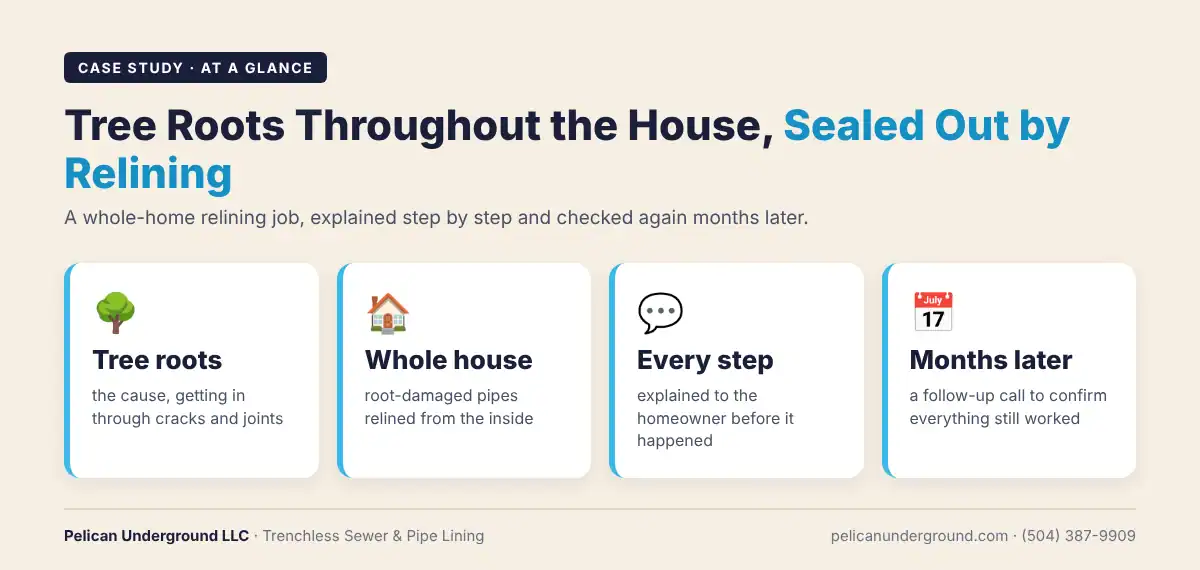
Service:
Pipe relining (CIPP) for root-damaged pipes, with camera inspection
Property:
Single-family home
Problem:
Tree roots had compromised the pipes throughout the house
Pelican's Gulf Coast service area (Louisiana, Mississippi and Alabama)
A clear explanation up front, quick responses and easy communication
A follow-up check several months later to confirm the pipes were still working
Root-damaged pipes relined, and a 5★ review that recommends Pelican
This wasn’t a typical repair job. The combination of depth, proximity to structures, and space constraints created a scenario where traditional excavation was not viable — and the stakes were high.
Root intrusion usually starts small: a hairline crack, an old joint, a gasket that has dried out. Fine roots get in, find steady water and nutrients, and thicken. Over time they pry joints apart and crack the pipe further. When one tree finds a weak line, others nearby often find it too, which is why damage can spread across a home’s piping.
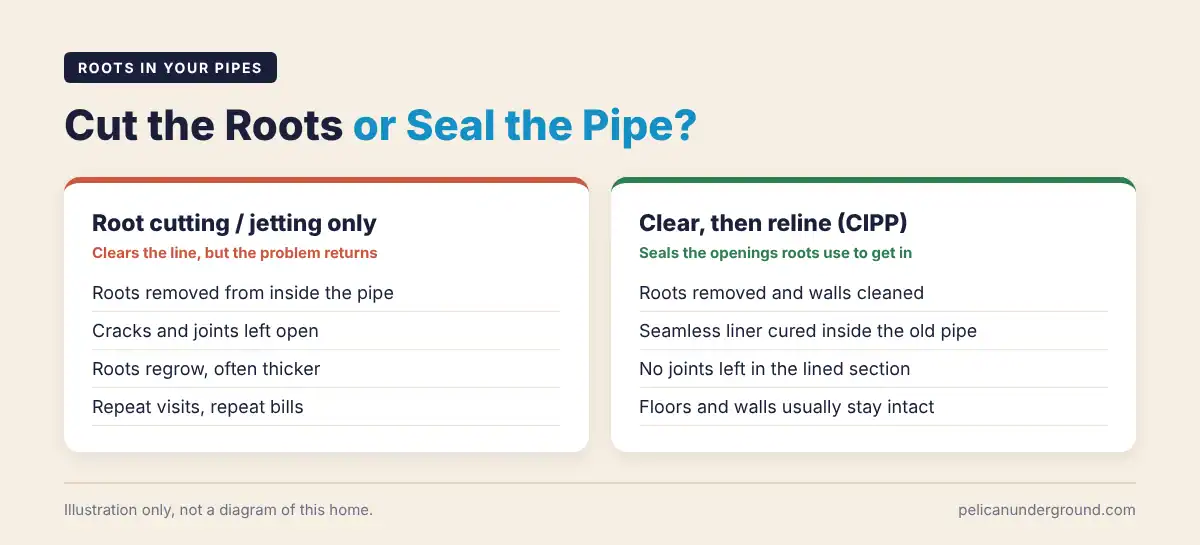
Mechanical cutting or hydro jetting can clear roots out of a line, but it leaves the openings they came through. Cut roots grow back, and often thicker. For a pipe that roots have already damaged, clearing it is maintenance, not a repair.
Traditional replacement of pipes under and inside a home can mean breaking up slab floors, opening walls, moving out of rooms and paying for flooring and finish repairs afterward. For a family already dealing with a hard situation, that is a lot to add.
When something goes wrong with the plumbing during a stressful stretch, not knowing what’s happening is almost as bad as the problem itself. The homeowner needed a contractor who would explain the work in plain terms and keep her updated, not just quote a number.
Pelican Underground deployed CIPP (Cured-in-Place Pipe) lining using premium Saertex UV GRP materials — the same technology trusted in demanding municipal and industrial applications worldwide. Here’s how the project was executed:
We start root jobs with a sewer camera inspection so the homeowner can see where the roots are getting in and how much of the pipe is affected. Our technicians are NASSCO-certified and follow PACP and LACP inspection standards, so the footage gives a clear record of the pipe’s condition before any work starts.
Before a pipe can be lined, the roots have to come out and the walls have to be cleaned. Then a resin-saturated liner goes into the existing pipe and cures in place, forming a smooth, jointless new pipe inside the old one. With no joints left for roots to get through, the main way they got in is sealed off.
The homeowner said we were “incredibly transparent about the process, clearly explaining the work needed and what to expect every step of the way.” That’s how we handle every job: we show the footage, explain the method, say what each day involves and answer questions as they come up.
A root problem is fixed when the openings are sealed, not when the roots are cut.
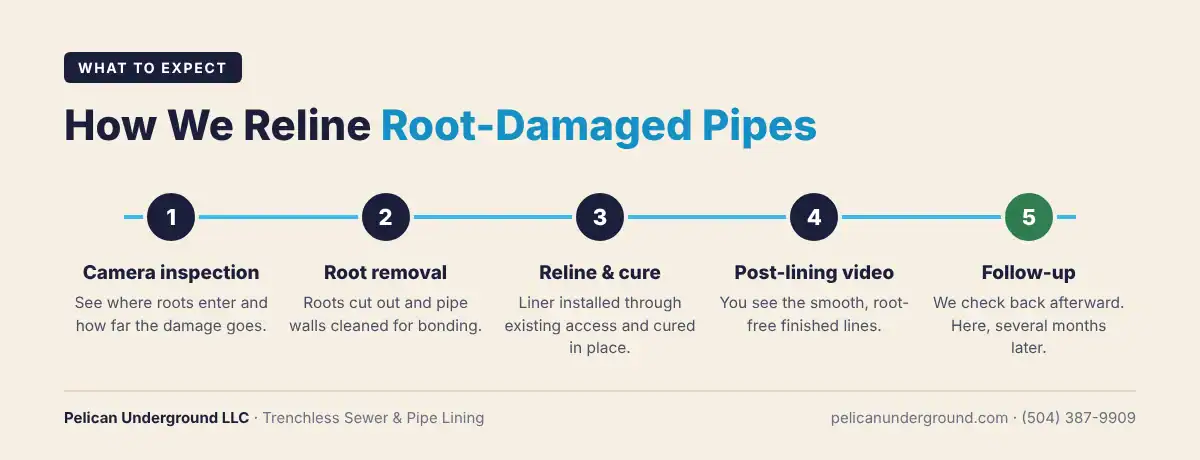
We record the lines, show you where roots are entering and explain whether relining is a good fit.
We cut out roots and clean the pipe walls so the liner bonds properly.
We install the liner through existing access points and cure it in place. We'll tell you ahead of time when water use needs to pause and for how long.
We run the camera again so you can see the finished lines, with smooth walls and no roots.
We check back after the job. In this case we followed up several months later to confirm everything was still working.
The pipes that roots had compromised throughout the house were relined, sealing the cracks and joints the roots had used to get in.
She called the whole experience “outstanding” from start to finish and said the team was responsive, professional and easy to communicate with.
Several months after the job, we followed up to make sure everything was still working perfectly. It was. She noted that it’s rare to find a service provider who cares about their work and their customers like this.
“…they relined the pipes throughout my house that had been compromised by tree roots. From start to finish, the entire experience was outstanding. They were incredibly transparent about the process… They made a point to follow up several months later to ensure everything was still working perfectly… I really enjoyed working with them and highly recommend!”
Katie Easterling · ★★★★★ Google Review
Factor | Root cutting / jetting only | Pipe relining (CIPP) |
|---|---|---|
What it does | Clears roots out of the pipe | Clears roots, then installs a new seamless pipe inside the old one |
Entry points for roots | Left open | Sealed; no joints remain inside the lined section |
How long it lasts | Until the roots grow back, often months | A long-term structural repair |
Disruption to the home | Low | Low; no trenching, and floors and walls usually stay intact |
Best for | Lines with light roots and no structural damage, or ongoing maintenance | Lines where roots have cracked joints or damaged the pipe |
Relining needs a pipe that is still mostly intact. If a section has collapsed or sags enough to hold standing water, it may need pipe bursting or a targeted point repair first. The camera inspection is how we tell which situation you have, and we’ll show you the footage either way.
Pelican Underground was founded in 2017 by Chase St. Clair and specializes in trenchless sewer repair and pipe lining. Our technicians are NASSCO-certified and follow PACP, LACP and MACP inspection protocols. We’re an active Nu Flow Technologies installer and hold Louisiana State Licensing Board for Contractors license #67347. We work for homeowners, commercial properties and municipalities across Louisiana, Mississippi and Alabama. Meet the team.
Relining removes the joints and cracks roots use to get into a pipe. Once a line is lined, roots have no easy way back into that section. Roots can still damage parts of the system that weren’t lined, which is why we inspect the whole line first.
Yes. We cut out the roots and clean the pipe walls so the liner seats and bonds properly. Lining over roots would leave weak spots.
Often, yes. Interior drain and sewer lines can usually be relined through existing access points. Whether that works for your home depends on pipe size, layout and condition, which we confirm on camera.
Usually not. There are periods when water use has to pause while the liner cures, and we schedule those with you ahead of time.
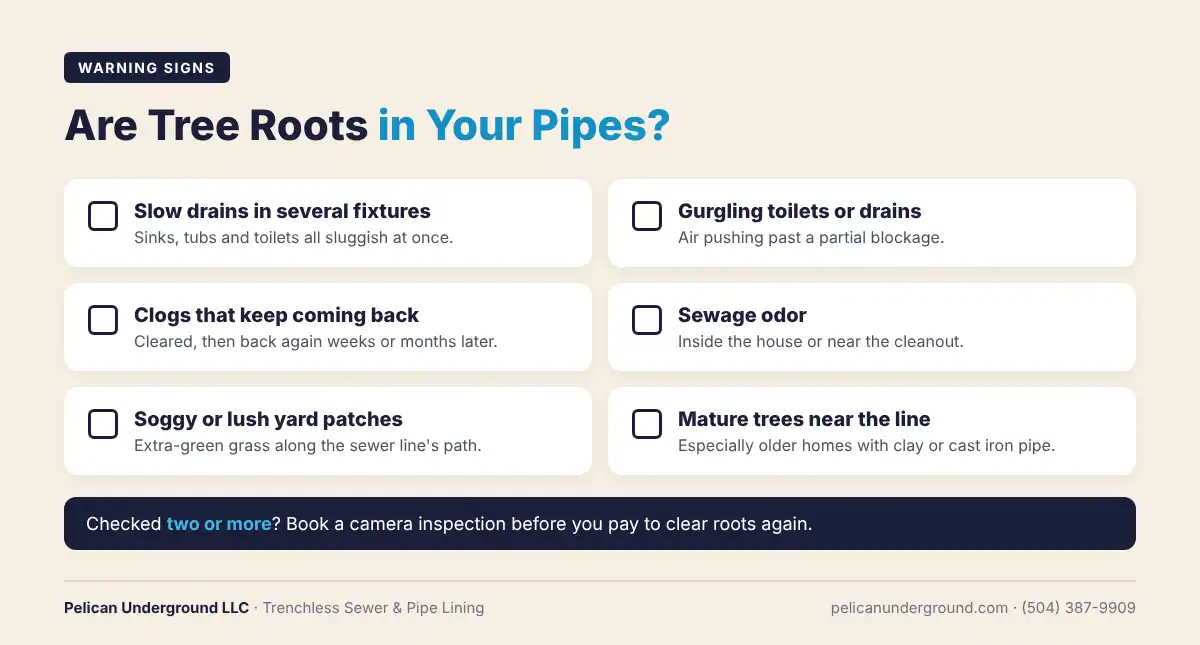
Common signs are slow drains in several fixtures, gurgling, clogs that keep coming back, sewage odors and soggy patches in the yard. A camera inspection confirms it.
Hydro jetting clears roots well, but it doesn’t seal the openings they came through, so they’ll grow back. It’s the right step before relining, or for maintenance on a pipe that’s still structurally sound.
Yes. We check back after the work. On this job we followed up several months later to confirm everything was still working.
Book a camera inspection and we’ll show you where roots are getting in and whether relining can stop them for good. You’ll get a straight answer, a clear plan and a follow-up after the work